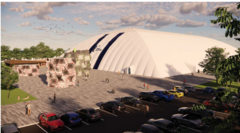
Rain.
It taps against the glass of a community center somewhere in Britain on a Tuesday evening in November, turning a patch of muddy grass outside into a dark mirror that reflects nothing but sodium streetlamps and the damp wool coats of teenagers waiting for a bus that is running late.
Inside, the air smells of floor wax, wet polyester, and boiled cabbage from the kitchen down the hall. A basketball bounces—thump, thump, thump—against scuffed maple boards while three kids wait their turn on the sideline, watching the clock because another group has the court at seven.
Eight hundred thousand pounds.
Say the number out loud and it sounds heavy enough to anchor a barge. Eight hundred thousand pounds spent on a sports dome project that was scrapped before a single whistle ever echoed beneath its curved roof, before a winter gale ever pressed against its fabric skin, before a child ever ran a sprint from one end of a dry, warm pitch to the other in the middle of a sodden February.
On paper, a scrapped project is a line item. A footnote in a committee report. A phrase in a local headline that people skim over while scrolling on their phones between stops.
Yet numbers like that do not evaporate into thin air. They sit somewhere. They press against budgets that were already stretched thin like old elastic, and they leave behind a quiet, hollow ache in places where people were counting on something solid to arrive.
I have stood on enough rain-slicked fields and watched enough community facilities stall in committees to know the peculiar frustration of waiting for a promise that keeps receding down a hallway of signatures, surveys, and revised estimates. You start out picturing dry turf and Saturday mornings without frostbite. You end up staring at a folder full of feasibility notes and asking how a roof that never went up managed to cost so much.
To understand what really happens when an eight-hundred-thousand-pound sports dome gets shelved, we have to look past the ledger and trace the human geometry of the thing. A sports dome is, at heart, a very simple bargain with the weather. Outdoors, winter has veto power. Wind gusts across a goalmouth, sleet stings bare ankles, darkness falls at four in the afternoon, and matches get called off until spring. An inflatable or tensioned dome—what metaphorically acts like a giant lungs-full of warm air stretched over a winter field—pushes winter back by a few precious degrees and a few hundred square meters.
It turns "maybe next month" into "see you at six."
That is why people care about sports domes in the first place. Not because fabric roofs are architectural wonders, though some are clever engineering feats, but because time and space for physical movement are scarce in towns and cities where playing fields are soggy half the year and indoor halls are booked solid by five-thirty.
Let me offer a hypothetical scenario to make the stakes concrete. Picture a youth football coach named Tariq—not a real person in this specific headline, just a composite of every volunteer coach I have ever seen knocking mud off his boots at dusk. Tariq runs training sessions for twelve-year-olds on a pitch that drains like a bath sponge. When autumn sets in, half the squad drops away because parents cannot stand freezing on the touchline for an hour and a half every week, or because evenings get too dark and too wet. When talk of a local sports dome starts circulating, Tariq begins planning around it in his head. Extra slot for the girls' team. A place for younger kids to kick a ball without sinking up to their laces. A refuge from the gray drizzle.
Then months pass. Costs creep upward—steel anchors, electrical connections, groundworks, planning conditions, consultancy fees, inflation on materials. Suddenly the price tag looks less like a brisk winter fix and more like a financial sinkhole. Someone pulls the plug before the project becomes an even bigger liability.
And Tariq is left standing on the same wet grass, holding a bag of deflated balls, wondering where eight hundred thousand pounds went when there isn't even a zip-up door to show for it.
Why Projects Vanish Before the First Brick or Anchor
When a public or community capital project is scrapped after spending hundreds of thousands of pounds, the immediate instinct is to look for a villain. A rogue contractor. A careless official. A sudden scandal.
Sometimes there is mismanagement, poor oversight, or optimism bias dressed up as a spreadsheet. Budgets get drafted in sunny conference rooms using assumptions that crumble the moment a surveyor puts a spade in the ground or an energy tariff shifts.
Yet much of the time, the culprit is less dramatic and far more maddening: death by a thousand preparatory cuts.
Think of it like cooking a complicated meal where you buy rare spices, rent extra burners, hire two sous-chefs to chop herbs, and test three sauces—only to realize halfway through that the oven cannot reach temperature and the gas line needs a permit that will take until next autumn. Every single expense along the way had a rationale. Survey the site. Check drainage. Draw up plans. Commission structural assessments. Consult stakeholders. Run legal checks.
None of those steps is inherently evil. Without groundwork, a dome can literally lift, tear, or flood. A structure designed to hold air pressure and resist crosswinds cannot be thrown onto boggy soil like a garden marquee.
The trap is that pre-construction costs are sunk costs. They feel small individually—twenty thousand here, sixty thousand there, another hundred thousand for revisions and compliance—until you step back and see eight hundred thousand pounds sitting on the receipt for a building that exists only in drawings and PDFs.
And once a project hits that awkward middle ground where the original budget no longer covers the revised reality, decision-makers face a brutal choice. Pour another half-million or million into finishing something that may still struggle with running costs, heating bills, or maintenance—or cut losses now before the hole grows deeper.
Scrapping the project is often framed as courage or fiscal discipline. Maybe it is. Stopping a bad spiral can save even more money.
Still, telling a community that eight hundred thousand pounds was spent on a scrapped sports dome project sounds less like prudent stewardship and more like watching someone tear up a winning ticket because the queue at the window looked too long.
The Invisible Bill Paid by the People Outside
Financial reports measure money spent. They rarely measure time lost.
When a sports facility never materializes, the ledger shows a single figure—£800,000—and a status update marked cancelled or abandoned. What does not appear in the audit is the ripple across ordinary weeks.
Consider another hypothetical figure: Hannah, a mother of two working shifts at a care home. Her days are stitched together from tight windows—school drop-off, shift handover, grocery runs, dinner, bedtime. Having a reliable, covered space nearby where her kids can burn off energy after school or on a rainy Saturday morning isn't a luxury lifestyle perk; it is the difference between cabin fever and a settled evening.
When a promised facility falls through, families adapt quietly. They drive further to another center if they have a car. They stay home if they don't. Screen time quietly expands to fill the gap left by a field too waterlogged to use.
Adults feel it too. Local amateur leagues, casual five-a-side kickabouts, community fitness groups—these aren't just hobbies. They are low-cost social glue. They are places where people learn each other's names, blow off steam after rough weeks at work, and stay moving through months when seasonal gloom makes it tempting to hibernate indoors.
I have lived through winters where every outdoor plan felt like gambling against a weather forecast that usually won. You put on three layers, step outside, feel that sharp damp chill cut right through your jacket, and realize within ten minutes that nobody is going to enjoy this. After three weeks of that, momentum dies. Habits break. People drift away.
A sports dome was supposed to interrupt that cycle. It promised continuity across seasons. Even if the project wasn't going to turn every local kid into an international athlete, it could have kept a ball rolling when the skies opened.
Instead, the money went into the preparation and planning stages of a project that never crossed the finish line, leaving the outdoor reality untouched and the indoor options just as tight as before.
How Optimism Meets Mud and Reality
Why do ambitious local projects stumble into this pattern so often?
Part of it is human nature. We fall in love with the finished picture. We see the bright interior lights, the clean turf, the lively crowd on a dreary afternoon. That vision makes early estimates look reasonable—almost cheerful.
Then reality arrives with its clipboard.
Ground conditions turn out to be trickier than expected. Access roads need reinforcement for heavy machinery. Utility connections cost more once engineers inspect the actual cables and pipes rather than relying on old maps. Planning rules require extra acoustic checks, lighting assessments, or drainage mitigation. Meanwhile, the cost of steel, fabric, labor, and power fluctuates in ways no initial spreadsheet predicted.
By the time the true total comes into focus, the project is no longer the neat, affordable solution everyone originally cheered for.
And here is a hard truth that makes many people uneasy, myself included: sometimes a project should be scrapped when the numbers stop making sense. Continuing blindly just to avoid admitting a mistake—what psychologists call the sunk cost fallacy—can turn an eight-hundred-thousand-pound write-off into a two-million-pound white elephant that costs tens of thousands more every year just to keep inflated and heated.
A dome isn't free to run once it's up. Fans have to keep air pressure steady. Heating systems have to fight winter cold so condensation doesn't rain down inside. Panels wear, zippers and seals need attention, and storm damage is a constant risk when gusts pick up.
If the economics of building and running the structure break down before construction even begins, walking away—painful as it is—can be the lesser of two headaches.
Yet knowing why a decision was made does not erase the sting of watching eight hundred thousand pounds disappear without a roof to show for it. Trust is fragile. Every time a public or community venture burns a large sum on a scrapped plan, skepticism grows thicker than the mud on a winter pitch. Next time someone proposes a grand improvement—a dome, a court, a pavilion, a track—people will nod politely and think, Sure. Believe it when I see it standing.
The Quiet Weight of What Never Opened
There is a particular stillness around a place where something almost happened.
You walk past a patch of grass that might have held a warm, bright dome humming softly against the wind, and instead there is just sky, wet leaves, and the distant sound of traffic on a slick road. Nothing exploded. Nobody marched in the streets. Life simply went on at a slightly lower pitch.
Eight hundred thousand pounds is enough to fund a lot of smaller, tangible things—new goals, floodlights, drainage repairs, coaching grants, community sessions—or, if spent on a major build, it ought to leave behind something you can touch when the rain comes down.
When it ends up on the tab of a scrapped sports dome project, the real loss isn't just financial. It is the loss of momentum, the loss of trust, and the quiet reminder of how wide the gap can be between a good idea on paper and a dry place to play when winter settles in.
Outside, the rain keeps falling on the empty grass, steady and unhurried, while inside the community center a basketball hits the floor one more time and the clock ticks toward seven.


