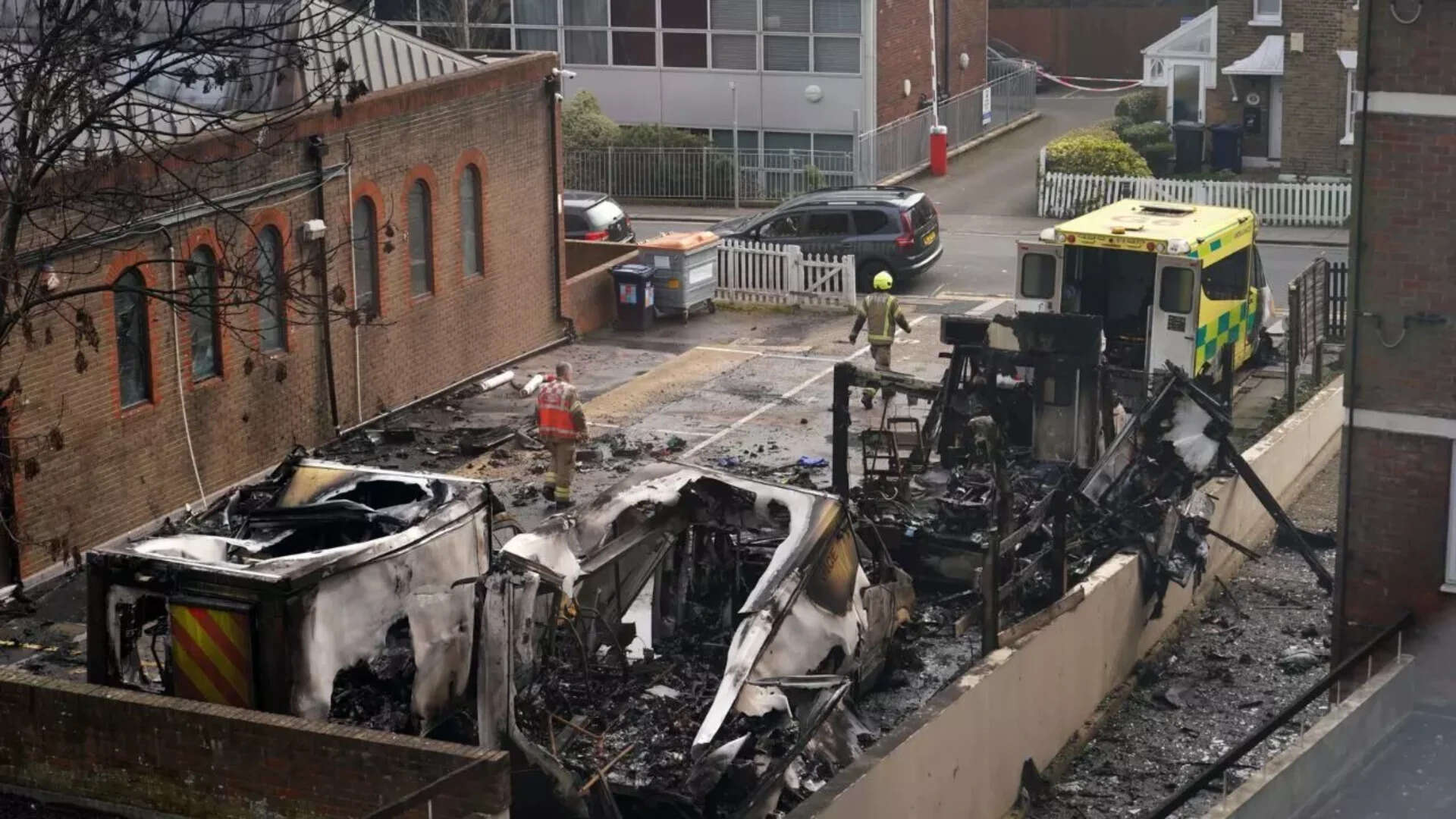
The recent arson attack targeting Jewish communal ambulances in London represents a shift from spontaneous civil unrest toward coordinated, state-sponsored kinetic operations. While initial media reports categorize such events as localized hate crimes, a structural analysis of the targeting profile, timing, and methodology suggests a sophisticated cost-benefit calculus consistent with IRGC (Islamic Revolutionary Guard Corps) external operations. This incident must be viewed not as an isolated criminal act, but as a data point in a broader strategy of "Grey Zone" warfare, where non-state actors are utilized to achieve state objectives while maintaining plausible deniability.
The Taxonomy of the Target: Why Ambulances?
In the logic of asymmetric warfare, the selection of a target serves two primary functions: the degradation of physical assets and the psychological destabilization of a specific demographic. The choice of ambulances—specifically those belonging to a Jewish communal organization—indicates a high-precision selection process designed to maximize "outrage efficiency."
- Symbolic Vulnerability: Ambulances are internationally recognized symbols of neutrality and humanitarian aid. Attacking them violates a fundamental social contract, signaling that no space is immune to violence.
- Operational Disruption: Beyond the symbolism, the destruction of medical transport assets creates a tangible gap in community resilience. For a minority population, the loss of specialized infrastructure increases the perceived and actual cost of maintaining communal security.
- Logistical Accessibility: Unlike high-security government buildings or fortified embassies, communal service depots often reside in soft-target environments. This allows for high-impact results with low-entry technical requirements, a hallmark of proxy-led operations.
The Attribution Framework: Evaluating the Iran Link
Attributing an arson attack to a foreign state requires moving past circumstantial evidence into a rigorous evaluation of "The Triad of Intent." This framework examines the intersection of capability, historical precedent, and current geopolitical friction.
The Mechanism of the Proxy Pipeline
Iran’s specialized units, particularly Quds Force and Unit 840, have a documented history of outsourcing kinetic tasks to local criminal networks. This "Contractor Model" of terrorism offers several strategic advantages:
- Insulation: The state avoids direct diplomatic fallout because the perpetrators are often career criminals with no formal ideological ties to Tehran.
- Deniability: The use of local "hired guns" allows the state to frame the event as domestic extremism or a localized hate crime.
- Scalability: By leveraging existing criminal infrastructures, a foreign intelligence service can trigger multiple attacks across different geographies simultaneously without deploying its own personnel.
The Timing Variable
The London incident does not exist in a vacuum. It coincides with heightened tensions in the Middle East and a series of disrupted plots across Europe targeting Jewish and Israeli interests. In the logic of strategic signaling, these attacks function as a "pressure valve." They serve to remind Western intelligence agencies that the domestic cost of Middle Eastern foreign policy can be heightened at will, using local proxies to bypass national borders.
Quantifying the Grey Zone: The Economic and Social Cost Function
To understand the gravity of these attacks, we must quantify the impact beyond the immediate property damage. The total cost of a state-linked kinetic action in a metropolitan center like London is calculated through the Systemic Friction Equation:
$$C_{total} = D_{physical} + S_{security} + F_{social}$$
Where:
- $D_{physical}$: The direct replacement cost of specialized medical vehicles and infrastructure.
- $S_{security}$: The permanent increase in insurance premiums and the recurring cost of heightened private security for communal sites.
- $F_{social}$: The intangible but significant cost of reduced social cohesion and the "chilling effect" on public participation in communal life.
The objective of the aggressor is not the $D_{physical}$ (which is negligible for a state actor), but the maximization of $S_{security}$ and $F_{social}$. By forcing a community to militarize its daily life, the aggressor succeeds in marginalizing that community and straining the host nation's internal security resources.
The Intelligence Bottleneck: Detection and Prevention Challenges
British counter-terrorism agencies (MI5 and the Metropolitan Police) face a specific set of hurdles when dealing with state-sponsored proxy arson. The primary bottleneck is the "Signal-to-Noise Ratio" in digital communications.
Modern proxy operations often utilize encrypted messaging apps or even "dead-drop" style instructions hidden in plain sight on social media. When the perpetrator is a low-level criminal recruited for a one-off task, there is often no prior extremist footprint for security services to track. This creates a "Zero-Day" vulnerability where the first indication of a threat is the execution of the attack itself.
The Shift to "Low-Tech" Kinetic Action
While much of the security discourse focuses on cyber warfare, the London ambulance attack highlights a pivot back to low-tech, high-impact physical disruptions. Arson is an ideal tool for this strategy:
- Low Forensic Barrier: Fire destroys much of the physical evidence, making it harder to link the act to a specific accelerant or ignition source.
- High Visual Impact: The imagery of burning ambulances is a powerful propaganda tool that propagates through news cycles faster than a sophisticated data breach.
Strategic Realignment: Hardening the Communal Infrastructure
Given the shift toward state-linked proxy attacks, the standard "reactive" policing model is insufficient. A proactive defensive strategy must be implemented, focusing on three operational pillars.
Tactical Surveillance Integration
Communal organizations must move beyond passive CCTV. Modern defense requires the integration of AI-driven behavioral analytics that can identify "pre-operational" indicators—such as repeated loitering, unauthorized mapping, or unusual vehicle patterns—long before a match is struck. This data must be fed into a centralized clearinghouse shared with national intelligence to identify cross-border patterns.
The Resilience of Redundancy
To counter the "Operational Disruption" goal of the attacker, communal services must adopt a distributed asset model. Rather than housing all vehicles in a single high-profile depot, assets should be dispersed across multiple low-profile locations. This reduces the "Single Point of Failure" risk and ensures that a single kinetic event cannot cripple a community's emergency response capabilities.
Countering the Narrative of Fear
The psychological objective of the IRGC-linked strategy is to make Jewish life in the Diaspora appear untenable. Countering this requires a state-level response that explicitly identifies and penalizes the state-sponsor behind the proxy. If the response is limited to prosecuting the "contractor" (the arsonist), the "principal" (the state) remains incentivized to continue the campaign.
The London arson attack is a diagnostic tool for the current state of global security. It reveals a landscape where the boundaries between foreign intelligence operations and domestic crime have blurred. The response cannot merely be a criminal investigation; it must be a multifaceted counter-intelligence operation that addresses the financial and logistical pipelines connecting Tehran to the streets of London.
The immediate priority for the UK Home Office and its international partners is to map the financial intermediaries facilitating these "bounty" payments. By treating these incidents as financial crimes with state-level origins, Western agencies can begin to dismantle the infrastructure that makes proxy-led arson a viable tool of statecraft. Failure to escalate the response from a localized hate-crime investigation to a systemic counter-proxy strategy will only ensure the frequency of these kinetic events increases.
Investigate the link between localized organized crime syndicates and foreign state actors by cross-referencing recent arson-related arrests with known financial movements in the crypto-asset space. This is no longer a matter of civil order; it is a matter of national security.