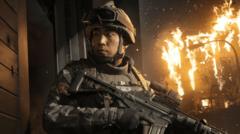
Activision and Infinity Ward have officially broken their silence on the next installment of their flagship shooter franchise, revealing that Call of Duty: Modern Warfare 4 will launch on October 23, 2026. The upcoming game will pivot away from the diffuse, counter-terrorism skirmishes of recent entries to depict a full-scale, conventional North Korean invasion of South Korea. By centering a narrative on a highly volatile, real-world flashpoint, the publisher is stepping directly into a geopolitical minefield. This creative choice risks significant diplomatic backlash and commercial censorship, yet it represents a calculated maneuver to restore a sense of genuine stakes to a franchise that has spent years coasting on repetitive, fictionalized proxy wars.
The narrative splits its focus between two distinct perspectives. Players will experience the front lines through the eyes of Private Park, a young South Korean conscript caught in a desperate defensive retreat through collapsing cities. A parallel storyline follows a rogue, outlawed Captain Price as he operates outside official military channels to hunt down a weapon capable of destabilizing global power. The conflict quickly expands beyond the Korean Peninsula, taking players through high-octane car chases in Paris, trench warfare in East Asia, close-quarters fighting in New York, and a Special Air Service night raid in Mumbai.
Breaking the Safety Shell
For over a decade, major military shooters have hidden behind comfortable abstractions. Developers routinely invented fictional Middle Eastern nations like Urzikstan or relied on historical Cold War nostalgia to avoid offending modern global markets. The decision to explicitly depict a North Korean invasion represents an aggressive departure from this corporate timidity.
The strategy carries immense commercial liabilities. In the past, games that touched too closely on the Korean conflict faced swift, severe economic consequences. When THQ released Homefront in 2011—a game depicting a unified Korea conquering the United States—the title was outright banned in South Korea to avoid escalating diplomatic tensions. Sony similarly suffered catastrophic digital infrastructure attacks in 2014 ahead of releasing The Interview, a satirical film involving the nation's leadership. By naming real nations and portraying active geopolitical fault lines, Activision is knowingly inviting regulatory scrutiny across Asian markets and risking targeted digital retaliation.
Friction is already emerging regarding the portrayal of regional military forces. To ground the experience, Infinity Ward is integrating authentic cultural and linguistic elements, ensuring South Korean characters communicate naturally in their native language during high-stress combat. The developer is also introducing American Marines embedded within these units to showcase the friction and cultural shock of international military cooperation. Portraying a real-world military alliance under catastrophic strain requires a delicate hand; any perception of Western savior complex or misrepresentation of South Korean defensive capabilities will alienate one of the world's most passionate gaming populations.
Structural Overhauls and Technical Cutoffs
The thematic shift is accompanied by an uncompromising technical transition. Modern Warfare 4 will completely skip last-generation consoles, launching exclusively on PlayStation 5, Xbox Series X|S, PC, and the upcoming Nintendo Switch 2. Eliminating the technical debt of older hardware allows the developers to implement advanced spatial audio propagation, denser urban environments, and complex environmental destruction that simulates the sheer kinetic horror of modern conventional warfare.
The core mechanics are undergoing a radical design philosophical shift. The studio is introducing a technology stack called Ballistic Authority, which completely removes weapon bloom from hipfire and aiming sequences. The mechanic ensures absolute predictability; every projectile correlates exactly to the physical orientation of the weapon barrel. By removing the randomized bullet spread that has polarized the community for years, the game demands strict mechanical precision.
| Feature Area | Modern Warfare 4 Implementation | Impact on Gameplay |
|---|---|---|
| Gunplay System | Ballistic Authority (Zero weapon bloom) | Eliminates randomness; rewards pure aiming precision. |
| Map Design | Kill Block (Dynamic multi-round reconfiguration) | Forces constant tactical adaptation across 500 layouts. |
| Hardware Target | Current-gen exclusive (PS5, Xbox Series, Switch 2, PC) | Unlocks dense geometry and realistic destruction physics. |
| Campaign Mode | Linear narrative with native offline support | Reverts the unpopular forced-online mandate of prior years. |
The multiplayer landscape introduces Kill Block, an architecture system that dynamically reconfigures map layouts between rounds. By altering sightlines, shifting cover structures, and blocking off familiar flanking routes across 500 potential permutations, the system prevents players from relying on memorized lane patterns. Furthermore, the game sees the return of DMZ, the extraction-based sandbox mode that developed a dedicated cult following in 2022. Positioned as an off-the-books operation behind enemy lines, it forces players to balance high-stakes resource gathering against the threat of permanent gear loss.
The Real Cost of Realism
Activision's pivot to an active crisis zone highlights a deeper industry tension. For years, the military shooter genre has struggled to balance visceral entertainment with the sober realities of modern combat. When a game uses the real-world anxieties of a peninsula on a permanent war footing as the backdrop for a commercial entertainment product, it walks an exceptionally thin line between gritty artistic expression and crass exploitation.
The inclusion of offline campaign play indicates the studio is listening to structural critiques regarding preservation and player autonomy. Yet, the true test of the title lies in its narrative execution. If the campaign reduces a complex, multi-generational human tragedy into a superficial background for Hollywood explosions and standard blockbuster heroics, the backlash will be swift and justified. Conversely, if Infinity Ward leverages its new current-gen architecture to genuinely explore the terror, confusion, and human cost of a modern conventional breakdown, it could redefine what a big-budget military narrative is capable of achieving.
The industry will be watching closely when the game launches this October. In trying to shake off its creative stagnation, Call of Duty has chosen the most volatile fuse available to light.