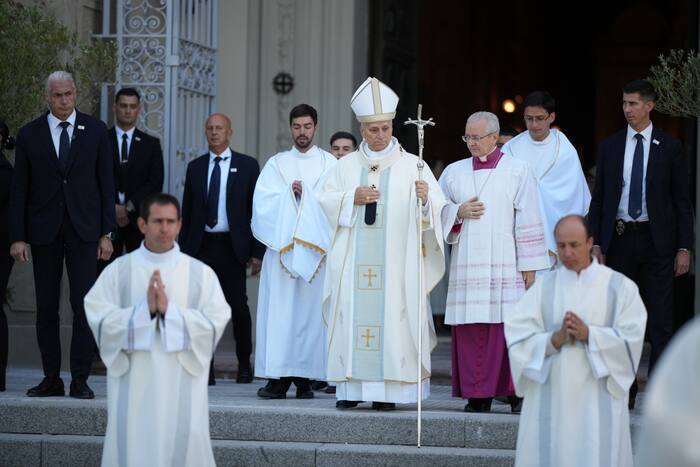
The papal transition from Montevideo to Buenos Aires represents a stark shift in diplomatic mechanics, moving from a high-stability secular consensus to an acute ideological collision between Vatican social doctrine and radical libertarian austerity. While standard media coverage frames this itinerary as a sentimental homecoming or a routine regional tour, a rigorous structural analysis reveals a high-stakes negotiation over institutional legitimacy, economic ethics, and domestic political survival. By transitioning across the Río de la Plata, the Holy See enters a theater where the foundational premises of Catholic social teaching—specifically the preferential option for the poor and the moral duty of state intervention—are actively dismantled by the executive branch of the host nation.
To understand the operational friction of this visit, one must separate the symbolic weight of a native pontiff returning to his homeland from the cold institutional calculus of the Vatican Secretariat of State. The two legs of this journey operate under entirely different diplomatic physics.
The Uruguay Baseline Low Friction Secularism
Uruguay functions as the control group for papal diplomacy in Latin America. As the most secularized nation in the hemisphere, having formally separated church and state in 1917, Uruguay presents a predictable operating environment where religious authority holds minimal direct legislative leverage.
- Institutional Decoupling: Because the Uruguayan state does not rely on the Catholic Church for social service delivery or moral validation, the pontiff operates purely as a moral commentator rather than a political actor.
- Consensus Alignment: The political establishment in Montevideo, across both center-left and center-right coalitions, maintains a broad commitment to social welfare frameworks. Papal rhetoric regarding environmental stewardship, labor protections, and multilateral cooperation aligns naturally with existing state policy, generating zero structural friction.
- Diplomatic Utility: For the Vatican, the Uruguay stop serves as a low-risk staging ground. It allows the pontiff to establish core thematic baselines—peace, social cohesion, and regional integration—without triggering immediate partisan backlash. The audience receives the message as universal philosophy rather than targeted domestic critique.
This friction-free environment ends the moment the papal aircraft crosses the estuary into Argentina.
The Argentine Asymmetric Matrix
Argentina presents a compound crisis where personal history, deep economic contraction, and ideological hostility intersect. Unlike any other stop on a papal itinerary, Buenos Aires is the birthplace of the pontiff, meaning every public gesture, every absence, and every rhetorical inflection is decoded through decades of domestic partisan warfare.
The core instability stems from the collision of two incompatible worldviews:
- The Vatican Framework: Rooted in the encyclicals Rerum Novarum and Fratelli Tutti, this doctrine views the free market as an instrument that must be subordinated to human dignity. It treats extreme wealth inequality as a structural sin and mandates state intervention to protect vulnerable populations from the volatility of capital.
- The Libertarian Executive Framework: President Javier Milei’s administration operates on anarcho-capitalist principles derived from the Austrian School of economics. In this model, the state is defined as a coercive monopoly, taxation is categorized as theft, and social justice is explicitly rejected as an immoral redistribution of property that violates natural rights.
This is not a standard policy disagreement between a conservative government and a progressive church. It is a fundamental epistemological clash over the definition of morality in economics. When the head of the Catholic Church speaks of social justice in Buenos Aires, he is invoking a theological imperative that the Argentine president has publicly labeled an aberration.
The Mechanics of Diplomatic Containment
Both the Casa Rosada and the Apostolic Palace face severe downside risks if the visit devolves into open confrontation. Neither party can afford a breakdown in protocol, forcing both sides into a strict posture of diplomatic containment.
The Executive Calculus
For the Argentine administration, hosting the pope is an exercise in risk mitigation. The government’s primary objective is maintaining macroeconomic stabilization through severe fiscal adjustment, currency devaluation, and the dismantling of state subsidies. These policies have driven short-term poverty metrics upward, creating acute social vulnerability.
- The Legitimacy Trap: Openly attacking the pope during a state visit would alienate moderate conservative voters and strain relations with traditional Catholic factions within the ruling coalition.
- The Co-optation Strategy: The executive branch must neutralize the pope's critique by framing the visit as a spiritual event rather than a political audit. By emphasizing personal reconciliation and national unity, the government seeks to strip papal statements of their immediate policy implications.
- Operational Concessions: Expect the administration to temporarily amplify targeted social assistance programs—such as direct food transfers managed through non-intermediary channels—during the week of the visit to blunt visual evidence of acute deprivation in the Greater Buenos Aires area.
The Vatican Calculus
The Holy See operates on a multi-decade timeline, prioritizing institutional preservation over short-term political victories. The Argentine Catholic Church remains a primary provider of grassroots social infrastructure, operating soup kitchens, addiction recovery centers, and educational facilities across the impoverished conurbano ring surrounding the capital.
- Protecting the Network: If the pontiff triggers an institutional rupture with the executive branch, local dioceses risk losing state funding, tax exemptions, and administrative cooperation essential for their charitable operations.
- Avoiding Partisan Capture: Throughout his papacy, the pontiff’s prolonged absence from Argentina was driven by the certainty that Peronist opposition factions would weaponize his presence to delegitimize non-Peronist governments. During this visit, Vatican protocol officers must enforce strict spatial and visual separation between the pontiff and opposition political figures, union leaders, and social movement organizers.
- Rhetorical Precision: Rather than naming specific economic policies or government officials, papal homilies will rely on structural theology. By focusing on the abstract dangers of "idolatry of money" and the "throwaway culture," the pontiff communicates clear disapproval of radical deregulation while maintaining plausible diplomatic deniability.
The Structural Limitations of Papal Intervention
A critical error in conventional political analysis is overestimating the capacity of a papal visit to alter domestic macroeconomic trajectories. Soft power has hard boundaries when confronting sovereign fiscal crises.
- Capital Markets Insensitivity: Sovereign bond yields, country risk indices, and International Monetary Fund disbursement schedules do not respond to papal encyclicals. The Argentine government’s survival depends on achieving primary fiscal surpluses and accumulating central bank reserves, metrics dictated by financial markets rather than moral suasion.
- Polarization Entrenchment: In a hyper-polarized information ecosystem, papal statements undergo immediate algorithmic distortion. Supporters of the administration will interpret calls for peace as an endorsement of public order and anti-picket protocols, while critics will frame references to poverty as a direct indictment of austerity. The message fragments upon impact, neutralizing its capacity to forge a national consensus.
- Generational Secularization: While Argentina remains culturally Catholic, institutional church attendance and clerical authority over voting behavior have steadily eroded, particularly among the younger demographic cohorts that form the core base of the libertarian movement.
Diagnostic Indicators During the Buenos Aires Leg
To accurately assess whether diplomatic containment is holding or failing during the Argentine segment of the tour, observers must ignore ceremonial platitudes and monitor four specific operational metrics:
- The Bilateral Meeting Duration and Protocol: A standard courtesy call at the Casa Rosada lasting under thirty minutes, accompanied by a terse, strictly formal communiqué from the Holy See Press Office, signals unresolved friction. An extended private audience followed by joint references to specific social cooperation mechanisms indicates a negotiated truce.
- Geographic Allocation in the Conurbano: The specific parishes, villas miseria (shantytowns), or rehabilitation centers selected for papal visits serve as direct policy statements. Visits to state-neglected zones where local priests run autonomous welfare networks validate the Church's parallel social architecture and implicitly critique state withdrawal.
- The Composition of the VIP Enclosures: Monitoring the seating arrangements at major liturgical events reveals the success of Vatican containment. The presence of prominent CGT union bosses or Kirchnerist governors in primary visual zones indicates a failure of protocol discipline and hands the administration a pretext to dismiss the event as a partisan rally.
- Episcopal Conference Positioning: Watch the public posture of the Argentine Episcopal Conference immediately following the departure. If local bishops issue an assertive pastoral letter demanding immediate wage and pension adjustments, it confirms that the pontiff used private meetings to authorize a more aggressive domestic stance by the local hierarchy.
The Strategic Reality Post-Departure
Once the papal plane departs Ezeiza International Airport, the structural drivers of Argentine politics will reassert total dominance. The visit will not slow the pace of state deregulation, nor will it bridge the ideological chasm between libertarian economics and Catholic social doctrine.
The true strategic outcome of this tour lies in institutional boundary-setting. For the Vatican, the objective is to insulate the Argentine Church from partisan exploitation while securing operational space for its grassroots welfare networks during a period of severe economic contraction. For the Milei administration, the victory condition is surviving the global media spotlight without suffering a major diplomatic incident or a surge in street-level mobilization. The visit succeeds not by resolving the contradiction between Rome and Buenos Aires, but by proving that both institutions can coexist in the same physical space without detonating a constitutional or social crisis.


