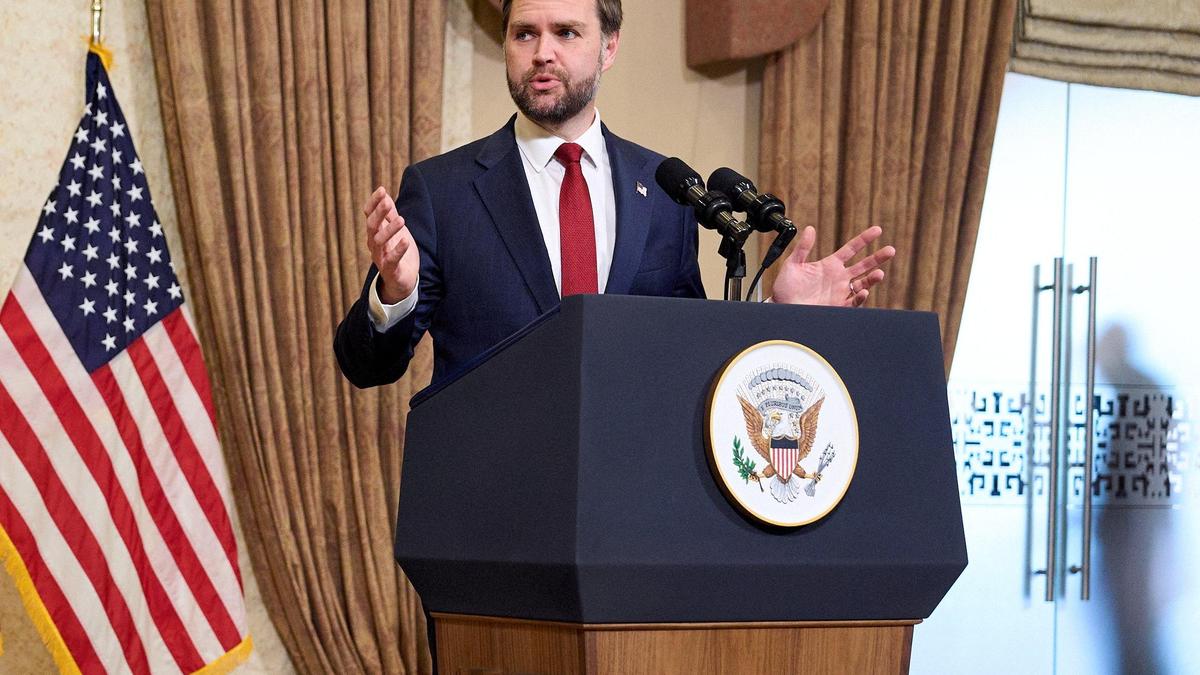
The current stalemate regarding Iran’s nuclear program is not a failure of communication but a calculated equilibrium where the perceived cost of concessions exceeds the immediate risk of escalation. J.D. Vance’s assertion that the "ball is in Iran's court" reflects a strategic shift from active pressure to a wait-and-see containment model. This posture assumes that the Islamic Republic is a rational actor capable of weighing economic survival against ideological expansion. However, this binary view ignores the internal friction within Tehran’s decision-making apparatus and the regional variables that dictate their response threshold.
The Tri-Node Conflict Model
To understand why diplomatic "progress" often fails to yield a definitive resolution, the situation must be viewed through three distinct nodes of influence:
- The Kinetic Node: This involves the physical enrichment of uranium and the development of delivery systems. As Iran approaches the 60% and 90% enrichment thresholds, the time available for a diplomatic solution—often referred to as "breakout time"—shrinks. This reduces the margin of error for Western intelligence and increases the likelihood of a pre-emptive strike by regional actors like Israel.
- The Economic Node: Sanctions serve as a friction mechanism designed to slow the Kinetic Node. However, the efficacy of sanctions is decaying. The development of "dark fleets" for oil transport and the strengthening of the Moscow-Tehran-Beijing axis provide Iran with an economic floor. This floor prevents total collapse, allowing the regime to withstand prolonged diplomatic isolation.
- The Proxy Node: Iran’s influence is not contained within its borders. The use of the "Axis of Resistance" (Hezbollah, Hamas, and the Houthis) allows Tehran to outsource escalation. This creates a strategic buffer; Iran can exert pressure on global trade or Israeli security without directly engaging in a state-on-state conflict that would trigger a full-scale U.S. intervention.
The Rationality of Iranian Delay
From a game theory perspective, Iran’s current strategy is optimal for regime preservation. By engaging in "talks about talks," they extract time. Time allows for the hardening of nuclear facilities, making a military solution increasingly difficult and costly. The Iranian leadership views the "ball" not as a tool for play, but as a ticking clock.
The internal logic of the Supreme Leader’s office prioritizes ideological purity and regional hegemony over domestic economic prosperity. When Vance suggests that the burden of the next move lies with Iran, he assumes the Iranian government perceives the status quo as untenable. Data suggests otherwise. Despite high inflation and civil unrest, the security apparatus remains intact. The regime has successfully decoupled its survival from its international standing.
The Breakout Time Calculus
The technical reality of Iran’s nuclear program has evolved beyond simple enrichment. The primary bottleneck is no longer just the acquisition of $U-235$ at weapons-grade levels. Instead, the focus has shifted to "weaponization"—the engineering required to fit a nuclear warhead onto a ballistic missile.
- Enrichment Velocity: Iran has mastered the cascade configurations required to move from 20% to 60% enrichment with minimal hardware changes.
- Storage and Dispersion: Unlike the early 2000s, Iran’s nuclear infrastructure is highly decentralized. Deeply buried sites like Fordow are designed to survive conventional bunker-buster munitions.
- Knowledge Retention: Sanctions and sabotage cannot erase the technical expertise gained by Iranian scientists. This intellectual capital is the most resilient component of the program.
The West’s reliance on the Joint Comprehensive Plan of Action (JCPOA) framework as a baseline for "progress" is arguably outdated. The 2015 agreement was built on a set of assumptions—specifically, that Iran’s breakout time could be held at twelve months. Current estimates suggest this window has narrowed to weeks or even days in some scenarios. Consequently, the "ball" being in Iran’s court is less an invitation to negotiate and more an acknowledgment that the U.S. has exhausted its non-military leverage.
The Fragility of the Containment Strategy
Vance’s rhetoric signals a return to a "Maximum Pressure" philosophy, but the global environment has changed since 2018. The emergence of a multipolar world order means that U.S.-led sanctions do not carry the same absolute weight.
The first limitation of the current containment strategy is the Enforcement Gap. While the U.S. can blacklist entities, it cannot unilaterally stop the flow of Iranian crude to independent refineries in China. This creates a constant stream of revenue that bypasses the global financial system.
The second limitation is the Security Dilemma. As Iran feels more secure in its partnership with Russia—exchanging drone technology for advanced fighter jets and air defense systems—it becomes less likely to trade its nuclear "insurance policy" for a promise of sanctions relief that could be rescinded by a future U.S. administration.
Regional Escalation Vectors
The conflict cannot be viewed in a vacuum. The internal dynamics of the Middle East act as a force multiplier for any decision made in Tehran.
- The Israeli Constraint: Israel views an Iranian nuclear weapon as an existential threat rather than a strategic one. This creates a "red line" that is likely more aggressive than Washington’s. If Israel perceives that the U.S. is content with a "contained" nuclear Iran, the probability of unilateral Israeli action increases exponentially.
- The Saudi-Iranian Détente: The recent Chinese-brokered normalization between Riyadh and Tehran has complicated the U.S. strategy of building a regional anti-Iran coalition. If Saudi Arabia feels that Iran is the ascending power, it may seek to hedge its bets rather than align strictly with Western interests.
- Maritime Chokepoints: The Houthi attacks in the Red Sea demonstrate Iran’s ability to disrupt 12% of global trade via a proxy. This provides Tehran with a "leverage tax" on the global economy, which they can increase or decrease based on the pressure they feel from Washington.
The Cost Function of Diplomacy
Diplomatic progress is often measured by the frequency of meetings or the tone of official statements. A more accurate metric is the Concession-to-Compliance Ratio.
For every dollar of sanctions relief or every diplomatic "thaw," what measurable rollback in enrichment or centrifuges occurs? Historical data shows a negative correlation. Iran typically uses periods of diplomatic engagement to modernize its IR-6 centrifuges while maintaining the appearance of cooperation. This "cheating at the margins" allows them to stay just below the threshold of triggering a military response while steadily advancing their technical capabilities.
The primary bottleneck in negotiations is the Verifiability Problem. The International Atomic Energy Agency (IAEA) has repeatedly reported gaps in its monitoring capabilities. Without intrusive, 24/7 access to all sites—declared and undeclared—any agreement is a matter of trust rather than verification. Given the history of the program, trust is a non-existent currency in this theater.
The Tactical Shift Toward Threshold Status
It is increasingly clear that Iran’s objective is not necessarily to detonate a device, but to achieve "Nuclear Threshold" status. Like Japan, a threshold state possesses the materials, technology, and delivery systems to assemble a weapon within a very short timeframe but chooses not to cross the final line.
For Iran, threshold status provides the ultimate deterrent without the international pariah status that follows an actual nuclear test. It forces the world to treat Tehran with the caution reserved for a nuclear power, effectively granting the regime a permanent seat at the regional table. Vance’s position assumes that Iran can be talked out of this objective. In reality, once a state reaches the threshold, the cost of going back is seen as a strategic defeat that no authoritarian regime can survive.
The Strategic Play
The "ball" is not in Iran's court for a return to the JCPOA or a grand bargain. The ball is in their court to decide exactly how close to the 90% enrichment line they can dance without triggering a regional war.
The U.S. and its allies must move beyond the binary of "Deal" or "No Deal." The focus must shift to a Dynamic Deterrence Framework. This involves:
- Defining Hard Red Lines: Moving away from vague warnings and establishing clear, public consequences for specific technical milestones (e.g., the introduction of weapons-grade uranium into a warhead-sized container).
- Symmetry in Proxy Conflict: Addressing the Proxy Node directly. If Iran uses proxies to attack Western interests, the response must target the assets of the Iranian Revolutionary Guard Corps (IRGC) that facilitate those proxies, rather than just the proxy groups themselves.
- Alternative Energy Infrastructure: Reducing the "leverage tax" by accelerating energy independence and maritime security in the Indo-Pacific and Mediterranean, making the threat of a closed Strait of Hormuz less economically catastrophic.
The assumption that Iran is waiting for a better offer is a fundamental misunderstanding of their strategic culture. They are waiting for the West to accept the reality of a threshold Iran. The next phase of this conflict will not be defined by a signed document, but by the management of a permanent, high-stakes nuclear tension.