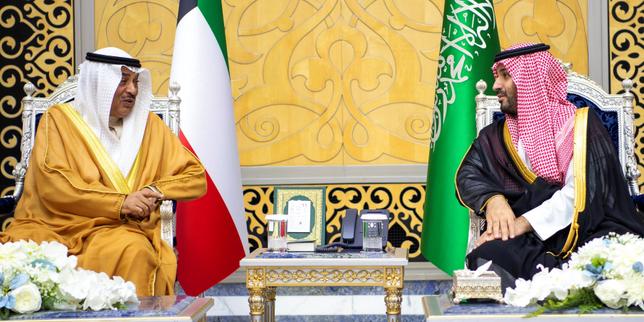
The escalating competition between Riyadh and Abu Dhabi has transitioned from a localized friction point into a structural realignment of the Arabian Peninsula's economic architecture. This "Gulf Cold War" is not a mere clash of egos; it is a forced-march diversification race driven by the looming obsolescence of the rentier state model. As Saudi Arabia and the United Arab Emirates (UAE) converge on identical economic targets—tourism, logistics, and tech-heavy foreign direct investment (FDI)—they create a zero-sum environment that threatens the stability of smaller neighbors like Kuwait, Qatar, and Oman.
The Dual-Pivot Resource Paradox
At the core of this rivalry lies the Resource Concentration Problem. Historically, the Gulf Cooperation Council (GCC) functioned as a loose oligopoly where roles were specialized: Saudi Arabia provided the energy muscle, while the UAE (specifically Dubai) served as the regional service hub. The implementation of Saudi Arabia’s Vision 2030 shattered this division of labor. Learn more on a connected topic: this related article.
The Saudi "Project Headquarters" mandate, which requires multinational companies to establish regional bases in Riyadh or lose government contracts, directly attacks the UAE’s primary value proposition. This creates a Negative Externality Cycle:
- Capital Migration: Firms are forced to choose between the established infrastructure of the UAE and the massive, untapped market potential of Saudi Arabia.
- Margin Compression: To retain talent and investment, the UAE is forced to offer increasingly aggressive tax incentives and residency reforms, eroding the fiscal buffers meant to fund its own post-oil transition.
- Redundant Infrastructure: Both nations are simultaneously building massive logistics hubs, airlines (Riyadh Air vs. Emirates/Etihad), and financial centers. This leads to regional overcapacity, which will eventually suppress internal rates of return (IRR) for these multi-billion dollar projects.
Regional Contagion and the Squeeze on Minor Players
The friction between the two giants creates a "Strategic Squeeze" for the smaller petromonarchies. Kuwait, Oman, and Qatar operate with significantly less fiscal headroom and smaller domestic markets, making them vulnerable to the gravitational pull of the Saudi-Emirati struggle. Additional analysis by Financial Times delves into similar perspectives on the subject.
The Kuwaiti Paralysis
Kuwait remains trapped in a cycle of legislative gridlock. While Riyadh and Abu Dhabi move with autocratic speed to deregulate, Kuwait’s political system hinders the structural reforms necessary to compete. As the Saudi-UAE rivalry drives regional standards for ease of doing business upward, Kuwait’s relative stagnation becomes more costly. The risk is a flight of domestic Kuwaiti capital toward the more dynamic Saudi and Emirati markets, deepening the country's dependence on sovereign wealth fund yields rather than productive economic activity.
The Omani Neutrality Tax
Oman has historically positioned itself as the "Switzerland of the Middle East." However, in a bipolar regional order, neutrality carries a heavy price. To maintain its independence, Muscat must secure investment from both sides without appearing to favor either. If the Saudi-UAE rift deepens into formal trade barriers or divergent regulatory zones, Oman’s logistics ambitions—centered on the Port of Duqm—could be sidelined by Saudi Arabia's Red Sea developments or the UAE's existing dominance in the Strait of Hormuz.
The Qatari Divergence
Qatar has leveraged its liquefied natural gas (LNG) dominance to carve out a unique path, but it remains susceptible to the security implications of a fractured GCC. The 2017-2021 blockade demonstrated that economic independence does not equate to geographic immunity. If Saudi Arabia and the UAE engage in a prolonged race for regional hegemony, Qatar may be forced to over-invest in defense and diplomatic lobbying, diverting funds from its own North Field expansion and diversification efforts.
The Three Pillars of Competitive Friction
To quantify the intensity of this rivalry, we must analyze three specific operational vectors:
1. The FDI Extraction Rate
Saudi Arabia is currently the world's largest construction site. Its demand for capital is insatiable. However, global FDI is a finite pool. By positioning itself as a "G20-scale" opportunity, Saudi Arabia effectively crowds out the smaller economies of the Gulf. The UAE responds by pivoting toward "Deep Tech" and "AI Sovereignty" (exemplified by G42), attempting to move up the value chain where Saudi Arabia’s sheer mass is less of an advantage. This creates a divergence in the regional labor market, where the UAE hunts for high-tier technical talent while Saudi Arabia absorbs the mass-market service and construction labor force.
2. Divergent Geopolitical Alignments
The UAE has increasingly pursued a "Transactional Realism" strategy, normalizing ties with Israel via the Abraham Accords and maintaining complex, high-level trade relationships with China and Russia. Saudi Arabia, while exploring similar avenues, remains the traditional guarantor of regional Sunni security. When their foreign policy goals diverge—as seen in the differing approaches to the Yemen conflict or Sudan—the resulting instability increases the "Risk Premium" for the entire region. Investors do not price risk country-by-country in the Gulf; they often price it as a bloc. A localized spat between Riyadh and Abu Dhabi raises borrowing costs for Bahrain and Oman.
3. Energy Transition Velocity
Both nations are racing to be the "Last Man Standing" in the global oil market. This requires maximizing production now to fund the transition, while simultaneously branding themselves as leaders in green hydrogen and solar. This creates a fundamental tension within OPEC+. If Saudi Arabia needs higher prices to fund its giga-projects, but the UAE wants to increase its production quota to monetize reserves before the energy transition peaks, the internal cohesion of the oil cartel dissolves.
The Infrastructure Overhang
A critical failure in the current regional strategy is the lack of cross-border integration. Instead of a unified rail network or a synchronized power grid that could create a powerhouse economic bloc, we see the development of "Parallel Silos."
- Aviation Density: The Gulf is on track to have the highest density of international "mega-hubs" in history. The logic of the hub-and-spoke model dictates that there is only room for a few dominant players. The entry of Riyadh Air into a market already saturated by Emirates, Qatar Airways, and Etihad suggests an impending price war that will decimate the margins of smaller regional carriers like Gulf Air or Kuwait Airways.
- Logistics Redundancy: Saudi Arabia’s "Global Supply Chain Resilience Initiative" aims to position the Kingdom as a bridge between three continents. This is the exact mission statement of DP World and Jebel Ali. This competition will likely lead to a "Race to the Bottom" in port fees and logistics costs, benefiting global shipping lines while hollowing out the fiscal returns for the host nations.
The Institutional Bottleneck
The primary risk to this competitive landscape is the lack of a robust dispute resolution mechanism. The GCC as an institution is increasingly marginalized. When Saudi Arabia unilaterally changes its import rules from "free zones" (targeting Jebel Ali), the UAE has no formal recourse within a regional legal framework. This institutional vacuum forces all competition into the realm of high-level diplomacy or retaliatory economic measures.
For the smaller states, this lack of structure is perilous. They are effectively "Price Takers" in a market where the two "Price Makers" are at war. The absence of a unified customs union or a common currency—ideas now effectively dead—means that every business in the Gulf must navigate a fragmented regulatory landscape that changes based on the temperature of the relationship between two royal courts.
Strategic Forecast: The Rise of Bipolarity
The regional economy is moving toward a bipolar structure. This will not result in a single winner, but rather in a permanent state of high-intensity friction that redefines the "Cost of Doing Business" in the Middle East.
- The Rise of Targeted Protectionism: Expect more "Local Content" requirements and "National Preference" policies. The era of the seamless GCC market is over.
- Specialization as Survival: Smaller states will survive only by finding niches that the "Big Two" overlook. Oman may pivot toward specialized green ammonia; Qatar will lean harder into its role as a global energy-diplomacy broker.
- The Talent War: We are entering a decade of aggressive immigration reform. The UAE’s "Golden Visa" and Saudi Arabia’s "Premium Residency" are the first shots in a battle to capture the human capital necessary to run a post-oil economy.
The ultimate test for the GCC will be the first major global recession of the post-2030 era. When oil prices inevitably face structural downward pressure, the ability of these nations to maintain their competitive giga-projects while funding social contracts will be stretched to the breaking point. In that scenario, the "Gulf Cold War" will shift from a race for growth to a fight for fiscal survival, and the smaller petromonarchies will find themselves with very little room to maneuver between the colliding interests of their larger neighbors.