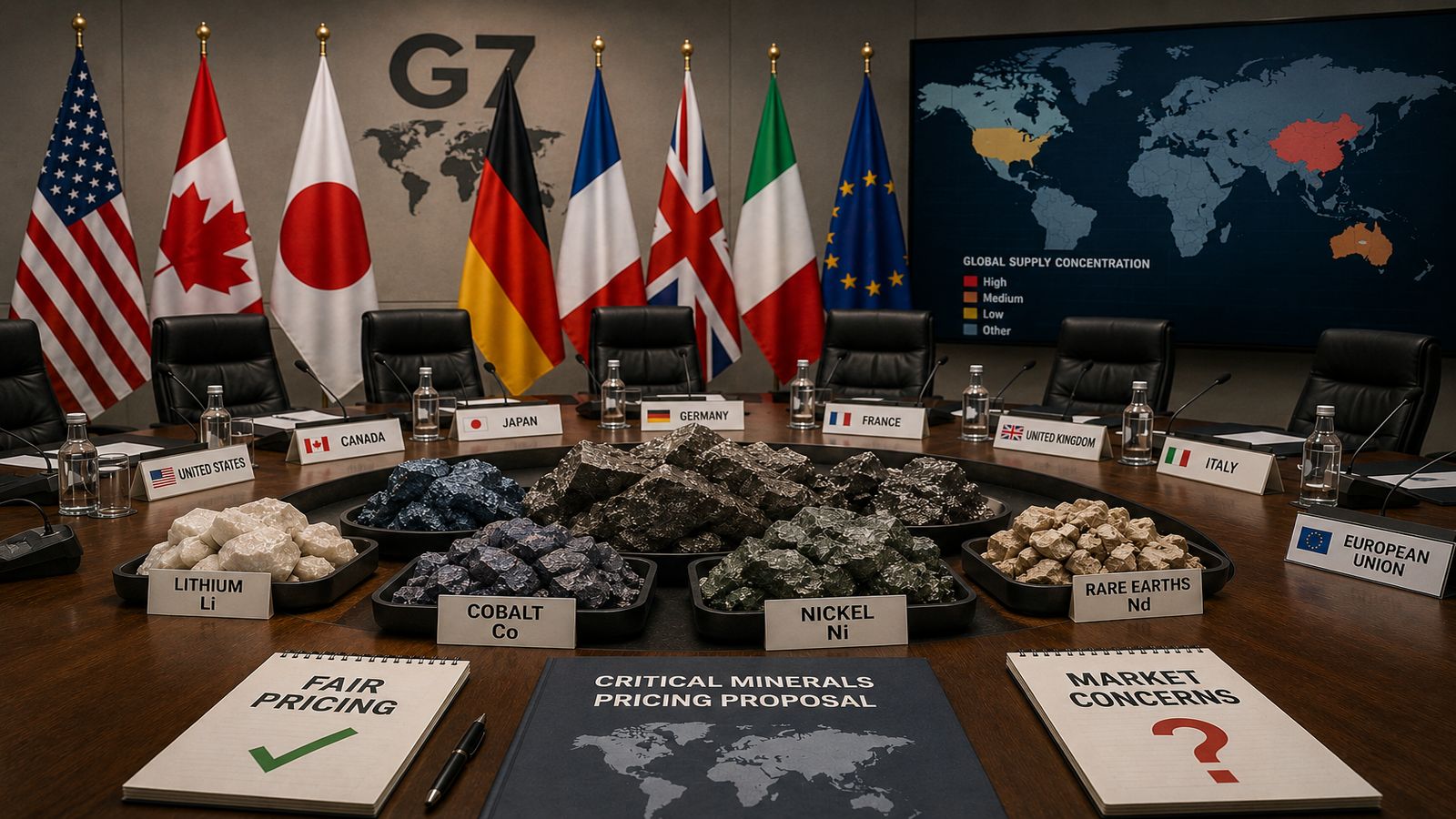
Western supply chains for defense, semiconductors, and advanced telecommunications are tethered to an artificial pricing mechanism controlled by a single state actor. By operating extraction and refining facilities at a structural loss, China has effectively suppressed the global market value of cobalt, lithium, nickel, and rare earth elements. This economic asymmetry creates a predatory pricing cycle. Whenever a Western competitor attempts to finance an independent extraction project, a targeted supply surge lowers prices below the marginal cost of production, driving the new entrant into insolvency.
The United States administration has introduced a policy counterweight: a proposed Western trading bloc anchored by guaranteed price floors, subsidies, and adjustable enforcement tariffs. This state-directed market design faces severe friction at the G7 negotiation level. The underlying gridlock is not merely diplomatic; it is an structural mismatch between the microeconomics of the mining industry and the macroeconomic models used by sovereign states.
The Trilemma of Interventionist Commodity Pricing
To replace an adversarial monopoly with a regulated trading bloc, a state must simultaneously solve for three variables: volume security, price stability, and fiscal sustainability. Minimizing risk in one domain exponentially increases exposure in another.
                  [Volume Security]
                         /\
                        /  \
                       /    \
                      /  *   \
                     /________\
     [Price Stability]        [Fiscal Sustainability]
The Cost-Plus Pricing Asymmetry
The administration seeks to determine critical mineral benchmarks using the United States Department of Defense's Open Price Exploration for National Security (OPEN) program—an algorithmic model developed by DARPA. The program calculates an engineered price based on transparent inputs: local labor rates, environmental compliance costs, energy inputs, and refining processing premiums.
The structural flaw in this approach lies in treating a political commodity as an equilibrium asset. Western mining operations are bound by capital expenditures that include strict regulatory permitting, high ESG (Environmental, Social, and Governance) compliance costs, and private equity hurdles. Conversely, Chinese production functions within a state-subsidized capital framework where equity returns are secondary to national industrial positioning. An AI model can accurately estimate western operational expenditures, but it cannot model the precise limit of a foreign treasury's willingness to absorb losses.
The Upstream versus Downstream Cleavage
A fundamental divide exists between the entities extracting raw materials and those manufacturing consumer goods. The corporate policy recommendations submitted to the United States Trade Representative highlight this friction:
- Upstream Extractors: Companies holding asset reserves require long-term price guarantees. Without a guaranteed price floor that covers initial capital expenditures and debt service, institutional lenders refuse to finance construction.
- Downstream Manufacturers: Industrial consumers, such as automotive OEMs and electronics manufacturers, operate on thin margins. Forcing these entities to purchase minerals at an artificially high domestic price floor—while global competitors buy raw inputs at depressed market rates—destroys their international competitiveness.
If a domestic automotive manufacturer must purchase battery-grade lithium at a premium to support allied mining, the cost must be absorbed by the balance sheet or passed to the consumer. This shifts the point of economic vulnerability from the mining sector directly to the technology and manufacturing sectors.
The Strategic Failure Modes of Allied Price Guarantees
The proposed trading bloc intends to enforce its pricing structure using adjustable tariffs under Section 232 of the Trade Expansion Act of 1962. If an imported processed mineral falls below the calculated floor, a variable tariff is applied to restore pricing integrity. This framework creates two severe economic bottlenecks.
Structural Overproduction and Revenue Drain
When a government establishes a persistent price floor above the global market clearing price, it incentivizes structural overproduction. High-cost producers enter the market, protected by state guarantees. If global demand softens or if non-aligned nations increase supply, the state becomes the buyer of last resort.
This exposure materialized when the administration extended an asset-specific price floor to select domestic rare earth operations. Without explicit statutory funding allocations from the legislature, long-term price guarantees become unbacked sovereign liabilities. This fiscal risk explains why the state is subtly pivoting toward requiring projects to demonstrate baseline financial viability without direct price support.
The Regulatory Drift of Trade Blocs
European G7 allies, led by France and Germany, reject unilateral, algorithmic price-setting managed from Washington. The European approach prioritizes multilateral institutional frameworks, favoring a permanent administrative secretariat within the International Energy Agency (IEA) or the OECD to oversee supply chains.
This governance dispute stems from conflicting strategic timelines. The United States aims for rapid, bilateral trade actions to decouple defense supply chains from adversarial influence. European nations fear that aggressive, variable tariffs will destabilize their export-driven industrial sectors and invite retaliatory trade barriers. The result is a fragmented regulatory landscape where capital remains on the sidelines due to shifting policy horizons.
Capital Allocation Dynamics under Divergent Regimes
The mining sector is highly capital-intensive, requiring seven to fifteen years to advance a project from initial discovery to commercial production. Capital will not commit to projects governed by short-term executive orders or contested multilateral frameworks.
| Intervention Strategy | Corporate Reaction | Systemic Risk |
|---|---|---|
| Direct Price Floors | Accelerates immediate upstream investment; satisfies junior mining operations. | Exposes public capital to market collapses; incentivizes inefficient resource extraction. |
| Tariffs & Import Restrictions | Protects localized refining margins; creates domestic production shields. | Triggers downstream margin compression; invites immediate retaliatory export bans. |
| Multilateral Subsidies (IEA/OECD) | Matches long-term institutional investment criteria; minimizes trade conflict risks. | Operational execution is slow; vulnerable to political gridlock and vetoes. |
The current policy gridlock leaves the Western alliance dependent on market dynamics that favor the lowest-cost producer. Companies with significant state-backed investments can sustain multi-year down-cycles to clear the competitive field. Western operators must rely on public equity markets or government grants that lack long-term operational scale.
The Tactical Blueprint for Western Mineral Insulated Markets
To break the current deadlock without causing fiscal strain or downstream industrial collapse, G7 policymakers must shift their focus from direct price-setting to structural market insulation.
Implement Tranche-Based Government Procurement
Instead of trying to fix prices across the entire global market, the alliance should establish isolated procurement pipelines dedicated strictly to national defense and critical infrastructure. These strategic tranches should explicitly mandate the use of allied-sourced and refined materials, paid for at a calculated cost-plus premium. This provides upstream extractors with guaranteed, bankable off-take contracts to secure private debt financing, while leaving the broader commercial market to operate on standard market terms.
Harmonize Processing Tariffs over Raw Material Penalties
Imposing tariffs on raw material imports hurts domestic manufacturing. The trade bloc should focus its tariff policy exclusively on downstream, value-added processing and refining stages. China's core advantage is not just raw extraction; it lies in its near-monopoly on midstream chemical refining. By applying coordinated, fixed tariffs on imported processed critical mineral derivatives while keeping raw inputs tariff-free, the G7 can encourage private investment in domestic processing infrastructure without starving downstream manufacturers of raw materials.
Establish an Inter-Sovereign Commodity Stabilization Fund
Rather than relying on an artificial AI price model to dictate trade policy, G7 nations should pool capital into a joint sovereign stabilization fund. This fund would act as a strategic commercial buffer, purchasing physical inventory during market gluts and releasing it during supply crunches. This mitigates the extreme price volatility that destroys Western project economics, using market mechanisms to counter state-subsidized supply manipulation. This approach protects allied supply chains without requiring the heavy-handed, bureaucratic price controls that partners reject.