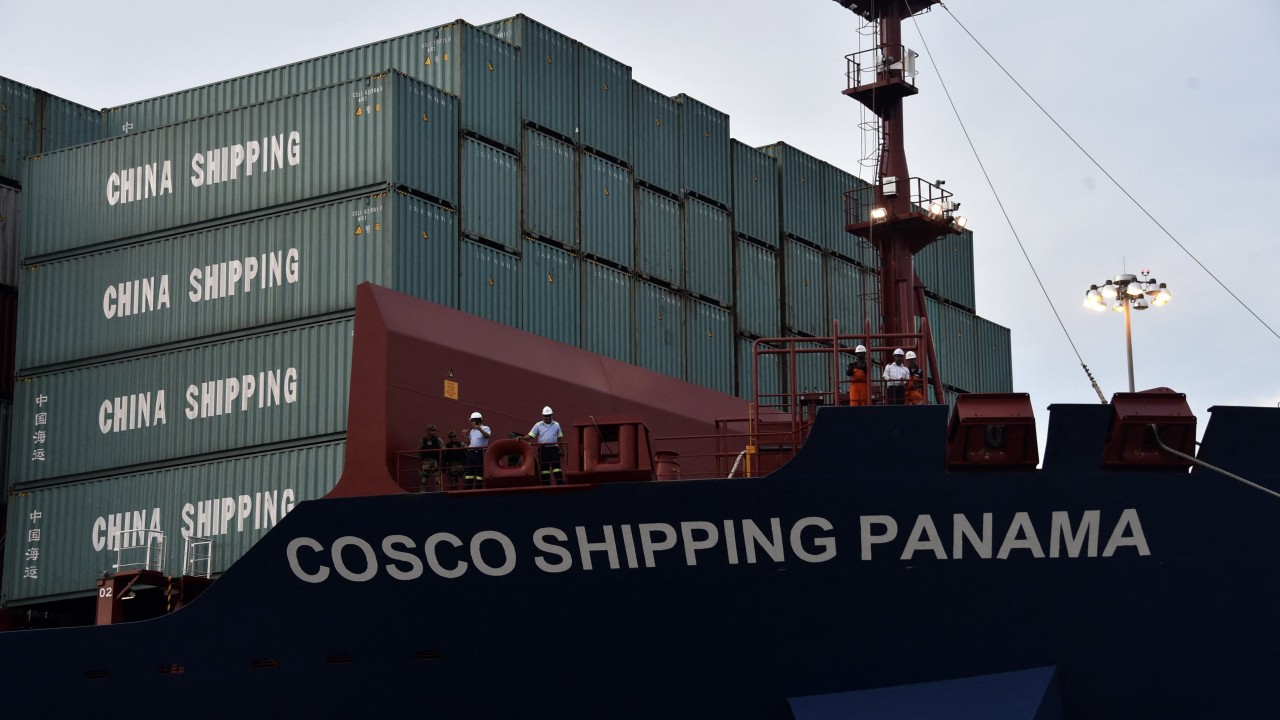
The global maritime trade network is currently experiencing a simultaneous failure of its two primary artificial arteries: the Panama Canal, restricted by systemic hydrological deficits, and the Suez Canal, rendered high-risk by kinetic conflict in the Red Sea. Beijing is capitalizing on this vacuum by accelerating a "Port Alliance" strategy that transitions the Belt and Road Initiative (BRI) from a debt-funded infrastructure project into an integrated, state-controlled logistical operating system. This is not merely a collection of harbor investments; it is a calculated attempt to decouple Chinese trade resilience from Western-controlled maritime chokepoints.
The Triad of Maritime Vulnerability
To understand the acceleration of China’s port diplomacy, one must first quantify the current fragility of global shipping. Three distinct variables are forcing a reconfiguration of trade routes:
- Hydrological Constraints: The Panama Canal operates on a freshwater lock system dependent on Lake Gatún. Prolonged drought has forced the Panama Canal Authority to reduce daily transits and draft limits. For a Suez-max or Neo-Panamax vessel, every foot of lost draft equates to approximately 2,500 containers of lost capacity.
- Kinetic Risk and Insurance Premiums: The conflict involving Iran-backed proxies in the Red Sea has effectively closed the Bab el-Mandeb Strait to high-value Western carriers. War risk insurance premiums for Red Sea transits have spiked by over 1,000%, forcing a massive diversion around the Cape of Good Hope.
- The Malacca Dilemma: China remains hyper-aware that 80% of its energy imports pass through the Strait of Malacca, a 1.7-mile-wide chokepoint at its narrowest.
By establishing a "Port Alliance," Xi Jinping is constructing a redundant logistics architecture. If the Panama Canal is restricted and the Red Sea is a combat zone, China’s control over ports in the UAE, Piraeus (Greece), and eventually the Arctic’s Northern Sea Route provides a diversified portfolio of transit options that Western competitors cannot match.
The Mechanics of the Port Alliance Framework
The "Port Alliance" is a sophisticated integration of three operational layers: Physical Infrastructure, Digital Surveillance, and Diplomatic Immunity.
The Physical Layer: Terminal Monopolies
Unlike traditional port operators like DP World or PSA International, Chinese state-owned enterprises (SOEs) such as COSCO Shipping and China Merchants Port Holdings seek "landlord" status. By securing long-term concessions (often 99 years), they gain the authority to prioritize Chinese-flagged vessels during periods of peak congestion. This creates a tiered hierarchy of maritime access where BRI-aligned nations receive preferential "Green Channel" processing, while non-aligned nations face escalating demurrage costs and berth delays.
The Digital Layer: The LOGINK System
The true force multiplier in this strategy is LOGINK, a state-sponsored logistics management platform. It aggregates data from over 20 nations and dozens of ports, providing the Chinese Ministry of Transport with real-time visibility into global cargo flows, carrier pricing, and inventory levels. When a port joins the "Alliance," it often integrates with LOGINK, effectively handing over the "nervous system" of its trade data. This creates a massive information asymmetry. Beijing knows exactly what its competitors are shipping, where, and at what cost, allowing for predatory pricing or strategic supply chain disruptions.
The Diplomatic Layer: Sovereign Enclaves
Through "Port-City" development models (e.g., Gwadar in Pakistan or Hambantota in Sri Lanka), China creates special economic zones that operate under unique legal frameworks. These ports serve as "Dual-Use" facilities. While they function as commercial hubs during peacetime, their deep-water berths and standardized logistics hardware are designed to support the People's Liberation Army Navy (PLAN) during a conflict.
The Cost Function of Redundancy
China’s investment in the Port Alliance ignores standard Return on Investment (ROI) metrics used by private equity. A traditional port investment requires a clear path to profitability via container throughput. In contrast, China’s "Strategic ROI" accounts for the prevention of "Economic Asphyxiation."
The cost of building a deep-water port in a volatile region like Iran or Pakistan is high, but the cost of a total maritime blockade of the Chinese mainland is an existential threat to the Communist Party. Therefore, these ports are "Hedging Assets." Their value is not found in the revenue they generate today, but in the insurance they provide against a Western-led sanctions regime or a blockade of the South China Sea.
The Panama-Suez Displacement
The disruption in Panama and the Red Sea has accelerated the shift toward "Multi-Modal" BRI routes. China is aggressively promoting the "Middle Corridor" (the Trans-Caspian International Transport Route) and the "Polar Silk Road."
- The Middle Corridor: By linking ports in Kazakhstan and Azerbaijan with rail networks, China can bypass both the Suez Canal and Russian territory. This route reduces transit time from 45 days (via sea) to approximately 15 days (via rail and short-sea).
- The Polar Silk Road: As Arctic ice thins, the Northern Sea Route offers a path from Shanghai to Rotterdam that is 40% shorter than the Suez route. Chinese investment in Russian Arctic ports ensures that this future chokepoint is under Sino-Russian influence from the outset.
Structural Limitations and Systemic Friction
The Port Alliance strategy is not without significant friction points that threaten its long-term viability.
- Sovereign Debt Saturation: Many Alliance members are nearing debt-to-GDP ratios that trigger domestic political instability. When a port is seized due to a debt-for-equity swap, it creates a "Neocolonial" narrative that hampers further expansion.
- Interoperability Gaps: While LOGINK provides a digital layer, the physical equipment across various ports remains fragmented. Standardizing maintenance and spare parts across a global network of disparate ports is a massive operational burden.
- Local Resistance and Security Costs: In regions like Balochistan (Gwadar), the Chinese presence has sparked insurgencies. The cost of protecting BRI personnel and infrastructure is escalating, requiring the deployment of Private Security Companies (PSCs) which further complicates the "peaceful rise" narrative.
Quantifying the Strategic Shift
We can model the impact of the Port Alliance using a Connectivity Resilience Index (CRI).
$$CRI = \frac{\sum (C_p \times A_s)}{T_v}$$
Where:
- $C_p$ is the Capacity of Chinese-controlled ports.
- $A_s$ is the Alternative Shipping routes available (excluding Western chokepoints).
- $T_v$ is Total Trade Volume.
As $A_s$ increases through the development of the Middle Corridor and Arctic routes, China’s dependency on the Panama and Suez canals decreases. The objective is to reach a state where $CRI > 1$, meaning China has more "safe" capacity than its total trade volume requires, effectively immunizing it from Western maritime leverage.
The Operational Imperative for Global Competitors
The response from Western nations and regional powers cannot be limited to traditional naval patrolling. To counter the Port Alliance, a strategy of "Logistical Decentralization" is required.
The first step involves the creation of a "Data-Secure Shipping Corridor." This is a digital alternative to LOGINK that uses decentralized ledger technology to protect shipping manifests and pricing data from state-sponsored surveillance. Without data dominance, the Port Alliance loses its ability to engage in predatory logistics.
The second step is the "Draft-Independent Infrastructure" investment. Given the climate-driven instability of the Panama Canal, Western capital must pivot toward "dry canals" (trans-isthmian rail) and high-capacity port facilities in deep-water locations that do not rely on freshwater lock systems.
The competition is no longer about who owns the ships; it is about who owns the data and the dirt. China has moved past the era of building bridges and is now in the era of owning the global operating system for trade. Any nation or corporation that treats a port as a mere parking lot for ships is fundamentally miscalculating the nature of 21st-century power. The strategic play is to build a parallel, transparent, and resilient network that treats "logistics as sovereignty." Would you like me to develop a risk-assessment framework for evaluating private equity exposure to ports currently integrating with the LOGINK system?