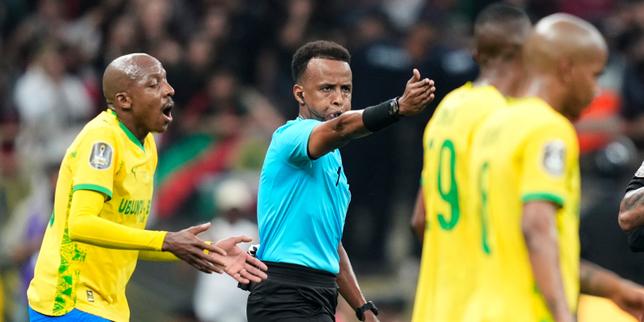
The global football apparatus recently collided with the realities of international border enforcement when a Somalian referee, selected for FIFA's elite officiating pool, was denied entry to the United States. While the sports world reacted with predictable outrage, treating the incident as an isolated bureaucratic error, the reality is far more systemic. This visa denial exposes a fundamental friction between FIFA's expansionist commercial ambitions and the rigid national security policies of Western host nations. By awarding major tournaments to countries with stringent immigration frameworks without securing ironclad diplomatic guarantees, football’s governing body has compromised the integrity of its own competitions.
The core of the issue lies in a naive assumption by sports executives. They believed that a FIFA credential functions as a universal passport. It does not.
The Illusion of the Global Game
FIFA prides itself on a membership larger than the United Nations, boasting 211 member associations. The marketing narrative suggests that on the pitch, every nation stands on equal footing. Yet, the moment a tournament requires travel, the structural inequality of the international passport hierarchy asserts itself.
When the United States, Canada, and Mexico were awarded the rights to host the expanded World Cup, the focus remained squarely on stadium capacities, media markets, and projected tourism revenues. Little attention was paid to the tightening web of immigration policies, travel bans, and visa processing backlogs that define modern border control.
The rejection of a qualified match official from a politically sensitive region is not a fluke. It is a predictable outcome. Western immigration departments operate on risk-assessments and automated profiling algorithms that do not pause for sporting prestige. A visa officer in a consulate is bound by federal law, not FIFA statutes. When a applicant originates from a state designated as high-risk, the default posture is refusal.
FIFA’s historical response to these situations has been characterized by quiet diplomacy that usually yields results when dealing with star players. Referees possess no such leverage. They are replaceable cogs in the tournament machinery, meaning their administrative hurdles are rarely escalated to ministerial levels until it is too late.
The Breakdown of the Host City Agreement
Every country bidding for a major tournament signs a comprehensive host city agreement. These documents are packed with assurances regarding tax exemptions, security cooperation, and the "expedited processing" of visas for players, officials, and dignitaries.
- The Flaw in the Promise: These agreements are rarely legally binding on the independent federal agencies that govern border security.
- The Reality of Enforcement: A department of homeland security or interior ministry retains absolute sovereignty. No sports federation can compel a sovereign state to waive its immigration checks.
- The Resulting Double Standard: Elite athletes representing wealthy nations breeze through expedited lanes, while officials and support staff from developing nations face months of scrutiny, interviews, and frequent rejections.
This creates a competitive imbalance that extends beyond the whistleblowers. It affects youth tournaments, qualifying matches, and administrative congresses. The football world chooses to look away because acknowledging this disparity would disrupt the lucrative cycle of hosting tournaments in high-value Western markets.
When Football Politics Collide with Hard Borders
The cowardice of football's leadership is found in their silence. To publicly challenge the visa policy of a superpower like the United States risks jeopardizing commercial relationships worth billions. Sponsors do not want to see headlines about diplomatic spats; they want clean, corporate spectacles.
Consequently, when an official from East Africa is barred from participating, the governing body issues bland statements about "working with local authorities to resolve the matter." This passivity sends a clear signal to the global football community. Some members are simply more equal than others.
Passport Power vs. FIFA Representation
┌───────────────────────────┬───────────────────────────┐
│ Top Tier Passports (EU/US)│ Low Tier Passports        │
├───────────────────────────┼───────────────────────────┤
│ • Visa-free travel        │ • Months of documentation │
│ • Instant entry approval  │ • High rejection rates    │
│ • Full institutional clout│ • Treated as flight risks │
└───────────────────────────┴───────────────────────────┘
Consider the logistics of preparing a referee for the highest level of international competition. It requires years of training, physical conditioning, and match assessment. When that development track is cut short by a consular official who sees a nationality rather than an elite athlete, the entire meritocracy of global sports governance collapses.
The Precedent of Selective Access
This is not the first time sporting integrity has been sacrificed on the altar of border control. Over the past decade, numerous athletes from Iran, Cuba, and various African nations have missed world championships due to visa delays or outright denials.
The sports community routinely treats these incidents as individual logistical failures. They are not. They are the direct result of a structural blind spot. Governing bodies refuse to demand binding, statutory visa waivers as a non-negotiable condition of hosting rights.
If a nation cannot guarantee entry to every qualified participant, regardless of their origin, it should not be permitted to host a global tournament. It is a simple principle. Yet, it is a principle that FIFA consistently refuses to enforce because the financial penalty of bypassing major Western economies is too high to stomach.
The Hidden Costs of Compromise
The damage of this compliance extends far beyond the career of a single referee. It erodes the credibility of the sport’s development programs. FIFA spends millions through its forward initiatives to improve coaching and officiating standards in developing regions.
What is the purpose of elevating a referee to international standards if the geopolitical reality prevents them from ever working the biggest stages?
Institutional Paralysis
The administrative response to these crises follows a weary, predictable script. Behind closed doors, middle managers scramble to find a replacement official from a "safer" country. The replacement is flown in, the tournament proceeds, and the television broadcast maintains the illusion of harmony.
This operational pragmatism mask a deeper institutional rot. By quickly covering up the cracks, football organizers ensure that the underlying problem is never addressed. The message to referees from marginalized nations is unmistakable: your talent is global, but your mobility is strictly local.
The Looming Crisis for Upcoming Tournaments
The expansion of the World Cup to 48 teams means more match officials, more support staff, and more delegation members from nations that face intense visa scrutiny. The scale of the logistics makes the current ad-hoc, reactive approach entirely unsustainable.
Without a fundamental shift in how hosting rights are negotiated, we will see high-profile players or entire coaching staffs blocked from entering host nations. The administrative chaos that took place in a quiet consulate will eventually play out on the tarmac of an international airport, under the glare of the global media.
The current system relies on the hope that these incidents remain quiet enough to ignore. That hope is a strategy destined for a spectacular, public failure. The governing bodies have spent decades treating geopolitical realities as someone else's problem, preferring to operate in a billionaire bubble of corporate hospitality and tax-free profits. That bubble has burst. The borders are closing, the rules are tightening, and football’s leadership is entirely unprepared for the world they have chosen to court.