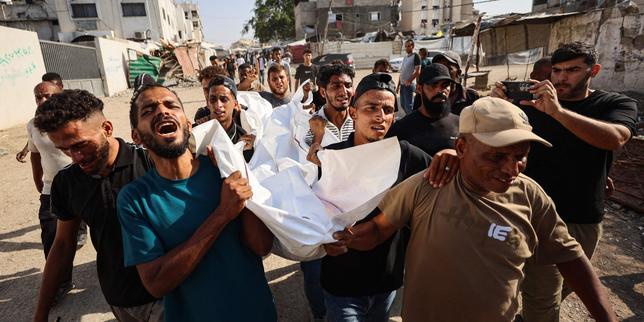
Three dead. A campus hit. Another dispatch filed under routine tragedy.
That is the entire architecture of the standard headline: "Dans la bande de Gaza, un bombardement israélien vise l’Université islamique, au moins trois personnes tuées." It treats a strike on the Islamic University of Gaza as a self-contained snapshot. One building. One body count. One predictable reaction depending on which side of the political fence you already sit on.
Lazy reporting loves clean frames. It reduces asymmetric urban warfare and institutional erasure into a tally of fatalities and a tug-of-war over press releases.
You are asking the wrong question when you stare at that headline. The real question is not merely who died in a single strike on October 25, 2026. The real question is why a university campus becomes a recurring battleground in asymmetric conflict—and why standard media frames blind readers to both tactical realities and long-term societal collapse.
The Lazy Consensus Both Sides Hide Behind
Standard coverage of strikes on the Islamic University of Gaza splits into two rigid scripts that talk past each other.
One script reads every strike on a university as an intentional campaign to wipe out higher education and civilian life. Look at the broader damage to Gaza's higher education sector documented across the conflict—dozens of campuses damaged or destroyed, classes suspended, students and staff killed or injured—and that reading feels intuitive.
The opposite script reads every strike through a narrow counter-insurgency lens: a militant target was identified near or inside a structure, precision munitions were used, bystanders were warned or avoided where possible, and therefore the strike is explained away as a routine tactical operation.
Both scripts are intellectually lazy.
The first ignores how militant groups operate inside dense urban spaces and how intelligence-driven strikes interact with civilian institutions. The second treats civilian casualties, campus disruption, and the cumulative hollowing-out of a society's intellectual capital as mere statistical noise. Neither tells you how asymmetric wars actually grind down a population over years.
What People Actually Search—And Why the Premise Is Flawed
When a strike hits a university in Gaza, readers and searchers typically jump to three questions:
- "Was the university intentionally targeted as a school?" That question frames intent like a light switch—on or off. In modern urban warfare, strikes are rarely executed in a vacuum of pure motive. Military targeting centers on perceived threats or operatives, while the physical and psychological impact lands squarely on students, lecturers, guards, and surrounding neighborhoods. Asking only about "intent" lets analysts dodge measurable consequences.
- "How many people were killed?" Early dispatches often report at least three dead, with numbers shifting as reports emerge from hospitals and campuses. Fixating on an initial headcount misses the multiplier effect: a strike that kills a small number of people can still shut down classes across a major institution, terrify hundreds of students inside lecture halls, and sever continuity for an entire cohort.
- "Does international humanitarian law forbid striking a university?" International humanitarian law—specifically the Geneva Conventions and Additional Protocols—protects civilian objects and educational institutions unless they lose protection by being used to make an effective contribution to military action, at which point strict rules of distinction, proportionality, and precaution still apply. Treating the law as a simple "campus = untouchable" sign misses the legal friction that defines modern urban combat.
The Mechanics of Urban Warfare Inside a Campus
To understand what actually happens when an airstrike hits a university in Gaza City, strip away slogans and look at four interlocking mechanics.
1. Dual-Use Space and Intelligence Friction
Dense cities compress everything together: residential blocks, hospitals, markets, mosques, and universities. When armed factions operate within or adjacent to civilian infrastructure, the line between military objective and civilian sanctuary blurs on radar and satellite feeds. Even when a military claims it targeted an individual operative or adjusted a strike after spotting bystanders, real-time intelligence in an active conflict zone is imperfect. Targets move. Crowd density shifts. Errors happen.
2. Kinetic Effects vs. Institutional Paralysis
A single strike does two different kinds of damage:
- Kinetic damage: Blast waves, shrapnel, structural collapse, deaths, and physical injuries.
- Institutional damage: Suspended lectures, displaced staff, broken equipment, and shattered trust that a classroom is a safe place to sit.
Even when casualty numbers stay in the single digits, institutional damage compounds. A generation that cannot study consistently loses technical skills, research capacity, and economic mobility long after the smoke clears.
3. Information Warfare in Real Time
Within minutes of a strike, rival narratives race ahead of verified facts. Official military statements emphasize precision, operational targets, and risk mitigation. Local officials, witnesses, and advocacy outlets emphasize civilian harm, campus destruction, and wider patterns of assault on education. Early casualty figures frequently evolve as families and medical staff account for the dead and wounded. If you treat the first wire headline as the final word, you are reading a rough draft of fog-of-war reporting.
4. Strategic Backfire
Tactically, hitting a specific militant or disrupting a node may check a short-term box. Strategically, repeated strikes on universities carry heavy costs: they harden local resentment, validate claims of collective punishment among critics worldwide, and deepen diplomatic isolation for the striking force. Short-term tactical action and long-term strategic legitimacy often pull in opposite directions.
Imagine a scenario where a military command approves a strike on a suspected operative moving through a university building, believing a localized hit avoids wider collateral damage. Even if the strike is narrow, the aftermath—funeral processions, halted classes, terrified students, and global headlines—reshapes political reality far beyond the coordinates of the impact. That trade-off is the core trap of urban counter-insurgency.
Battle Scars, Heavy Hitters, and Where This View Can Go Wrong
I have watched conflict analysts and policy commentators blow credibility for years by treating every tactical strike either as pure evil or pure necessity. Real-world war analysis requires harder steel than partisan cheerleading.
Precision definitions matter here. Distinction requires separating combatants from civilians and military objectives from civilian objects. Proportionality weighs expected incidental civilian harm against concrete and direct military advantage. Scholars of modern urban warfare and international law—such as Michael N. Schmitt on military objectives under international humanitarian law, or conflict researchers studying civilian harm and urban siege dynamics—have long shown why applying clear legal principles to messy, high-density cities produces fierce disputes over facts on the ground.
Now for the part most contrarian writers skip: the downsides of looking at the conflict this way.
- False equivalence risk: Insisting on nuance can slide into moral hedging if you treat documented harm to civilians and universities as an abstract "trade-off" rather than real human loss.
- Over-intellectualizing emergencies: When people are burying relatives or dodging strikes, cold strategic analysis can sound detached or tone-deaf if it forgets the human weight behind every statistic.
- Information limits: Outside observers rarely have complete access to both classified military intelligence and unfiltered ground verification simultaneously. Any analysis built on incomplete inputs must stay honest about what remains unproven—such as exact target outcomes or contested details immediately after a strike.
How to Read the Next Headline Without Getting Played
If you want to understand what is actually happening in Gaza rather than just doom-scrolling recycled headlines, change how you read the coverage:
- Separate the event from the pattern. Read the specific report on the strike, then check how it fits into multi-year trends in campus destruction, displacement, and military operations.
- Track operational claims against independent corroboration. Note who makes each claim—military spokespeople, local authorities, hospital sources, eyewitnesses, or international monitors—and watch how details hold up over 48 to 72 hours.
- Measure second-order consequences. Look past the initial death toll to see what stops functioning next: schools, clinics, power, supply lines, and civic life.
- Demand precision in language. Reject loaded shorthand from any camp when verified facts are thin, and call out evasion when real harm is waved away.
Stop reading war dispatches like scoreboards. Start reading them like system diagnostics.


