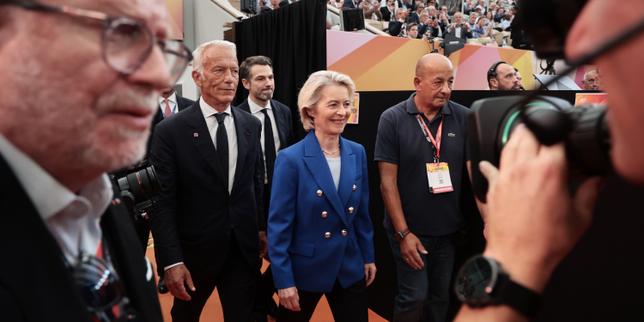
French corporate leaders are mad. They are tired of drowning in paperwork, paying record energy prices, and watching foreign competitors play by entirely different rules. When Ursula von der Leyen stepped up to face these frustrated executives, the tension in the room was palpable. You cannot blame the business community for feeling bitter. For decades, they bought into the grand European dream, only to find themselves shackled by a mountain of bureaucratic red tape while global rivals surge ahead.
Brussels has a massive reality check on its hands. The European industrial base is bleeding out, caught between soaring energy costs at home and aggressive state-subsidized competition from abroad. Over half of European production now faces direct pressure from Chinese manufacturing, while critical supply chains rely almost entirely on outside powers. Von der Leyen tried to soothe the restless crowd by promising an economic bloc that produces, invests, and protects. Yet, words alone won't fix structural paralysis.
The Triple Shock Crushing French Industry
Factories across France face a brutal combination of economic hurdles. It is not just one bad policy or a single unfortunate quarter. It is a compounding crisis.
- Energy pricing: French manufacturers pay vastly more to keep the lights on compared to their American or Asian counterparts.
- Regulatory bloat: Compliance requirements drain internal resources away from actual innovation and product development.
- Unfair trade: Subsidized imports undercut local producers who must adhere to stringent domestic environmental standards.
When you talk to factory owners in regions like Auvergne-Rhône-Alpes or Grand Est, the sentiment is identical. They want to invest locally, but the economic math rarely works out. Why build a new plant locally when regulations penalize growth at every single turn? Von der Leyen's response hinges on creating a unified industrial strategy, but local executives have heard endless promises before. They want execution, not another five-year roadmap filled with bureaucratic milestones.
The Talent Shortage Threatening Growth
Money and energy regulations represent only half the battle. Companies cannot find workers to fill specialized industrial jobs. Two out of three small and medium enterprises report severe hiring difficulties for qualified technical roles.
Schools aren't pumping out the right skill sets fast enough. The labor market lacks fluidity across borders, meaning talent trapped in high-unemployment zones cannot easily move to where factories desperately need hands. The Commission has floated mobility packages and a social security passport to ease cross-border employment, but implementation moves at a glacial pace compared to fast-moving market shifts.
Rebuilding Trust or Losing Ground Permanently
If Europe wants to keep its industrial champions from packing up and moving overseas, the leadership in Brussels must radically shift gears. Protectionism isn't a dirty word anymore when your domestic market is under siege. European companies need immediate relief on energy prices, a massive pruning of redundant directives, and targeted investments that reward production rather than penalize carbon output blindly.
French executives haven't completely shut the door on the European project. Their frustration comes from a place of deep care for the continent's economic sovereignty. If Brussels continues to ignore the ground-level warnings from factories and workshops, those disappointed romantics will eventually look elsewhere for their future.
Von der Leyen unveils industrial strategy
This video provides additional context on the political and industrial pressures shaping Ursula von der Leyen's economic strategy for Europe.
http://googleusercontent.com/youtube_content/1