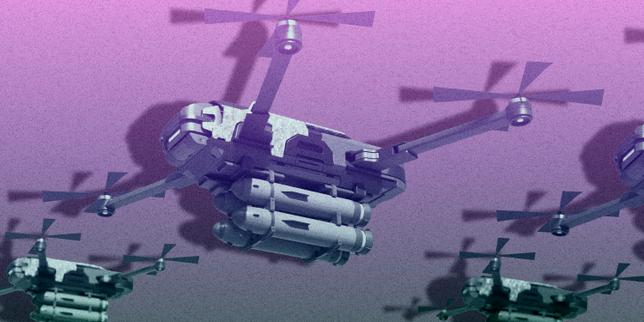
France is finally waking up to the reality of modern warfare. For years, the French military watched conflicts in Nagorno-Karabakh and Ukraine from a distance, realizing their expensive, heavy hardware lacked a crucial shield. Drones. Cheap, expendable, and deadly quadcopters have completely changed how armies fight. The French government noticed, launching a flurry of programs to fix the gap. But let's be honest. The current French strategy for military drones is a band-aid on a gaping wound. The money allocated in the latest Military Programming Law (LPM) spanning 2024 to 2030 looks impressive on paper, but it doesn't match the terrifying speed of industrial warfare.
You can't fight a high-intensity conflict with a boutique fleet of perfectly engineered, overpriced prototypes. You need mass. You need attrition-ready factory lines. Right now, France has a cultural obsession with high-tech perfection that is actively crippling its ability to deploy military drones at scale.
The Illusion of the French Drone Upswing
The French Ministry of Armed Forces loves to talk about its new-found momentum. They point to the rapid acquisition of Aarok MALE (Medium-Altitude Long-Endurance) drones developed by Turgis & Gaillard. They highlight the Integration of micro-drones like the Parrot Anafi USA into standard infantry units. The defense budget boasts a cool 5 billion euros dedicated solely to unmanned systems over the next few years.
It sounds great. It's not enough.
Consider the sheer consumption rate of unmanned aerial vehicles (UAVs) on modern battlefields. Reports from the Royal United Services Institute (RUSI) indicate that Ukraine loses roughly 10,000 drones per month. Read that again. That is not a typo. Ten thousand a month. France’s entire planned inventory across all services doesn't even hit a fraction of that number for the decade.
The strategic mistake lies in treating these systems like mini-fighter jets. The French procurement agency, the DGA (Direction Générale de l'Armement), operates with a bureaucratic mindset suited for the 1990s. They spend years drafting specifications, testing for every possible edge case, and demanding gold-plated systems that cost hundreds of thousands of euros per unit. When a single jammer or a 50-dollar shoulder-fired rocket can knock that drone out of the sky, the math just doesn't work.
The Mass Production Bottleneck France Ignores
To understand why France lags, you have to look at the domestic supply chain. France possesses incredible aerospace engineers. Dassault, Thales, and Safran can build world-class electronics. What they can't do is pump out 500 FPV (First-Person View) strike drones a day.
French Drone Strategy vs Battlefield Reality
-----------------------------------------------------------------
Metric              French Approach           Battlefield Demand
-----------------------------------------------------------------
Unit Cost           High (Gold-plated)        Low (Disposable)
Production Cycle    Years of R&D              Days/Weeks iteration
Supply Chain        Strictly Domestic/EU      Agile, commercial tech
Philosophy          Zero-failure tolerance    Acceptable attrition
The French defense industrial base relies on a highly protected, slow-moving ecosystem. If a French startup wants to build a military drone, they face a mountain of regulatory paperwork. They must certify components to stringent military standards. Meanwhile, companies in Eastern Europe buy commercial carbon fiber frames, solder off-the-shelf flight controllers, attach a 3D-printed trigger mechanism, and send it to the front lines within weeks.
France wants sovereign control over its tech stack. That's admirable. But trying to build every single motor, battery, and radio chip inside French borders kills speed. If you don't have the industrial capacity to build electric motors by the millions, you don't have a drone industry ready for a real war. You have a luxury laboratory.
The Aarok and Patroller Dilemma
Take a look at the tactical level. The Safran Patroller, a tactical drone meant to support French army corps, suffered years of delays and a high-profile crash during testing. By the time it officially entered service, the global understanding of how to use these aircraft shifted. Large, slow, unstealthy drones are easily tracked by modern air defense networks unless you have total air superiority.
Then there is the Aarok, a heavy prototype revealed at the Paris Air Show. It's a capable machine, designed to carry heavy payloads and perform intelligence missions. But it operates in a price bracket that makes it a scarce asset. If a commander is terrified of losing a multi-million-euro asset, they won't deploy it aggressively. That defeats the entire purpose of unmanned systems.
Software Over Hardware Is the Missing Link
The French military remains fixated on the physical drone. They worry about wingspans, engine efficiency, and payload weight. They are missing the real battleground. Software.
Modern electronic warfare can completely blind a standard drone. Russian jamming systems regularly drop GPS signals and sever the radio links between pilots and aircraft. The only way to survive is through autonomy. Drones need terminal guidance systems driven by computer vision. They need to recognize a tank, a radar dish, or a trench line without a human operator guiding the sticks.
Critical Weaknesses in French Procurement
1. Obsession with heavy, multi-million-euro platforms.
2. Bureaucratic certification processes that take years.
3. Lack of large-scale domestic manufacturing for basic electronic components.
4. Slow adoption of AI-driven, jam-resistant terminal guidance.
While French military doctrine emphasizes the presence of a "human in the loop" for ethical and operational reasons, this philosophical stance slows down tactical execution. When your radio signal is jammed, a human in the loop means a crashed drone. French labs work on artificial intelligence, but getting those algorithms out of the research center in Toulouse and onto a muddy field takes way too long.
Actionable Steps to Fix French Drone Doctrine
France cannot just throw more money at old defense contractors and hope for a breakthrough. The entire framework needs a hard reset.
First, the DGA needs to split its procurement tracks. Keep the long-term projects for strategic bombers and nuclear submarines. But create an express track for small, disposable UAVs. This track should bypass standard military certification entirely. If a drone works 80% of the time and costs 2,000 euros, buy it. Buy thousands of them.
Second, embrace commercial tech. Stop trying to reinvent the electric motor. Use the civilian industrial base. Companies making agricultural drones or racing quadcopters have mastered cheap manufacturing. Partner with them directly, fund their factories to scale up, and ruggedize their products for field use rather than building military-only systems from scratch.
Finally, fix the training pipeline. Every single French infantry squad should have multiple drone operators as a standard rule, not just specialized tech units. Soldiers need to treat quadcopters like ammunition. You use them, you lose them, you open a new box. Until the French military changes its culture from treating a drone as a prized aircraft to treating it like a high-tech hand grenade, the country will remain dangerously unprepared for the future of conflict.