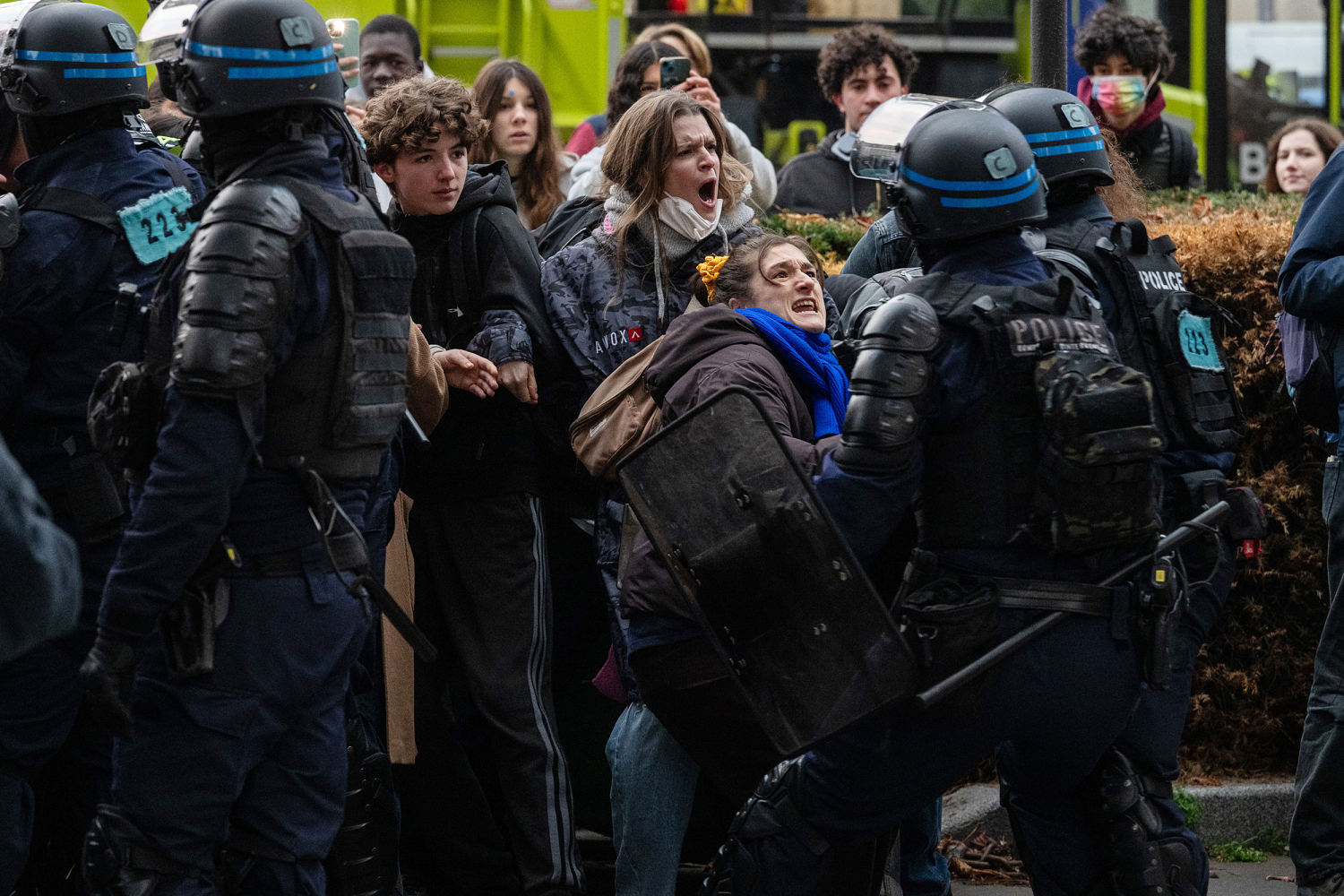
Turn on any English-language cable network during a French general strike and the script never changes. Burning barricades in Paris. Tear gas drifting past Haussmannian balconies. Anchors shaking their heads at a nation supposedly allergic to basic math and determined to set its own economy on fire.
That narrative is lazy, comforting to foreign observers, and completely wrong.
Mainstream coverage of "Black Thursday" protests treats French street mobilization as an erratic emotional outburst—a romantic, self-sabotaging tantrum thrown by spoiled workers who refuse to accept fiscal reality. Look closer at the mechanics of the Fifth Republic, the actual data on French labor productivity, and the structural design of the European labor market, and the picture flips. France is not breaking. France is executing a predictable, institutionalized negotiation protocol that happens in the street because the constitution deliberately locked unions out of the legislature.
If you want to understand why trains stop, refineries lock their gates, and riot police deploy in Lyon, Marseille, and Paris every few years, stop reading the riot porn. Start reading the constitutional architecture.
The Myth of the Lazy French Worker
Every time a transport union calls a nationwide walkout, pundits trot out the same tired caricature. They point to the 35-hour workweek, generous pension entitlements, and early retirement ages as proof that France is a museum economy coasting on borrowed time.
The numbers tell a different story.
According to data consistently tracked by the Organisation for Economic Co-operation and Development (OECD), French labor productivity per hour worked ranks among the highest in the G7, routinely sitting neck-and-neck with Germany and trailing only the United States among major economies. When French workers are on the clock, they generate enormous output per hour. The lower total annual hours worked per capita in France compared to the US is not evidence of laziness; it is a deliberate social choice to distribute gains through leisure time and longer vacations rather than purely through private cash wages.
Furthermore, the framing of these protests as a rejection of "inevitable" economic reform ignores a basic macro-fiscal reality. France has one of the highest tax-to-GDP ratios in the developed world—hovering around 45 percent—paired with public social spending exceeding 30 percent of GDP. For the French middle and working classes, high payroll contributions are accepted under an explicit social contract: you surrender a massive slice of your gross paycheck today in exchange for guaranteed healthcare, subsidized higher education, and a predictable retirement tomorrow.
When a government alters the retirement age or cuts unemployment insurance, French workers do not view it as a technocratic budget adjustment. They view it as unilateral breach of contract. Imagine paying into a private annuity for thirty years, only for the insurer to announce five years before payout that you must keep paying premiums for two extra years while receiving less back. You would sue. In France, where administrative courts move slowly and parliamentary opposition is structurally neutered, you march.
Why French Protests Happen in the Street Instead of Parliament
To understand why "Black Thursday" escalates so rapidly into national paralysis, you have to examine Charles de Gaulle’s 1958 constitution.
The Fifth Republic was engineered specifically to cure the chronic parliamentary instability of the Fourth Republic, where governments collapsed every few months. De Gaulle and his legal architect, Michel Debré, created an executive presidency with sweeping powers and weak legislative checks. Most notably, Article 49.3 of the French Constitution allows the Prime Minister to force legislation through the National Assembly without a direct vote, unless the opposition successfully passes a vote of no confidence.
Think about what that does to pressure valves in a democracy.
In Germany, sectoral unions like IG Metall sit inside corporate supervisory boards under the Mitbestimmung (co-determination) system. Labor disputes are hashed out in boardrooms before a single factory floor goes cold. In the United States, labor disputes are decentralized, company-by-company battles fought through unionization drives and localized strikes.
In France, union density is remarkably low—roughly 8 to 10 percent of the workforce, one of the lowest rates in Europe. Yet French labor law extends collective bargaining agreements across entire industries regardless of union membership. Because unions lack large dues-paying war chests and possess zero institutional veto power inside a parliament dominated by executive decrees, their only credible leverage is demonstration capacity.
A "Black Thursday" mobilization is not a breakdown of French democracy. It is the French legislative amendment process.
When the Confédération Générale du Travail (CGT) or the more moderate Confédération Française Démocratique du Travail (CFDT) calls a general strike, they are demonstrating to the Élysée Palace that the social cost of implementing a decree outweighs its fiscal savings. History proves the tactic works. In 1995, Alain Juppé’s government retreated from pension overhauls after three weeks of winter transport strikes. In 2006, Jacques Chirac scrapped the First Employment Contract (CPE) after massive student and union marches forced his hand. Even when governments push reforms through—as Emmanuel Macron did with the 2023 pension overhaul—the political capital burned in the street effectively paralyzes the rest of the administration's domestic agenda for years.
The Media’s Favorite Optical Illusion
I have watched international markets panic over Paris protest footage for two decades, and every time, asset managers who mistake television optics for sovereign risk leave money on the table.
Cable news cameras gravitate toward a specific 500-meter radius around Place de la République or Place de la Bastille. They film the Black Bloc—a fringe, decentralized contingent of radical anti-capitalist agitators who infiltrate peaceful union marches specifically to smash bank windows, torch municipal trash bins, and provoke tear gas volleys from the Compagnies Républicaines de Sécurité (CRS).
Conflating the Black Bloc with the French labor movement is analytical malpractice.
A typical "Black Thursday" mobilization involves hundreds of thousands—sometimes over a million—schoolteachers, air traffic controllers, railway engineers, hospital nurses, and municipal clerks walking peacefully behind union banners and sausage grills. Meanwhile, a few hundred masked youths on the flanks engage in choreographed street theater with riot police.
The visual is explosive. The economic impact is vastly overstated.
Let’s look at the actual macroeconomic footprint of a national strike day in France. During the peak months of the 2023 pension strikes—some of the largest in modern French history—the French national statistics agency (INSEE) estimated the direct drag on quarterly GDP growth at roughly 0.1 to 0.2 percentage points. Why so small? Because modern service economies absorb single-day disruptions with remarkable elasticity.
- Remote work buffers commuter shocks: White-collar workers in La Défense simply open their laptops at home when the RER commuter trains stop running.
- Deferred consumption rebounds: Shoppers who avoid central Paris on Thursday buy their groceries and retail goods on Saturday.
- Industrial output catches up: Factories and logistics hubs adjust shift schedules over subsequent weeks to clear backlogs.
The real economic cost of French social conflict is never the broken glass on Boulevard Voltaire. It is the permanent risk premium baked into French sovereign debt spreads over German Bunds, and the hesitation of foreign direct investors who fear unpredictable regulatory reversals.
Answering the Questions Foreign Observers Get Wrong
When headlines about French strikes trend globally, search engines light up with variations of the same naive questions. Dismantling the premises behind them reveals how badly the outside world misunderstands European political economy.
Are French strikes actually effective, or do they just hurt ordinary citizens?
Both things happen simultaneously, and that friction is the entire point. A strike that inconveniences nobody is a parade. Transport unions like the SNCF railway workers and RATP Paris metro operators wield asymmetric power precisely because shutting down urban transit holds the broader economy hostage.
Does it alienate commuters? In the first forty-eight hours, yes. Yet polling across multiple French strike waves consistently shows a phenomenon that baffles Anglo-Saxon commentators: majority public sympathy for the strikers often persists even while commuters are stuck walking miles to work. French citizens view public sector unions as the frontline infantry fighting to defend social protections that private sector workers lack the job security to strike for themselves. When railway workers strike, an accountant in Lyon often sees them fighting for his pension too.
Is France heading toward sovereign debt default because of its refusal to cut spending?
No. France faces a serious structural deficit problem—with public debt hovering above 110 percent of GDP and persistent budget deficits breaching European Union fiscal rules—but equating street protests with imminent sovereign default is nonsense.
France issues debt in euros, backed by the deep institutional architecture of the Eurozone and the European Central Bank’s Transmission Protection Instrument (TPI), which exists specifically to prevent unwarranted fragmentation in Eurozone bond markets. Furthermore, French households maintain one of the highest savings rates in Europe—consistently around 17 to 18 percent of disposable income—creating a massive domestic capital pool. France’s fiscal challenge is a slow-motion squeeze on public investment and debt-servicing costs, not a sudden Greek-style liquidity cliff triggered by a Thursday walkout.
Why doesn't the French government just crush the strikes like Thatcher or Reagan did?
Because France is neither 1980s Britain nor 1980s America, legally or culturally.
In 1981, Ronald Reagan fired 11,345 striking PATCO air traffic controllers because federal employees were legally barred from striking. In France, the right to strike (droit de grève) is explicitly enshrined in the preamble to the 1946 Constitution and carried directly into the current 1958 Constitution. Firing a worker for participating in a legal strike is not merely difficult; it is a constitutional violation that courts will overturn immediately with punitive damages.
While the French state possesses the power of réquisition—forcing essential workers like refinery operators or nuclear plant technicians back to work under threat of fines or jail if national energy security is threatened—deploying it too aggressively backfires instantly. In 2022, when the government requisitioned striking Esso-ExxonMobil refinery workers, unions across completely unrelated sectors joined the strikes out of pure solidarity against perceived state authoritarianism.
The Uncomfortable Truth About the French Model
Here is where the contrarian view has to confront its own blind spots. Defending the logic of French protests does not mean pretending the French economic model is healthy. It isn't.
The street-negotiation system comes with brutal, long-term side effects that union leaders rarely acknowledge. By defending rigid labor protections and high payroll taxes at all costs, French unions have inadvertently created a dual-tier labor market.
- The Protected Insiders: Older workers on permanent contracts (CDI - Contrat à Durée Indéterminée) enjoy fortress-like job security, generous severance rules, and predictable wage progression.
- The Precarious Outsiders: Young entrants, immigrants, and low-skilled workers are trapped in a revolving door of short-term contracts (CDD - Contrat à Durée Déterminée), internships, and structural youth unemployment that chronically outpaces Germany, the Netherlands, and the UK.
Companies terrified of the legal nightmare required to lay off a permanent employee during a downturn simply refuse to hire permanent employees during an upturn. Meanwhile, raising the statutory retirement age—while deeply unpopular—is basic demographic arithmetic. In 1960, France had roughly four active workers supporting every retiree. Today, that ratio has collapsed to roughly 1.7 workers per retiree. You cannot out-march a demographic pyramid.
Yet the French political class bears equal blame for the impasse. Successive presidents have treated structural reform as an exercise in top-down technocratic imposition rather than genuine coalition building. Instead of negotiating comprehensive productivity pacts—trading pension adjustments for real wage growth, improved workplace conditions for older workers, and genuine corporate governance reform—Paris relies on constitutional shortcuts and riot police.
How to Actually Read the Next French Crisis
The next time "Black Thursday" dominates your news feed, ignore the breathless commentary predicting the collapse of the Fifth Republic. Watch three specific indicators instead to know whether a protest is mere routine theater or a genuine systemic rupture:
- The Union Front Unity: When the radical CGT and the reformist CFDT march together, the government is in real danger. The CFDT represents pragmatic, negotiation-oriented workers; if they are in the street, the government has overplayed its hand badly. When the CFDT stays home and only the CGT marches, the strike is routine noise.
- Refinery and Logistics Blockades: Street marches in Paris generate headlines, but blockades at fuel depots in Fos-sur-Mer or Normandy choke the real economy. Until trucks run out of diesel at regional distribution hubs, corporate France continues operating largely uninterrupted.
- Bond Yield Spreads (OAT-Bund): Watch the spread between French 10-year government bonds (OATs) and German 10-year Bunds. Institutional bond traders do not care about burning trash cans; they care about whether the French parliament can pass a coherent budget. When that spread widens sharply, political risk is turning into financial reality.
France’s streets are loud because its parliament is quiet. What looks from the outside like chaos is actually a society enforcing its boundary lines the only way its constitution allows. The barricades will go up on Thursday, the tear gas will clear by Friday morning, and by Monday, the highest-productivity workforce in Europe will be back at its desks—waiting for the next decree.