Steam changes the rules of a room.
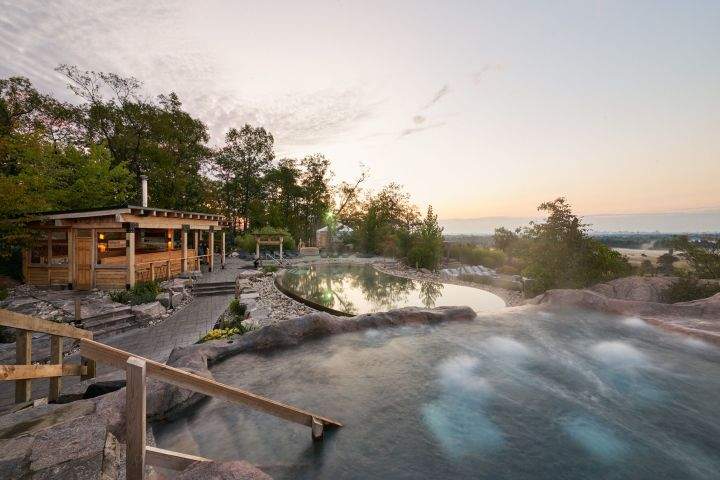
Walk into a thermal bathhouse on a freezing Tuesday afternoon in Chelsea, Quebec, and the air wraps around you like a heavy wool blanket, smells faintly of eucalyptus and wet cedar, and muffles every footstep until the outside world feels miles away. You surrender your phone at the locker. You trade your armor for a white terrycloth robe and a pair of rubber sandals. By the time you step out onto the heated stone walkways of Nordik Spa-Nature, North America’s largest spa, you have agreed to an unspoken contract: I will lower my guard here, because this is a sanctuary. Also making news recently: Soft Power Choreography Why Royal Cultural Participation in the Bahamas Operates as a Strategic Retention Mechanism.
Silence. That is the core currency of the thermal cycle. For decades, Nordik has built an empire on the promise that if you alternate between scorching Finnish saunas, freezing plunge pools, and quiet relaxation pavilions, the noise of modern life will dissolve. Millions of visitors have bought into that ritual, seeking refuge from burnout, grief, and the relentless hum of screens.
Yet behind the frosted glass and the rising mist, a deeply unsettling reality was taking shape—one that has forced the famed Quebec retreat to overhaul its physical space, retrain its staff, and confront a growing legal reckoning. Further information regarding the matter are explored by TIME.
When Sanctuary Turns Vulnerable
Consider a hypothetical evening in the baths—not a specific court filing, just the ordinary mechanics of a place designed for sensory deprivation. Imagine a guest, let us call her Claire, floating in an outdoor pool after dusk. The lighting is deliberately dim to soothe tired eyes. Steam rises three feet thick off the 104-degree water, blurring the silhouette of the person five feet away. By house rules, no one is permitted to speak above a whisper, and phones are strictly banned.
In an environment engineered to strip away vigilance, what happens when someone exploits the very architecture of calm?
For dozens of women who have come forward in recent years, that question is not a thought experiment. It is the center of a proposed class-action lawsuit filed in Quebec Superior Court against Nordik Spa-Nature, alleging that guests were subjected to sexual assaults by other patrons—and in some instances, by staff members—while management failed to provide adequate protection or response.
The allegations paint a stark contrast to the serene marketing brochures. According to court filings and public reporting surrounding the lawsuit, incidents reportedly occurred in dimly lit pools, steam rooms, and massage spaces between 2016 and the early 2020s. Plaintiffs allege that when they reported unwanted touching or assault to staff, the institutional response was often slow, dismissive, or disorganized, leaving survivors feeling isolated in the very place they came to heal.
The irony is sharp enough to cut. The features that make a Nordic spa restorative—darkness, quiet, semi-nudity, the absence of cameras or phones—are the exact conditions that make accountability difficult when boundaries are crossed.
The Anatomy of an Overhaul
Public pressure and legal scrutiny have a way of accelerating change faster than internal audits ever could. Following intense media coverage and the mounting class-action proceedings, Nordik Spa-Nature announced a sweeping set of new safety measures across its flagship Chelsea property.
On paper, the updates read like a checklist of hospitality risk management. On the ground, they represent a fundamental shift in how a luxury wellness facility polices its own tranquility.
First came visibility. Nordik introduced increased lighting in previously shadowy outdoor pools and transitional walkways—a delicate balancing act between maintaining ambiance and eliminating blind spots where predators could operate unseen. Alongside better illumination, the spa expanded its network of security cameras in common corridors, locker room entrances, and perimeter zones, while maintaining strict privacy boundaries inside changing areas and treatment rooms.
Second came human presence. The company significantly increased the number of dedicated security personnel and trained "ambassadors" patrolling the baths, saunas, and relaxation pavilions. Instead of relying solely on lifeguards focused on water safety, staff were specifically tasked with behavioral monitoring—watching for lingering, boundary-pushing, or signs of distress among guests.
Third came reporting and response protocols. Recognizing that trauma freezes the voice, especially in a "silent zone" where guests are conditioned not to make a scene, Nordik implemented clearer, more accessible channels for reporting misconduct immediately. Staff underwent mandatory training on trauma-informed intervention, consent, and de-escalation, backed by stricter zero-tolerance policies that result in immediate expulsion and police involvement rather than quiet refunds or vague warnings.
These changes did not emerge in a vacuum. They are the direct result of survivors refusing to keep the spa’s enforced silence once they walked back out to the parking lot.
The Invisible Contract of Wellness Tourism
To understand why the Nordik Spa controversy resonated so deeply across Canada and beyond, you have to understand the psychology of the modern wellness industry.
Over the last fifteen years, spa culture has shifted from an occasional indulgence to a perceived necessity. Burnout is epidemic. People do not visit thermal baths merely for skincare; they go for nervous-system regulation. When you pay upwards of a hundred dollars for a day pass, you are buying psychological safety. You are paying for the right to close your eyes in a steam room without wondering who is sitting three feet to your left.
Think of a spa like a darkened theater. When the lights go down, the audience agrees to sit still, stay quiet, and trust that the strangers beside them will respect the invisible line of the armrest. If someone crosses that line in the dark, the victim faces an immediate, paralyzing social trap: Do I scream and shatter the room? Did I imagine it in the mist? Will anyone believe me if there are no witnesses?
In a thermal bath, that trap is amplified tenfold. You are wearing a swimsuit. Your hair is wet. You have no wallet, no phone, no keys—nothing in your hands except a towel. You are physically and socially disarmed.
For years, the wellness sector treated safety primarily as a matter of slip-resistant tiles, water chemistry, and lifeguard certifications. Interpersonal safety—protecting guests from other guests—was largely left to etiquette signs and good faith. But etiquette signs do not deter someone who has come to a crowded, steam-filled pool with predatory intent.
What Guests Actually Need to Know Now
Whenever high-profile safety upgrades are announced amid a lawsuit, a predictable skepticism follows. Is this genuine cultural transformation, or is it reputation management designed to insulate a brand before a judge rules on class-action certification?
The truth usually lives somewhere in the uncomfortable middle.
Litigation forces institutions to confront blind spots they previously rationalized away. Before the class action gained momentum, many hospitality venues operated under an outdated assumption: that visible security ruins the "vibe." Management worried that brighter lights or uniformed patrols would remind guests of airports and shopping malls, breaking the spell of escape.
What Nordik’s overhaul demonstrates is that the spell was already broken for anyone who felt unsafe. True relaxation is impossible without security. You cannot down-regulate your nervous system while hyper-vigilant.
For anyone planning a visit to Nordik Spa-Nature—or any large-scale thermal bathhouse—the practical reality has changed in tangible ways:
- The silent rule has an explicit exception. House rules now emphasize that silence never applies to personal boundaries or safety. Speaking up loudly in a quiet zone to stop unwanted contact is not a breach of etiquette; it is backed by staff policy.
- Patrols are visible and frequent. Guests will notice staff members circulating through outdoor baths and steam rooms at regular intervals, identifiable and approachable without needing to walk all the way back to the main reception building.
- Lighting is noticeably brighter after sunset. While still atmospheric, the deep shadows that once cloaked the corners of the infinity pools and cedar saunas have been dialed back to improve sightlines.
- Zero-tolerance enforcement is codified. Management has formalized partnerships with local law enforcement and victim advocacy groups to ensure incidents are documented and escalated rather than swept under the rug with complimentary vouchers.
Still, policies on a wall are only as strong as the lowest-paid employee on a busy Saturday night. When a spa hosts hundreds of visitors simultaneously, many of them consuming alcohol at the on-site lounges before re-entering the pools—a factor critics have frequently pointed out as an accelerant for boundary violations—the pressure on staff remains immense.
The Cost of Looking Away
I remember the first time I experienced a traditional Nordic bath circuit on a winter evening. The temperature outside was minus fifteen Celsius. Steam rose off the water in thick, ghost-like ribbons, so dense you could barely see your own outstretched hand. Someone brushed past my knee under the surface—an accidental bump in a crowded pool, nothing more—and yet my heart spiked instantly. For ten seconds, I sat completely frozen in the hot water, straining my eyes through the fog, trying to read the posture of a stranger whose face was obscured by mist.
Nothing happened. They murmured a quiet pardon and drifted away.
But those ten seconds taught me something permanent about sensory environments: when you remove sight and sound, instinct takes over. And if an institution has not built unmistakable, visible guardrails around that vulnerability, your body knows it before your mind does.
That is the real lesson sitting beneath the legal briefs in Quebec. A sanctuary is not defined by the thickness of its robes, the temperature of its saunas, or the number of awards hanging in its lobby. It is defined by what happens in the dark when someone tests the edges of the rules.
Nordik Spa-Nature has spent millions sculpting rock, water, and timber into a monument to stillness. Now, under the watchful eye of the courts and the public, it is learning a harder craft—proving that silence can protect the people inside it, rather than the ones who do them harm.
The steam still rises over the Gatineau Hills every morning at dawn, thick and warm against the cold air, waiting to see who will trust it again.