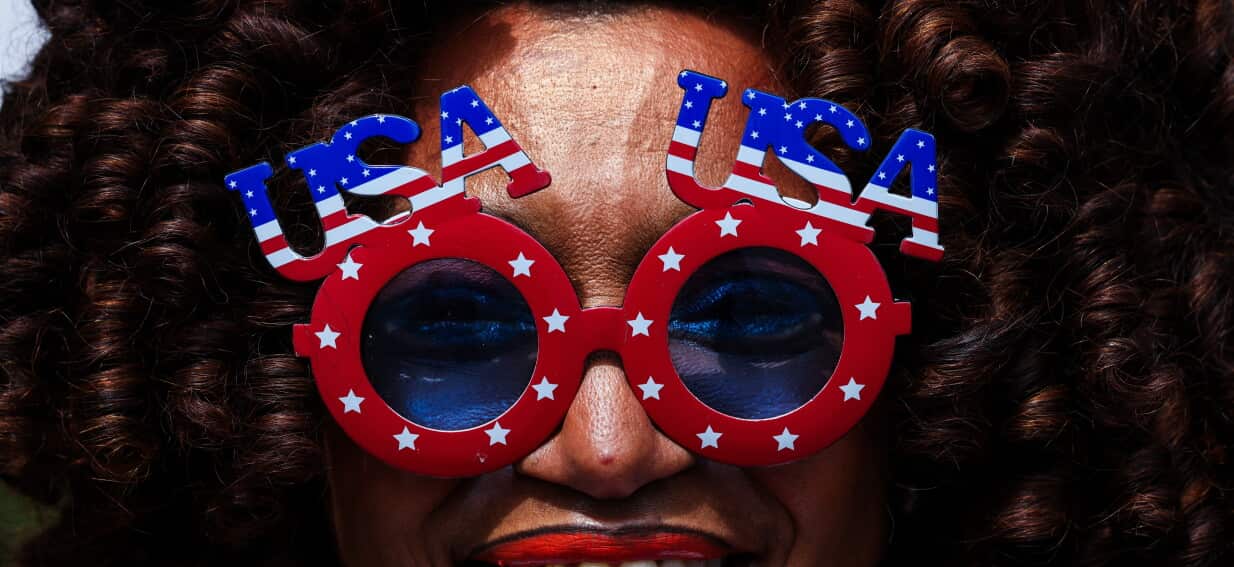
The sulfur sticks to the back of your throat long after the smoke clears. On the National Mall, the heat of a July evening doesn't dissipate; it just sits on your skin, heavy and damp, smelling of fried dough, cheap plastic flags, and the metallic tang of pyrotechnics. A quarter of a millennium. That is the number everyone kept repeating. Two hundred and fifty years since a group of wealthy radicals signed a document declaring that an experiment had begun.
To stand in the crowd was to feel the sheer weight of that duration. The fireworks were colossal, the kind of explosions that rattle your ribcage and force a momentary, involuntary silence from a hundred thousand people. For a fraction of a second, the light from above turned every face in the crowd the exact same shade of brilliant, blinding white, then crimson, then a deep, bruised blue.
But when the echoes faded into the Potomac, the silence didn't last. It never does.
Donald Trump took the stage against a backdrop of towering monuments, delivering a speech designed to evoke the grand mythos of American exceptionalism. He spoke of frontiers conquered, battles won, and a destiny written in the stars. To a significant portion of the audience, his words were a necessary anchor, a reassuring promise that the ground beneath their feet was still solid. They cheered with a fervor that felt almost desperate, as if the volume of their applause could drown out the fractures running through the foundation of the republic.
Yet, just a few blocks away, past the security perimeters and the ice cream trucks, a different kind of gathering was taking place.
They wore matching sunglasses, khaki pants, and baseball caps, moving with a chilling, synchronized discipline. White nationalists, emboldened by the cultural friction of a nation undergoing a protracted identity crisis, marched with flags of their own. They didn't see the 250th anniversary as a celebration of a universal ideal. They saw it as a tribal rallying cry.
This is the reality of the American milestone. It is not a unified chorus. It is a fierce, loud, and sometimes terrifying argument happening under a sky lit by millions of dollars of gunpowder.
Consider a hypothetical observer named Marcus. He is a high school history teacher from Ohio who saved up for nearly a year to bring his teenage daughter to Washington for this specific weekend. He wanted her to feel the history. He wanted her to stand where Lincoln stood, to look at the words etched into the stone of the Jefferson Memorial and feel a sense of shared ownership.
Instead, as they walked back to their hotel, they had to step off the sidewalk to avoid a column of masked men chanting slogans about blood and soil. Marcus told his daughter to look at her phone, to keep walking, to ignore them. But you cannot ignore the shaking in a child's hand.
The core conflict of this anniversary isn't about the past at all. It is about who owns the future.
The official narrative of the Semiquincentennial was supposed to be one of resilience. The numbers themselves are staggering when you look at them through the lens of global history. Most democratic experiments do not survive this long. They collapse under the weight of corruption, or they are torn apart by civil strife. By any objective metric of longevity, the United States has defied the odds. The economy remains an unyielding colossus, the cultural export of the nation dominates every corner of the globe, and its military might is unquestioned.
But statistics do not comfort a father trying to explain why men are marching in the streets of the capital with symbols of hate on the nation's birthday.
The ideological divide has ceased to be a mere disagreement over tax rates or infrastructure spending. It has become existential. On one side is a vision of America rooted in a specific, nostalgic interpretation of heritage—one that views change not as progress, but as erosion. On the other side is a vision that sees the traditional narrative as fundamentally incomplete, an unfinished project that has consistently failed to live up to its explicit promises.
When the president spoke of patriotism, he was invoking a version of the country that feels entirely real to his supporters. It is an America of small towns, industrial might, and unquestioning faith in the righteousness of the flag. To them, the criticisms leveled against the nation's history feel like a betrayal, an attempt to dismantle the very things that made the country great.
But for those standing on the periphery, that same language can feel exclusionary. The tragedy of the 250th anniversary is that the vocabulary of unity has been weaponized into a tool of division. The word "patriot" no longer describes someone who loves their country; it has become a partisan badge of entry.
The presence of white nationalists at the fringes of the celebration is not an anomaly. It is the predictable outcome of a culture that has allowed its civic immune system to weaken. When mainstream political discourse begins to flirt with the rhetoric of replacement and grievance, the extremes are always the first to mobilize. They don't hide in the shadows anymore. They march in the daylight because they believe the wind is at their back.
The sky eventually went black again. The crowds drifted toward the metro stations, leaving behind a carpet of crushed aluminum cans, discarded plastic glow sticks, and the faint, lingering smell of burnt powder.
We tend to look at milestones like a 250th anniversary as a destination, a point where we can stop, look back, and congratulate ourselves on surviving the journey. But history doesn't work that way. It doesn't pause for fireworks. The morning after the celebration, the same problems were waiting on the desk. The same anger was simmering on the airwaves. The same marchers were planning their next event.
Marcus and his daughter caught an early flight back to Ohio. On the plane, she finally asked him if the country was going to break. He didn't have a simple analogy to offer her. He couldn't tell her a reassuring lie because she was old enough to see the world clearly.
The American experiment was never guaranteed to succeed. It was just a wager made by men in linen coats who knew that human nature is inherently flawed. The next fifty years won't be decided by the speeches given on the National Mall or the size of the fireworks display. They will be decided in the quiet, uncomfortable spaces where we have to look at each other without the mask of ideology and decide if we still want to share a country.
Below the clouds, the landscape stretched out in an endless grid of roads, towns, and fields, silent and indifferent to the noise we make trying to define it.