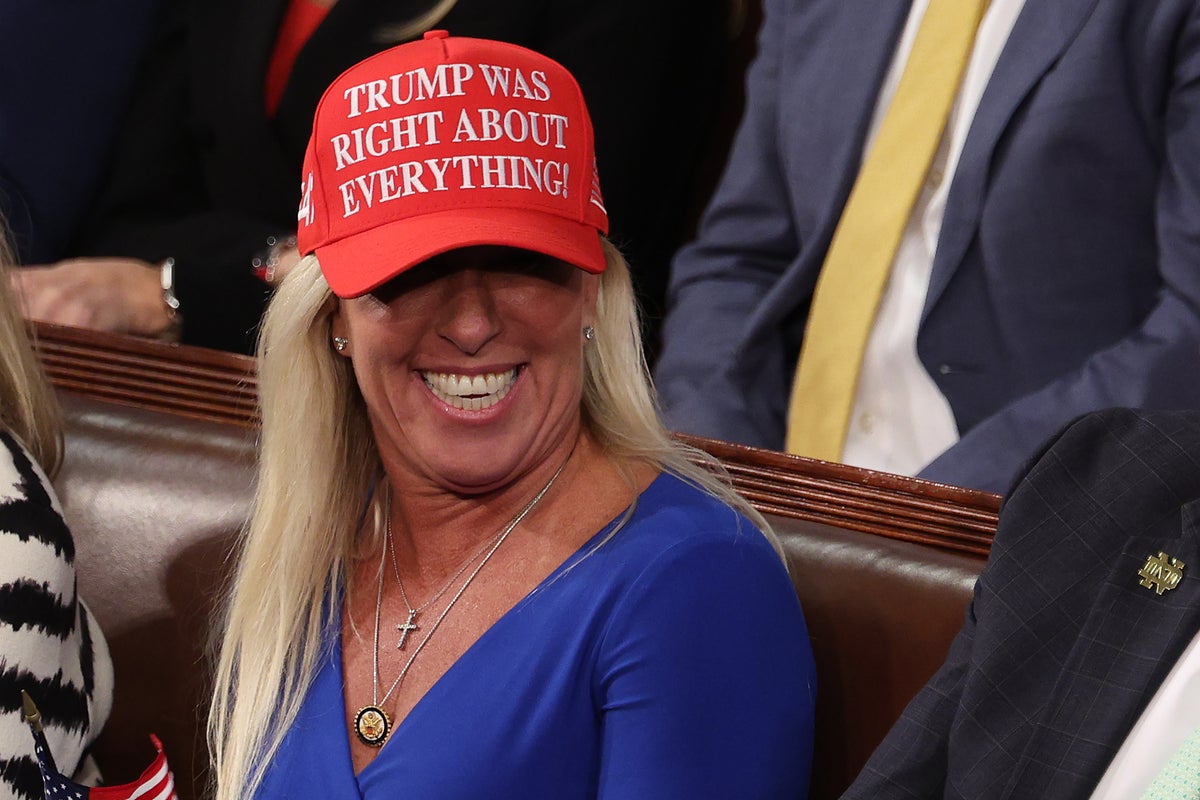
The primary mechanism of conservative media influence in the United States is currently undergoing a structural decoupling. This is not merely a political disagreement between a high-profile Representative and a legacy news outlet; it is an architectural failure in the feedback loop between content creators, platform distribution, and the core demographic of "Boomer" consumers. When Representative Marjorie Taylor Greene publicly critiques Fox News for "brainwashing" and "fake news," she is signaling a shift in the marginal utility of legacy cable news for the modern populist movement.
The Feedback Loop Collapse
Historically, the relationship between Fox News and the Republican base functioned as a closed-circuit system. The network provided the narrative framework, which the political class then adopted, creating a unified front for the electorate. This system relied on three specific pillars of stability:
- Distribution Monopolies: Before the proliferation of Rumble, Substack, and X (formerly Twitter), Fox News held a near-monopoly on high-reach conservative video distribution.
- Demographic Concentration: The "Boomer" cohort—defined here as the primary economic and voting bloc born between 1946 and 1964—retains a high propensity for linear television consumption.
- Narrative Alignment: The economic interests of the network (ad revenue, carrier fees) generally aligned with the tactical goals of the Republican National Committee.
This alignment has ruptured. The current friction emerges because the populist wing of the GOP now views Fox News as a "legacy" gatekeeper rather than a vehicle for disruption. Greene’s accusations of "brainwashing" reflect a strategic pivot toward decentralized media where the politician, not the network, controls the primary data stream.
The Cognitive Capture of Linear Television
The "brainwashing" claim, while rhetorically charged, points to a quantifiable psychological phenomenon: the high-frequency repetition of narrative frames within a closed information environment. For the demographic in question, linear television serves as a primary cognitive anchor. Unlike digital-native cohorts who engage in multi-source verification, the "Boomer" consumer often treats the cable news crawl and the nightly host's monologue as a definitive reality.
This creates a Cognitive Capture Ratio. When a single entity controls 70% or more of an individual's information intake, the entity effectively defines the boundaries of the "overton window" for that individual. Greene is arguing that Fox News has narrowed this window to exclude the more radical, populist elements of the party. By labeling it "fake news," she is attempting to break the trust-bond that sustains this capture ratio, forcing the audience to migrate toward unmediated digital platforms.
Economic Disincentives for Legacy Media
The tension is exacerbated by the differing economic models of a billion-dollar media corporation versus a political insurgent. Fox News must manage a complex risk profile that includes:
- Defamation Liability: Recent high-profile settlements have created a "cautionary tax" on the network’s editorial choices.
- Advertiser Retention: Unlike decentralized platforms, Fox is sensitive to corporate boycotts.
- Carriage Fee Stability: Maintaining presence on major cable providers requires a veneer of "news" legitimacy that populist firebrands often find restrictive.
Conversely, a politician like Greene operates on a Direct-to-Consumer (DTC) Attention Model. Her "revenue" is measured in donations, social media engagement, and primary votes. She benefits from maximum volatility and narrative friction. When Fox News attempts to "moderate" or "fact-check" to protect its corporate infrastructure, it creates a bottleneck for the populist message. The accusation of "fake news" is the tool used to bypass this bottleneck.
The Three Pillars of Media Disintermediation
To understand why this conflict is terminal rather than temporary, one must analyze the components of media disintermediation currently at play.
1. The Erosion of Editorial Authority
In the legacy model, an editor or producer decided what was "newsworthy." In the decentralized model, the "newsworthy" status is determined by algorithmic velocity. When a politician can reach 10 million followers directly on X, the "gatekeeper" function of a cable host becomes a liability rather than an asset.
2. The Valuation of Raw vs. Curated Data
The core of the "brainwashing" critique is that curated news is inherently manipulative. The populist base has developed a preference for "raw" data—unedited livestreams, leaked documents, and direct posts. Fox News, by its nature as a produced television product, cannot provide raw data. It must curate. This curation is now interpreted as a form of "faking" the news.
3. The Demographic Mortality of Linear TV
The "Boomer" audience is shrinking due to natural actuarial trends. As the audience ages, the total addressable market (TAM) for linear cable news declines. Younger conservative cohorts are already entirely digital. Greene is positioning herself for the post-cable era, recognizing that the "brainwashing" power of the TV set is a diminishing asset.
The Mechanism of Narrative Arbitrage
Greene is engaging in a form of narrative arbitrage. She identifies the "spread" between what the Fox News audience believes and what the network is willing to broadcast. By filling that gap with more aggressive rhetoric, she captures the "loyalty equity" of the viewer.
This creates a destructive cycle for the legacy network:
- If Fox News follows the populist right into more extreme territory, it increases its legal and advertiser risk.
- If Fox News stays the course, it loses the most engaged segment of its audience to "alternative" platforms.
- This loss of audience reduces the network's leverage with the political class, leading to more public attacks from figures like Greene.
Structural Vulnerabilities in the GOP Information Ecosystem
The Republican party currently lacks a centralized "Clearing House" for truth. This is a deliberate feature of the populist movement, but it creates a strategic bottleneck. Without a trusted arbiter like Fox News once was, the movement fragments into competing factions, each with its own "truth" generated by its own preferred influencers.
The second limitation of this fragmentation is the Loss of General Election Reach. While "alternative" media is highly effective for base mobilization, it has zero "crossover" appeal. Fox News historically functioned as a bridge—it was conservative, but it was still "The News" in many public spaces (airports, waiting rooms, gyms). As the base abandons Fox for more insular platforms, they lose the ability to influence the "median voter" who still consumes traditional media.
Quantifying the "Brainwashing" Variable
To deconstruct the "brainwashing" claim logically, we must look at the Persuasion Decay Rate. Information delivered via a trusted, authoritative source like a "News Channel" has a longer shelf life in the human brain than information delivered via a social media post. By attacking the "authority" of Fox News, Greene is effectively increasing the decay rate of their influence. If the audience views the host as a "liar" or a "shill," the information they provide is immediately discounted.
This is a high-risk strategy. If Greene successfully destroys the trust in Fox News, she destroys the most powerful tool for mass-conservative persuasion in the history of American media. The replacement—a chaotic swarm of influencers and podcasts—is harder to coordinate and easier for opponents to marginalize as "fringe."
The Cost Function of Narrative Control
For Fox News, the cost of narrative control has become prohibitively high. The network is essentially paying a "populism tax." To keep the audience, they must entertain theories that lead to legal jeopardy. To avoid legal jeopardy, they must alienate the audience.
The internal logic of the network is now defensive. They are no longer focused on "winning the day" but on "surviving the cycle." This defensive posture is what Greene identifies as "fake." It is not that the facts are necessarily false, but that the selection of facts is seen as a compromise with the "establishment."
Strategic Play
The shift from a centralized media model to a decentralized one is irreversible. For political strategists and stakeholders, the primary play is no longer about "securing a slot" on a major network. Instead, the focus must shift to Distributed Narrative Management.
- Direct Infrastructure Investment: Political entities must own their distribution channels (email lists, SMS, proprietary apps) to bypass the "gatekeeper" volatility of both Fox News and Silicon Valley platforms.
- Fragmented Content Deployment: Stop viewing the "conservative media" as a monolith. Content must be tailored specifically for the "Fox viewer" (linear, authoritative) versus the "X/Rumble viewer" (raw, aggressive, unedited).
- Authority Hijacking: When legacy outlets are attacked as "fake," the vacuum must be filled with "New Authority" figures—academics, data analysts, and practitioners who provide the veneer of objectivity while maintaining populist alignment.
The conflict between MTG and Fox News is not a spat; it is the sound of an old system breaking under the weight of a new technological and demographic reality. The "brainwashing" of the past is being replaced by the "algorithmic sorting" of the future. Success in this new environment requires a total abandonment of the legacy media playbook. Focus entirely on the cultivation of high-trust, high-frequency digital touchpoints that exist independent of any single corporate entity.