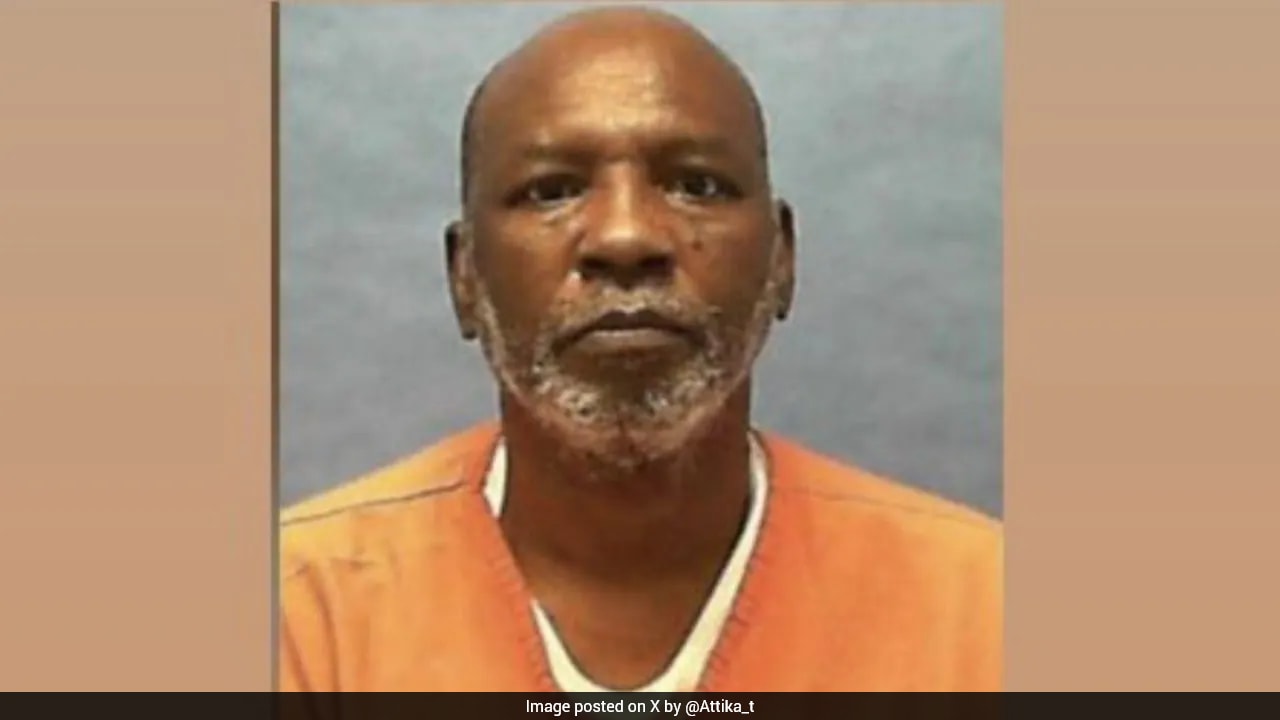
On a Tuesday evening inside the Florida State Prison near Starke, a 77-year-old man strapped to a gurney took several deep breaths and became the state's 18th execution of the year. William Reaves Jr., an aging Army veteran whose mind and body had weathered four decades behind bars, faced the lethal injection chamber for the 1986 murder of Indian River County Deputy Richard Raczkoski. His death was not merely the termination of a long legal saga; it served as a stark marker of an aggressive capital punishment surge that has made Florida an outlier in modern American jurisprudence.
The mechanics of the evening followed a cold, bureaucratic rhythm. The execution chamber curtains rose precisely at six o'clock. Asked for last words, Reaves offered none, stating simply that he did not have any. A three-drug protocol—a sedative, a paralytic, and a heart-stopping agent—was administered. Within minutes, the life of a man who had spent nearly half a century in the appellate wilderness was extinguished, pushing the state dangerously close to matching its modern record of 19 executions set just the year prior.
Yet the numbers alone fail to capture the profound legal and moral friction defining this era of capital punishment. Behind the grim statistics lies a complex machinery of state power, institutional exhaustion, and deeply fractured notions of accountability.
The Long Shadow of 1986
To understand why an elderly veteran was put to death for a crime committed during the Reagan administration, one must examine the glacial pace of capital appeals and the changing political climate of the state.
The original confrontation occurred outside a Vero Beach convenience store on September 23, 1986. According to court records, Reaves placed a 911 call from a public payphone, drawing Deputy Raczkoski to the scene. During their interaction, a firearm slipped from Reaves's clothing. A violent struggle ensued over the weapon, ending with the deputy being shot four times as he attempted to retreat.
Reaves fled across state lines, captured days later in Georgia, and was initially convicted and sentenced to death. But the wheels of justice wobbled early on. The Florida Supreme Court overturned that initial conviction due to a prosecutorial conflict of interest, forcing a complete do-over. A new jury convicted him again in 1992, setting off a multi-decade labyrinth of federal petitions, state motions, and constitutional challenges.
For forty years, the case crawled through courts while society shifted around it. Witnesses aged, prosecutors retired, and the legal arguments surrounding execution protocols evolved. By the time the U.S. Supreme Court declined an 11th-hour stay without comment on that Tuesday afternoon, Reaves was no longer the desperate young man who had grappled with a deputy in the Florida heat. He was a frail septuagenarian whose execution raised uncomfortable questions about the purpose of temporal retribution.
The Weight of Unaddressed Trauma
As execution day approached, a different kind of defense emerged that widened the scope of the debate far beyond the parameters of a standard legal appeal. More than one hundred military veterans banded together, dispatching an urgent plea to Governor Ron DeSantis to halt the lethal injection.
Their argument rested on a factor that the original trial juries in the early 1990s never heard: Reaves was a Vietnam War veteran rated 100% disabled by the Department of Veterans Affairs due to severe post-traumatic stress disorder. The coalition of veterans argued that the psychological wounds inflicted by combat and the subsequent failure of the state to account for those invisible injuries constituted a critical context that deserved executive clemency.
This dynamic exposes a recurring fault line in modern criminal justice. The intersection of military service, trauma, and violent crime creates a tangled web that courts are often ill-equipped to untangle decades after the fact. While service-connected trauma does not absolve an individual of taking a life, critics of the execution argued that executing a broken, aging veteran suffering from untreated combat trauma reflects an assembly-line approach to state-sanctioned killing rather than a measured application of justice.
The executive branch remained unmoved. Under Governor DeSantis, Florida has aggressively cleared out its death row, positioning itself as a national leader in executions at a time when many other states are abandoning the practice entirely or maintaining indefinite moratoriums.
The Illusion of Closure
Following the execution, the public statements from officials underscored the deep emotional chasm that surrounds capital punishment. Indian River County Sheriff Eric Flowers attended the execution and spoke candidly afterward, rejecting the notion that the event brought true justice.
"Would we all be so lucky to be 77 years old and to die so peacefully," Flowers remarked to reporters, expressing open disappointment with how humane and clinical the process appeared compared to the violent reality of the original crime. He drew a sharp line between administrative closure and moral justice, suggesting that waiting four decades for an elderly man to pass away via lethal injection falls short of a meaningful reckoning.
Conversely, surviving family members of the slain deputy voiced relief that a chapter spanning two generations had finally closed. The presentation of a memorial badge to the victim's brother served as a poignant reminder that while the state measures justice in dockets, warrants, and execution numbers, families measure loss in empty seats at holiday tables that remain vacant for half a century.
This dichotomy sits at the heart of the modern death penalty debate. For proponents, executions represent the fulfillment of an ultimate debt to public safety and law enforcement. For detractors, a system that takes forty years to execute a geriatric inmate highlights an administrative absurdity—one characterized by exorbitant legal costs, decaying deterrence value, and ethical compromises.
The National Landscape
Florida's acceleration stands in stark contrast to the national trajectory. While the entire United States carried out fewer than fifty executions in the previous year, Florida alone accounted for nearly half of them, dominating national statistics through a relentless schedule of lethal injections. With subsequent dates already locked in for other high-profile death row inmates, the state shows no sign of slowing its pace.
This divergence points toward a future where capital punishment becomes a regional phenomenon rather than a national norm. A handful of southern states continue to utilize the ultimate sanction with regularity, while the federal government and a growing majority of states have instituted pauses or abolished the practice altogether.
As the curtains closed on William Reaves Jr. and the medical team confirmed his death, the state machinery immediately turned its attention to the next dossier on the calendar. The philosophical questions regarding age, military trauma, and the efficacy of vengeance remain unresolved, echoing quietly in the sterile corridors of Florida State Prison as the state drives forward into the next execution.
This video provides a firsthand news report and archival context regarding the execution of William Reaves Jr. at Florida State Prison.