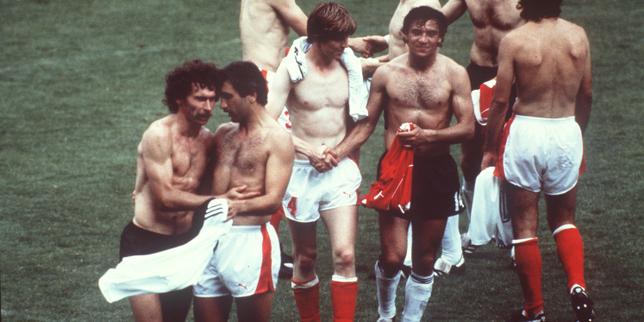
Forty-four years ago, two European nations stood on a pitch in Gijón, Spain, and executed a calculated footballing betrayal that eliminated Algeria from the 1982 World Cup. West Germany needed a 1-0 win over Austria to ensure both teams advanced to the next round at the expense of the Desert Foxes. Once Horst Hrubesch scored in the tenth minute, the match transformed into a walking simulator. Players passed backward, kicked the ball aimlessly, and waited for the clock to bleed dry. It remains the most blatant collusion in modern sporting history, known forever as the "Disgrace of Gijón."
While FIFA subsequently altered tournament rules to ensure final group stage matches kick off simultaneously, the scar never truly healed for Algerian football. Now, as the 2026 World Cup expands to a massive 48-team format, the ghost of 1982 has returned to haunt the tournament. The administrative fixes implemented decades ago are being tested by sheer scale, proving that systemic vulnerabilities in tournament design still favor established powers over emerging nations.
The Architecture of a Sporting Crime
To understand the depth of the Algerian grievance, one must look past the anger and examine the mathematical certainty that made the collusion possible. Algeria had shocked the world by defeating West Germany 2-1 in their opening match, playing a brand of fluid, technical football that European analysts completely underestimated. After a loss to Austria and a hard-fought victory over Chile, the Algerians had played all their group games.
They sat on four points. West Germany and Austria knew the exact equation required to send them both through when they met the following day.
What followed was not a breakdown of discipline, but a rational application of flawed tournament rules. The two teams realized that fighting for a better scoreline carried unnecessary risk. A higher German victory margin would eliminate Austria. A draw or an Austrian win would eliminate West Germany. The 1-0 scoreline was the unique sweet spot where self-interest aligned perfectly across enemy lines.
The backlash was immediate but toothless. German commentator Eberhard Stanjek refused to speak for the final half-hour of the broadcast. Algerian fans in the stadium burned banknotes, gesturing that the spectacle before them had been bought and paid for. Yet, the tournament marched on. FIFA validated the result because no written rule had been technically broken. Teams are not legally obligated to attack.
The Flawed Illusion of Concurrent Kickoffs
FIFA’s ultimate concession to the Gijón scandal was the introduction of simultaneous final group games, a fixture of every World Cup since 1986. For forty years, this mechanism successfully minimized the opportunity for pre-meditated match manipulation. It relied on the chaotic reality that neither team could completely certain of what was happening on a distant pitch in real-time.
But the expansion to the 48-team format in 2026 exposed how fragile that solution always was. When football's governing body initially proposed twelve groups of four, critics pointed out that the sheer volume of games risked creating dead rubbers—matches where top teams could rest entire squads, indirectly deciding the fate of lower-ranked teams trying to qualify as the best third-placed finishers.
The math changes when third-place teams are pulled into the equation. A team playing on Tuesday in Group A will post a final point tally and goal difference. A team playing on Thursday in Group F will know precisely what result they need to outrank Group A's third-place finisher. The simultaneous kickoff rule only protects teams within the exact same group. It does nothing to prevent multi-group calculus where richer federations can manipulate their intensity based on the known failures of teams that played 48 hours prior.
Algerian football officials have long argued that institutional bias didn't end in Gijón; it merely evolved into administrative complexity. The structural advantages still lean toward the nations with deeper benches and more political weight within FIFA’s executive committees.
Why Technical Compliance Overrides Sporting Integrity
The underlying issue of the 1982 fix is that sports governance treats integrity as a matter of technical compliance rather than ethical behavior. When the Algerian Football Federation protested the Gijón match, the tournament organizers hid behind the rulebook. The match officials could not penalize players for passing the ball to their own defenders, as no law forbids safe possession.
This legalistic loophole persists today. Modern data analytics and sports science have given teams even more sophisticated tools to manage workloads. If a dominant European or South American nation decides to field a reserve side or instruct their players to maintain a low-intensity possession game to preserve energy for the knockout rounds, they are acting logically. Yet, the economic and sporting fallout hits smaller footballing nations disproportionately.
Consider the financial disparity. For a nation like Algeria, progressing to the knockout stages of a World Cup transforms domestic sports infrastructure, secures millions in development grants, and elevates an entire generation of players into elite global leagues. For traditional powerhouses, group stage survival is an assumed baseline. When collusion or administrative scheduling compromises that survival, it cuts away the lifeblood of footballing growth in the Global South.
The Long Memory of the Desert Foxes
The anger in Algiers isn't merely about a single missed opportunity in Spain. It is rooted in the realization that the match changed how Algerian football viewed its place in the world. It birthed a distinct footballing identity built on deep suspicion of European footballing authorities.
That suspicion is passed down through generations of players. The 1982 squad, featuring legends like Rabah Madjer and Lakhdar Belloumi, became martyrs of a broken system. When Algeria qualified for subsequent World Cups in 1986, 2010, and 2014, the media coverage inside the country never failed to reference Gijón. It is used as a psychological tool, a reminder to the squad that they cannot rely on fair play or favorable circumstances; they must win convincingly enough to take the math out of the hands of the bureaucrats.
The expansion of the modern tournament means more matches, more revenue, and more corporate sponsorship. It also means more opportunities for structural anomalies that leave emerging football nations vulnerable to the strategic choices of the elite. The Disgrace of Gijón proved that when pushed to the brink, the traditional powers will protect each other to survive. As long as tournament structures prioritize television schedules and expanded fields over absolute competitive equity, the ghost of 1982 will continue to sit in the room.