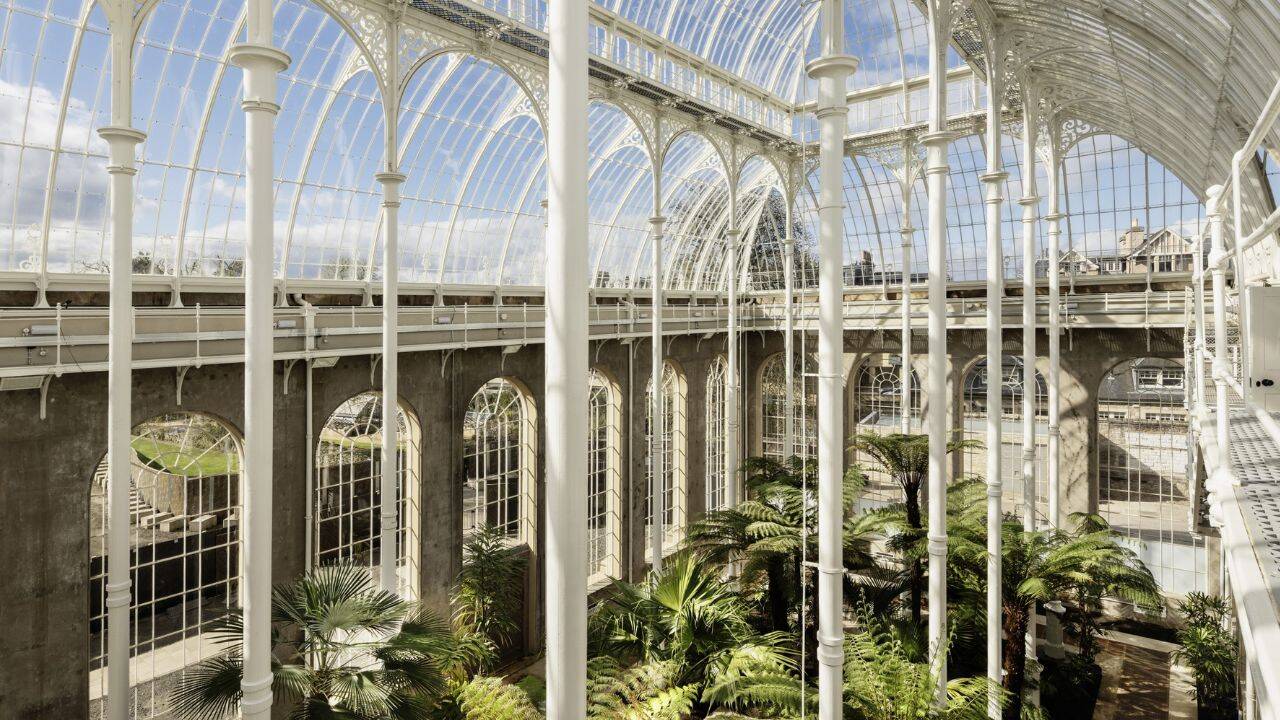
Walk into a Victorian glasshouse on a damp November afternoon in Edinburgh, and the first thing that hits you isn't the light. It's the weight of the air.
Thick. Humid. Sweet with damp soil, crushed fern fronds, and a warmth that feels almost personal, as if the building itself were exhaling after holding its breath all winter. Outside, North Sea wind scrapes across the stone walls of the Royal Botanic Garden, turning breath into pale mist and driving rain sideways against wrought iron. Inside, a palm frond the size of a canoe leans toward a beam of pale northern sun, entirely unbothered by the weather thirty feet away. Don't forget to check out our previous post on this related article.
For years, that sanctuary was thinning out. Panes cracked, frames tired, and a £23.5m restoration had to step in to replace 5,750 panes of glass across Edinburgh's historic Palm Houses before the climate inside turned from refuge to ruin.
Numbers like twenty-three point five million pounds and five thousand seven hundred and fifty panes have a way of flattening things. They make a living, breathing rescue mission sound like a spreadsheet. A procurement order. A ribbon-cutting photo op where someone holds oversized scissors in front of a ficus. To read more about the background here, Travel + Leisure provides an excellent breakdown.
I've stood inside enough crumbling old structures—not just glasshouses, though I've spent plenty of hours pressing my forehead against cool windowpanes in botanic gardens from Kew to Glasnevin—to know what happens right before a place like this breaks. You don't notice it on a Tuesday. You notice it when a drip starts in a corner that used to stay bone dry, or when a pane of glass develops a hairline fracture that only hums when a gust hits at the right angle. Suddenly, a room meant to hold an entire tropical ecosystem starts acting like a sieve.
Wait. Let's pause and ask a question that sounds small until you sit with it: why does it cost £23.5m to replace glass and fix old ironwork in the first place?
To understand the bill, you have to understand what a historic palm house actually is. It isn't a shed with big windows. It's a thermodynamic balancing act built out of cast iron, timber, and thousands of individual pieces of glass that all expand and contract at different rates as temperatures swing. When you pull 5,750 panes of glass out of a heritage structure, you aren't just swapping old squares for shiny new ones. Every single opening has its own slight warp, its own century-old settling, its own quirks from when Victorian craftsmen bolted iron ribs together and hoped they'd hold.
If you force rigid modern glass into a frame that has shifted a few millimeters over a hundred and fifty years, something gives. Usually the glass.
The Quiet Slowness of Living Things
Botanical collections move on a clock that has nothing to do with fiscal quarters or news cycles.
A cycad doesn't care about budget approvals. A palm doesn't speed up its growth because a grant came through early. Many of the specimens inside Edinburgh's Palm Houses have been growing there for generations—some brought back from expeditions in the nineteenth century, others propagated from stock that has been tended by hands long gone. When you care for plants like that, you aren't just a gardener. You're a relay runner holding a baton made of roots and bark.
Let's use a hypothetical scenario to make the stakes concrete—not to invent history, just to picture the daily tension behind the scenes.
Picture Clara, a hypothetical senior horticulturist walking through the house in the middle of the restoration work. She isn't swinging a hammer. She's checking leaf tips. She's feeling the soil moisture with her knuckles, squinting up at scaffolding, watching how light shifts across species that evolved under equatorial canopies and have spent their entire lives under Scottish skies. Every time a section of glass comes out and temporary protection goes up, the microclimate shifts. A little cooler here. A little draftier there. Clara knows plants well enough to know they don't throw tantrums when stressed; they sulk. They drop a leaf. They stall. They quietly lose ground that takes three years to win back.
That's the part a headline misses. You can replace a pane of glass in an afternoon. You cannot replace a hundred-year-old plant if the environment around it fails while the work is underway.
I'll admit something honestly: whenever I read about huge restoration price tags on historic public buildings, a cynical voice in my head always asks whether the money is going to the right place. Public budgets are tight everywhere. Heating bills are real. People worry about groceries and rent, and then they read that tens of millions of pounds went into glass and ironwork for exotic plants.
Doubt. It's healthy. It keeps us honest.
If a restoration only served to create a pretty postcard for tourists, I'd share that skepticism. Nobody needs a £23.5m selfie backdrop.
Why Glass Matters More Than You Think
Consider what happens next: once you look past the price tag, you start seeing what those 5,750 panes of glass are actually doing.
Glass is a boundary. That sounds obvious until you realize how many boundaries in our lives are opaque walls, screens, or locked doors. A glasshouse offers a rare kind of threshold. You can see the green life inside clearly, feel its warmth wash over your face, smell the damp earth, and still remain connected to the cold city just outside.
Historically, Victorian glasshouses were built in an era obsessed with classification, empire, and control—bringing distant flora under a British roof. There is real history there, and not all of it is tidy or romantic. Acknowledging that doesn't diminish the craft of the ironwork or the dedication of the people who kept the plants alive; it simply keeps the story grounded in reality rather than nostalgia.
Over time, though, the meaning of these spaces shifted. Today, when a historic glasshouse reopens after major work, it functions less like a trophy cabinet and more like a living archive and a refuge.
People often wonder about the practical details when a major project like this wraps up. Can you just walk in? Are the plants the same ones people loved before? How do you keep a glass building warm in Scotland without burning through endless energy?
Let's weave those real questions right into what happens inside the house.
When the doors open to the public again, the first relief comes from stepping out of the wind. Visitors—families with restless kids, older couples taking a slow loop around the paths, solo walkers trying to shake off a gray week—move through spaces where air and light behave differently. The restored glazing lets daylight through cleanly without turning the room into a trap or letting winter bleed straight in. Modern environmental controls work quietly behind the scenes alongside historic bones, keeping humidity and temperature steady so the collection can settle back into its rhythm.
You don't need a botany degree to feel the difference. Your shoulders drop. Your glasses fog up for three seconds when you walk in from the cold, then clear, and suddenly you're standing beside a trunk that looks like braided rope.
Craft That Outlives Its Makers
There's a specific kind of courage in restoring something that takes decades to mature.
Fast things are easy to celebrate. A quick fix. A shiny gadget. A building thrown up in nine months that looks dated by year six. Restoration is the opposite. It asks skilled engineers, glaziers, conservators, and horticulturists to spend years carefully taking apart old problems so future generations can enjoy a space they haven't even been born to appreciate yet.
Think of it—and here I am using a metaphor deliberately to capture the feeling—like tuning a massive, fragile instrument in the middle of a concert hall. Every pane of glass is a string or a key. If one is cracked or warped, the whole chord sounds slightly off. Replace all 5,750 of them with care, seal the joints properly, respect the iron beneath, and the whole structure begins to hum in tune again.
Not overnight. Not without effort. Slowly.
Because the work isn't just about preserving wood, metal, and glass. It's about preserving attention.
In a world that trains us to skim, scroll, and move on in four seconds, a palm house demands stillness. You can't rush past a towering palm without feeling slightly silly. You have to crane your neck. You have to listen to water dripping softly from a broad leaf onto a fern below. You have to stand still long enough for your eyes to pick out the difference between five shades of green.
What Stays With You After You Leave
When you step back outside into the cold Edinburgh air after spending an hour inside a restored glasshouse, the contrast is sharp.
Wind. Gray sky. Damp pavement.
Yet something shifts on the walk back toward the gate. You remember the warmth on your skin. You remember the quiet persistence of roots gripping dark soil a long way from home, kept going by human hands, careful engineering, and a decision that some things are worth saving even when the bill is steep and the work is hard.
A pane of glass is brittle if you hit it wrong. Put five thousand seven hundred and fifty of them together in a frame built to last, and they hold back the storm while letting the light pour through.