The white Ford Econoline van was just another ordinary shape moving across the vast, concrete geography of Miami International Airport. Inside, seven people sat shoulder to shoulder. They were workers for a contract cleaning company, finishing up a shift that most of the world never thinks about. Cleaners, loaders, mechanics—the invisible architecture that keeps global commerce breathing. They were talking about ordinary things, perhaps what they would cook for dinner, or how tired their feet felt after hours spent scrubbing cabins.
Then came the roar.
It did not belong to the ground. It was the screaming weight of a Boeing 767 cargo jet, branded with the ubiquitous smile of Amazon Air, hurtling down Runway 30. Flight 7598 had just arrived from San Juan, Puerto Rico, slicing through a damp, heavy afternoon sky thick with wind and shifting weather. But the plane was not slowing down.
Instead of settling gracefully onto the tarmac and bleeding off speed, witnesses would later note how the aircraft seemed to hover far down the strip, carried by an unyielding tailwind. Pilots know the terrifying geometry of a long landing. Every foot of concrete that passes beneath the wheels without touching down is a precious margin vanishing into thin air.
When the heavy jet finally met the runway, it was already too late.
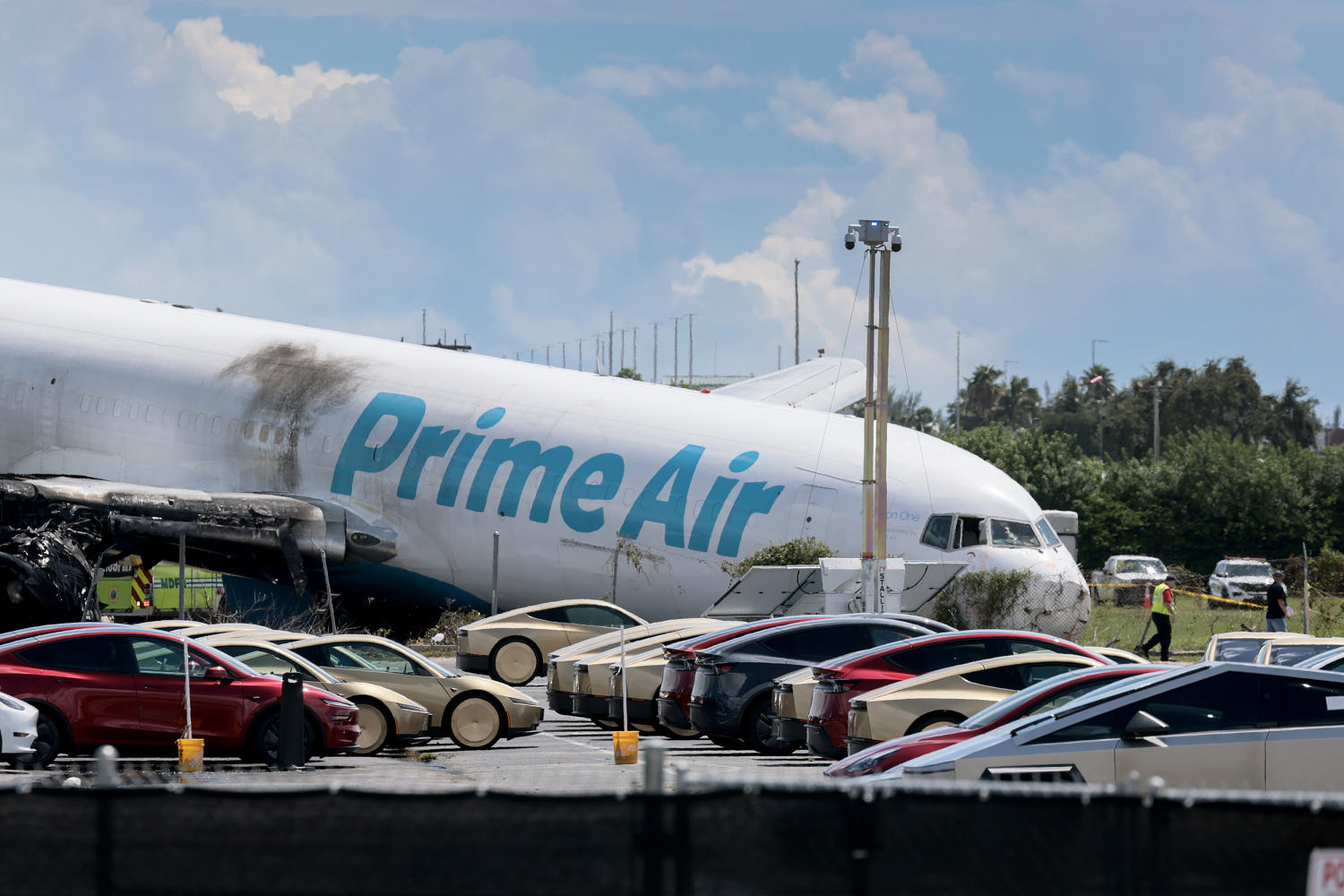
Thirteen hundred feet of grass, perimeter fencing, and navigational aids stood between the aircraft and total catastrophe. The plane smashed through them all like paper, a mountain of aluminum and jet fuel turning the airport's outer boundary into a war zone. The Econoline van didn't stand a chance. It was pulverized, ripped completely apart by the kinetic fury of a multi-ton machine that refused to stop. The jet's momentum carried it onward, smashing into a Toyota Corolla Cross traveling on a nearby public thoroughfare before finally grinding to a halt amid rows of stationary Tesla robotaxis.
When the smoke cleared and the emergency lights painted the wreckage in harsh flashes of red and blue, the human cost was laid bare.
Five lives vanished in less time than it takes to tell the story. Rolando Aleman Leon, 55. Yoel Rodriguez Naranjo, 53. Julio C. Pineda, 75. Carlos Acosta Fajardo, 53. Javierkys Reyes Quevedo, 47. They ranged in age from their late forties to their mid-seventies, carrying decades of personal histories, families, and quiet routines that ended abruptly on a perimeter service road. Three others were left clinging to life in critical condition.
Federal investigators arrived soon after, walking through puddles of volatile jet fuel, unspooling the black boxes, and measuring the skid marks of a system failure that reaches far beyond a single cockpit. Questions immediately turned to the infrastructure of safety. Miami International Airport features the standard thousand-foot safety buffer required by federal guidelines, but it lacks the engineered materials arrestor system—beds of lightweight, crushable concrete designed specifically to swallow the momentum of a runaway aircraft before it breaches a fence. It is a technology that has saved hundreds of lives across the country, yet remains absent from runways where planes touch down every single day.
For now, the flight data recorders are resting in a lab, and the NTSB is piecing together the milliseconds of a landing gone wrong. But statistics do not bleed. Bureaucracy does not weep at empty kitchen tables.
Somewhere out there, boxes keep moving across the grid, delivered in two days or less, borne on a vast and invisible machinery that stitches the modern world together. Yet every package carries a hidden ledger, written in the quiet sacrifices of ordinary people who went to work on a Sunday afternoon and simply never came home.