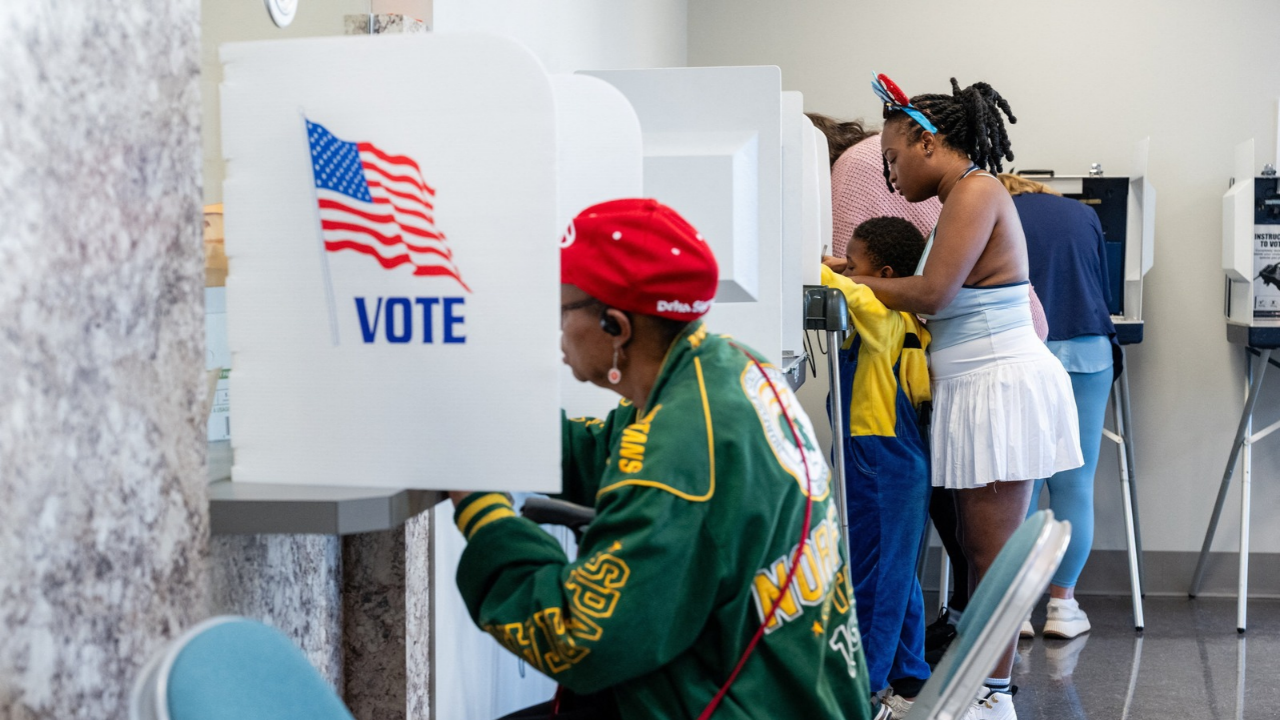
The fluorescent lights of a county annex in Harris County hum at a frequency you only notice when the room goes quiet. Outside, the Texas autumn hangs heavy with residual humidity, the kind that clings to your collar before eight in the morning. Inside, the line does not move fast, yet nobody checks their watch with the usual commuter impatience. They stand on scuffed linoleum, holding driver's licenses and voter registration cards, waiting for their turn behind a cardboard privacy screen.
Silence.
That is what fifty million early ballots actually sound like. Not the roar of a stadium rally or the metallic clatter of cable news chyrons, but the soft shuffle of sneakers on municipal tile and the faint beep of an optical scanner accepting a sheet of paper. According to national election tracking figures compiled across state reporting portals and the University of Florida Election Lab, early voting in the 2026 United States midterm elections surpassed 50.5 million cast ballots ahead of Election Day, with Texas recording a marked jump in early participation compared to previous midterm cycles.
Numbers like 50.5 million tend to flatten into wallpaper when we read them over morning coffee. Our brains were not built to hold fifty million distinct human decisions in a single thought. We need a smaller door to walk through if we want to understand what is happening in the American electorate right now.
The Architecture of a Line
Consider a hypothetical voter—let’s call her Elena, a composite drawn from thousands of real suburban commuters across the Sun Belt. Elena is forty-two, manages inventory for a regional medical supplier outside Houston, and spent the last six years treating midterm elections like optional background noise. Presidential years felt like cinema; midterms felt like fine print.
This October, she took forty minutes out of her Tuesday lunch break to stand in line at a community center gymnasium. Why? Not because she suddenly fell in love with partisan theater. She showed up because her property tax appraisal arrived in the spring with numbers that made her swallow hard, because her aging parents' prescription costs shifted again, and because the school board three miles from her driveway became the loudest room in town.
Multiply Elena by several million, and the statistical spike in Texas stops looking like an anomaly and starts looking like a structural shift. Election analysts tracking county-level returns across Texas noted surging early ballot totals in both sprawling metropolitan hubs like Harris, Dallas, and Tarrant counties and fast-growing suburban rings like Collin, Denton, and Williamson. At the same time, rural counties posted steady, disciplined turnout of their own.
When early voting climbs this sharply in a non-presidential year, it signals something deeper than temporary enthusiasm. Think of voter turnout like water pressure in an old municipal pipe system. For decades, midterm elections operated under low pressure—a slow, predictable trickle dominated by older, hyper-engaged partisan regulars while the rest of the country stayed home until the next White House race. When fifty million people push through the valves before Election Day even arrives, the pressure inside the system has fundamentally changed.
What the Numbers Hide—and What They Reveal
If you have ever worked a polling place—or stood in one as the doors unlocked at seven in the morning—you know how deceptive raw turnout headlines can be. A surge in early voting does not automatically tell you who is winning. That is the oldest trap in political commentary, and reporters fall into it every two years like clockwork.
Early ballot totals measure intensity and habit, not outcome.
To understand why, look at how American voting behavior has rewired itself since 2020. For millions of citizens, "Election Day" is no longer a single Tuesday in November; it is a multi-week window ending on a Tuesday. Campaigns no longer hoard their get-out-the-vote budgets for the final seventy-two hours. Instead, party field operations—both Democratic and Republican—treat the first day of early voting like the opening bell of a championship fight, banking reliable supporters early so they can spend the final days chasing reluctant, infrequent voters.
In Texas, where no-excuse mail-in voting remains restricted primarily to voters aged sixty-five and older, those with disabilities, or those out of the county, early voting means showing up in person. Every single tick upward in the Texas Secretary of State's daily early-vote tally represents a physical body driving to a library, a courthouse, or a school gym, finding parking, and standing in line.
That distinction matters. Mailing an envelope from your kitchen table requires five minutes and a stamp. Driving across a congested metroplex in weekday traffic requires resolve.
The Invisible Stakes Behind the Ballot
Why are people willing to spend their lunch breaks in folding-chair queues during a midterm cycle?
Ask ten voters outside a polling place in San Antonio or Fort Worth, and you will rarely hear them recite national party talking points verbatim. You will hear about the price of groceries that never quite returned to 2019 norms. You will hear about energy grids, water infrastructure, border security, reproductive rights, classroom curricula, and whether a twenty-five-year-old can ever afford a starter home within an hour of where they work.
Midterm elections are where abstract national debates collide with concrete local consequences. A congressional race decides who controls committee gavels and federal spending bills in Washington, yes—but the same ballot carries state legislative seats, judicial benches, county commissioners, and municipal bond measures that determine whether a bridge gets repaired or a hospital district stays solvent.
For years, political strategists assumed that voters needed a charismatic presidential candidate at the top of the ticket to feel that sense of urgency. The 2018 midterms challenged that assumption when national turnout hit a century-high mark for a non-presidential election. The 2022 cycle reinforced it. Now, with early voting crossing 50.5 million in 2026, the exception has become the rule. Midterms are no longer off-year exhibitions; they are full-contact referendums on daily life.
The Geography of Persistence
Still, it is worth being honest about what remains uncertain. Election data is a rearview mirror that only shows how many cars entered the highway, not which exit they took.
In Texas, rapid demographic growth has complicated every tidy political forecast for over a decade. Between 2020 and 2026, hundreds of thousands of new residents moved into the Texas Triangle—the vast economic corridor anchored by Dallas-Fort Worth, Houston, San Antonio, and Austin. Some arrived from California and New York seeking lower taxes and warmer winters; others arrived from across the Midwest and Latin America chasing jobs in energy, healthcare, tech, and logistics.
Newcomers do not arrive with uniform politics. A software engineer relocating from Seattle to Austin brings a different set of priorities than a small-business owner moving from Illinois to Plano, or a first-generation homeowner buying in the Rio Grande Valley. When early turnout jumps across Texas, both major parties point to the numbers as proof of their own momentum. Republicans highlight surges in suburban-exurban crossover counties and steady rural participation; Democrats point to high volume in urban centers and booming diverse suburbs.
Both sides are looking at the same ledger and reading different prophecies. And the truth is, until the ballots are tabulated and precinct-level demographics are cross-referenced weeks later, nobody holding a clipboard outside a precinct door knows for certain how the split breaks.
What we do know is that the myth of the apathetic American voter—the lazy caricature of a citizenry too distracted by screens to care about self-government—is harder to defend than ever.
The Weight of a Paper Receipt
There is a particular moment inside every early voting location that never makes the evening broadcast.
It happens right after the voter feeds their marked ballot into the scanner. The machine whirs for two seconds, pulls the paper inward, and ticks the digital counter on its small screen upward by one. The poll worker sitting beside the machine—usually a retiree wearing a lanyard and comfortable shoes, earning a modest stipend for twelve-hour shifts—gives a small nod. You're all set.
No fireworks. No applause. Just a white "I Voted" sticker pressed onto a cotton shirt or the back of a phone case, and the walk back out into the daylight.
Fifty point five million times across the country, someone walked through that quiet sequence before Election Day even began. In Texas alone, millions stepped away from work shifts, childcare routines, and highway commutes to make sure their names were checked off the ledger early.
Outside the annex in Harris County, the morning humidity finally burns off around noon, leaving the asphalt bright under a high autumn sky. Another wave of cars pulls into the lot—nurses coming off shift, delivery drivers on a thirty-minute break, retirees walking together with folded sample ballots tucked into their pockets. The doors swing open, the line inches forward on the scuffed linoleum, and the machine behind the partition whirs again.