The perimeter fence at RAF Fairford does not look like much from the county road. It is chain-link, silver-grey, topped with coiled razor wire that catches the gray Gloucestershire mist like frozen thorns. To a passing driver on a Tuesday morning, it is simply a boundary. It separates the damp English countryside from miles of concrete hardened to withstand the heavy footprint of global power.
Inside that wire, the world moves differently. B-52 bombers sit heavy on the tarmac, their titanium bellies holding a legacy of Cold War deterrence that most people prefer to forget exists. But on a Tuesday morning, the fence is not just a boundary. It is a target.
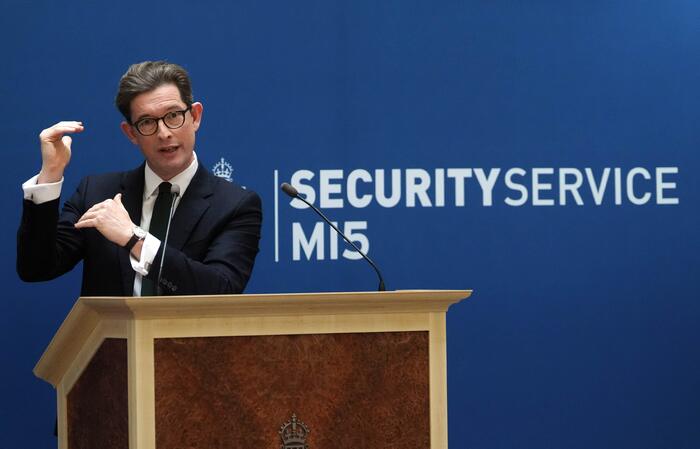
We live with an inherited illusion of distance. We believe that oceans and alliances are moats, that geography is a shield, and that modern statecraft is a polite game of diplomats shouting across mahogany tables. But the warning delivered by the head of MI5, Ken McCallum, cuts through that comfort with the cold precision of a scalpel. The threat is not arriving via an armada on the horizon. It is sitting quietly in a rented sedan parked three hundred yards from a runway, operated by someone who checked into a budget hotel using a passport that looked entirely legitimate.
Consider the ordinary rhythm of a security guard shifting his weight against the chill at Gate Three. He is watching for shadows, but the real danger is not a shadow. It is code. It is a ghost in the machine, a reconnaissance drone bought off a commercial shelf, or a local contact paid in cryptocurrency to photograph the shift changes of gate personnel.
The plot intercepted near RAF Fairford—unfolding with a quiet, terrifying mundanity—is not an anomaly. That is the chilling core of what security officials mean when they say these operations are not unique.
We are accustomed to thinking of espionage and sabotage as the exclusive domain of cinematic thrillers. We imagine masterminds in subterranean bunkers, elaborate disguises, and poisoned umbrellas. The reality is far more banal, and therefore infinitely more dangerous. It relies on outsourcing. Intelligence agencies like those in Tehran increasingly utilize criminal proxies, petty traffickers, and radicalized freelancers to do their dirty work. They rent operatives the way modern corporations rent cloud storage.
Picture a twenty-four-year-old courier in a crowded rail station in London. He has never set foot in the Middle East. He does not speak Farsi. He has a stack of maxed-out credit cards, an eviction notice taped to his kitchen door, and an encrypted messaging app pinging softly in his pocket. A message arrives from an anonymous handle, offering enough cash to clear his debts in exchange for dropping a small, unassuming package behind a rubbish bin near a military installation, or filming the license plates of transport trucks leaving an air base.
He does not think of himself as a traitor. He thinks of himself as a survivor. By the time MI5 intercepts the digital breadcrumbs linking that transaction to a handler in a foreign ministry, the courier is already wondering why his phone stopped working.
This is the invisible architecture of modern hybrid warfare. It is fought in the gray zone between peace and outright conflict. It is designed to probe, to test, to map vulnerabilities without ever crossing the threshold that would trigger a conventional military response. If an air base is successfully targeted by a proxy cell, the sponsoring government can shrug, issue a diplomatic denial, and watch the evening news cycle fracture into endless debates over attribution.
Deniability is the new armor.
For decades, British counter-intelligence focused on traditional state actors—diplomats acting as intelligence officers, classic dead drops in leafy suburbs, structured networks with clear hierarchies. That world has splintered. Today, the battlefield is decentralized. Iran’s targeting of military sites and dissidents on British soil is not merely a collection of isolated incidents; it is a campaign of attrition. It is an attempt to bleed the UK's focus, to stretch security services thin, and to cultivate a low-level hum of insecurity that erodes public trust.
When you walk past a military housing estate in Oxfordshire, or a discreet signals intelligence facility tucked into the rolling hills of the Cotswolds, you are looking at a frontier. The people who live there—the pilots, the analysts, the cooks, the mechanics—are civilians by uniform choice when they step off base, but they are frontline targets the moment they walk out the gate. Their children play on the same swings as yours. Their spouses shop at the same local supermarkets.
That proximity is the vulnerability.
Intelligence agencies do not always need to breach the hardened steel of a hangar door if they can turn the person holding the key, or map the exact pattern of when the lights go out in the barracks. The plot at Fairford reminds us that the front line is no longer a trench in a distant theater of war. It is the curb outside your local cafe. It is the Wi-Fi router in a suburban home. It is the unvetted contractor hired to service the HVAC units in a restricted government building.
We often look at security measures—the cameras, the checkpoints, the background checks—and feel a faint irritation. We view them as bureaucratic friction slowing down our day. But behind those measures is a frantic, sleepless machinery trying to hold back a rising tide of silent aggression.
The directors of intelligence services do not stand at podiums to deliver warnings for theatrical effect. When they speak publicly about iran targeting military sites and domestic dissidents, they are sounding an alarm bell they wish they didn't have to ring. They are telling us that the margin for error has evaporated.
There is a heavy psychological toll to living in this reality. It invites paranoia if we let it, or worse, apathy. We can shrug and assume that governments will handle it, that the unseen shield will hold forever because it has held so far. But shields are not permanent. They are maintained by human vigilance, by analysts drinking cold tea at three in the morning, parsing through thousands of intercepted data packets for a single anomalous string of text.
The silence outside RAF Fairford tonight is heavy. The mist clings to the barbed wire, turning the metal into silver beads. Somewhere out there, beyond the perimeter, a car engine turns over. A headlight sweeps across the asphalt. Most people will sleep through it, dreaming of ordinary tomorrows, trusting that the invisible war remains invisible.
And for now, it does. Until the next wire is tested.


