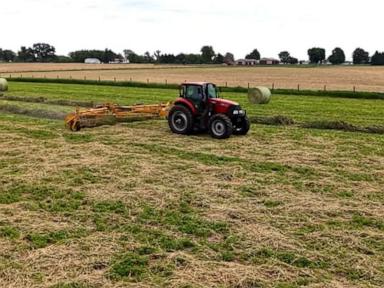
You probably picture a giant corporate factory when you think about modern food production. Huge machines, windowless offices, and billionaires pulling strings from a skyscraper somewhere. It's a common image. Honestly, it's also dead wrong.
The real engine behind American agriculture isn't a multinational conglomerate. According to data from the United States Department of Agriculture (USDA) latest reports, family farms make up about 97% of all farms in the United States. They control roughly 91% of the country's operated farmland and drive 85% of total agricultural production value. When you eat dinner tonight, you're eating something grown by a family, not a faceless board of directors. In related updates, take a look at: The Economics of Fragmentation: Deconstructing the Baltic Ammunition Deficit.
These operations basically built the economic foundation of rural America. They didn't just clear fields; they founded communities, funded local schools, and established regional banks. But the landscape is shifting fast. Running a multi-generational agricultural business right now requires surviving under extreme financial pressure. Understanding how these families operate is essential if you want to understand where our food security is heading.
The Financial Reality of the Modern Homestead
Let's clear up a major misconception. "Family farm" doesn't mean a tiny hobby garden with three cows and a tractor from the 1950s. The USDA defines a family farm as any operation where the principal operator and their relatives own more than 50% of the business. The Wall Street Journal has also covered this fascinating topic in extensive detail.
This means family operations come in drastically different sizes:
- Small Family Farms: Operations with a Gross Cash Farm Income (GCFI) under $350,000. They represent roughly 86% of all US farms but only generate about 17% of total production value.
- Midsize Family Farms: Operations pulling in between $350,000 and $999,999. They account for about 6% of farms and 18% of total production value.
- Large-Scale Family Farms: Businesses with a GCFI of $1 million or more. They represent only about 5% of operations but command a massive 50% of total production value.
Small operations handle the bulk of the country's hay production and hold down massive chunks of the cow-calf beef market. Large family operations dominate capital-intensive sectors like dairy and cash grains.
But holding onto that land is getting brutal. The USDA National Agricultural Statistics Service reported that the total number of US farms dropped to around 1,865,000, losing 15,000 operations in a single year. Farmland shrunk by over 2.5 million acres during that same window. The only category actually growing in number is the large-scale operation group. Small and midsize players are getting squeezed out.
High Risk and Thin Margins
Why are families walking away? The profit margins are razor thin, and the risk profiles are terrifying.
Recent data from the Illinois Extension analysis of the Farms and Ranches at a Glance report highlights a stark reality. Over 70% of all US agricultural operations sit in a high-risk financial category based on their Operating Profit Margin. For small family farms with low sales, that high-risk figure spikes above 80%.
Think about running a business where you invest hundreds of thousands of dollars in seed, fertilizer, and diesel before you make a single dime. Then you pray it rains. But not too much. If a freak hail storm hits your county, or global market prices tank because of a trade dispute across the ocean, your entire year's income vanishes.
To survive, most small-scale operators don't even make their living from the soil anymore. The primary operators or their spouses work full-time jobs off the farm just to pay for health insurance and keep the mortgage solvent. The farm itself becomes a second full-time job worked in the evenings and on weekends.
Surviving the Shift
If you own or manage land and want to keep it in the family, the old playbook won't work. Relying solely on commodity crops like corn or soybeans without diversification is financial suicide for smaller operations. Successful producers are adapting by leaning into niche high-value markets or changing how they utilize their acreage.
Direct-to-consumer sales, agritourism, and specialty organic crops offer much higher margins per acre than traditional commodities. Instead of selling grain to a massive co-op at wholesale prices, families are processing their own goods or partnering directly with regional restaurant groups.
Technology plays a massive role here too. Precision agriculture is changing how inputs are managed. Farmers use yield monitors, GPS-guided tractors, and targeted variable-rate fertilizer applicators to cut waste. The upfront cost is incredibly steep, but reducing input expenses by even 8% can mean the difference between a profitable year and financial ruin.
Many operators are also turning toward on-farm renewable energy. Data shows a massive surge in farms installing solar arrays, wind turbines, and methane digesters to lower utility costs or create an alternative revenue stream by selling power back to the grid.
Keeping the Land in the Family
If your goal is protecting a family-run agricultural business for the next generation, you need to transition from focusing purely on daily operations to treating the farm like a corporate transition project.
Start by drafting a formalized succession plan with an estate attorney who specializes specifically in agricultural law. Too many multi-generational farms fall apart because the older generation passes away without a clear, legally binding structure for how ownership shares transfer to heirs who want to work the land versus those who just want to sell it.
Audit your current operational expenses to identify where input costs can be trimmed through precision technology or cooperative buying groups. Look hard at your revenue mix. If 100% of your income comes from a single volatile commodity, start dedicating 5% to 10% of your resources toward a diversified crop, livestock enterprise, or alternative energy lease to build a financial buffer. Food security depends on keeping these independent operations alive, but survival requires running the farm like the complex business it is.