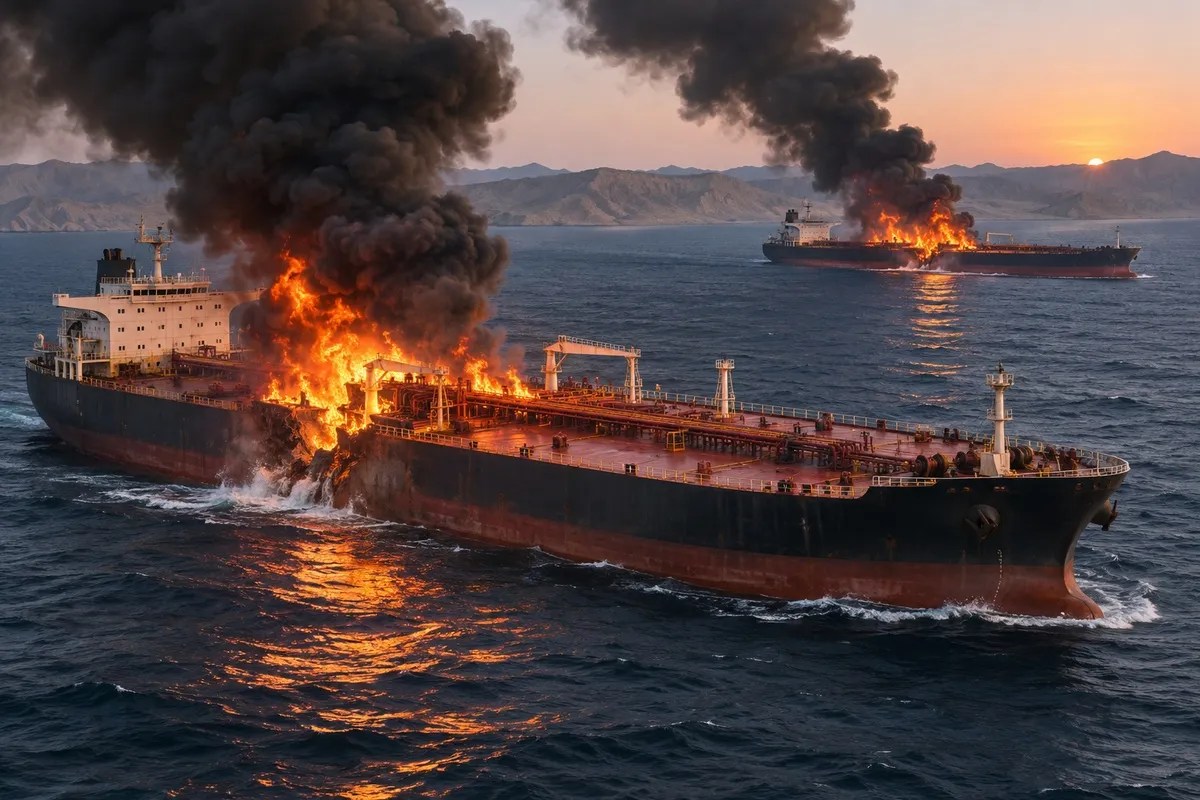
Two oil tankers burn in the Strait of Hormuz. The Islamic Revolutionary Guard Corps issues a warning. Tensions between the United States and Iran spike.
Every cable news panel and wire report rushes to the same script. Two ships on fire equals an imminent blockade. An imminent blockade equals $150 crude and global economic paralysis.
That script is lazy. It is also wrong.
A burning hull in the Strait of Hormuz makes for dramatic footage. Dramatic footage sells ads. It does not automatically shut down a waterway that carries roughly a fifth of the world's petroleum trade, nor does it force Tehran to commit economic suicide.
To understand what actually happens when two oil tankers are hit amid US-Iran tension, you have to stop treating maritime headlines like a movie trailer and start reading the mechanics of maritime insurance, asymmetric warfare, and Gulf export economics.
What Standard Coverage Misses About a Tanker Strike
Standard coverage treats a strike on two vessels as a binary switch: open or closed. Markets and shipping lanes rarely work that way.
First, define the terms precisely. A blockade is a formal, sustained military effort to prevent vessels or cargo from entering or leaving a defined coast or waterway, typically backed by naval interdiction and legal blockade rules. Harassment or asymmetric disruption—using mines, drones, fast-attack craft, limpet mines, or anti-ship missiles—raises risk and cost without necessarily closing the sea lanes outright.
Even when explosions hit two tankers, commercial traffic often splits rather than vanishes. Some operators pause transits for 24 to 72 hours to assess threats. Others reroute, delay loading, or demand armed escorts. A complete, multi-week closure requires sustained naval dominance and acceptance of severe escalation by whoever attempts it.
I have watched supply chain teams and corporate treasurers blow millions overreacting to the first wave of headline panic. They lock in panic hedges at peak fear premiums, cancel voyages prematurely, or over-order high-cost spot cargo days before physical flows actually stop. By the time real supply balances settle, they have eaten maximum friction for a disruption that turned out to be selective rather than total.
The Economics Tehran Cannot Afford to Ignore
The lazy consensus assumes Iran gains from choking the Strait of Hormuz because higher oil prices hurt Western consumers and create leverage over Washington. That logic stops halfway through the balance sheet.
Iran's own state budget depends heavily on oil and condensate exports moving out of the Persian Gulf through the exact same narrow choke point—roughly 21 miles wide at its narrowest navigable stretch between Iran and Oman. Sealing the strait permanently does not just squeeze importing economies in Asia and Europe; it chokes Iran's own export lifeline and invites direct military retaliation against Iranian coastal infrastructure, terminals, and naval assets.
Consider the incentive structure of the Islamic Revolutionary Guard Corps. Asymmetric pressure gives Tehran deniability, psychological leverage, and market volatility without crossing the threshold into full-scale war where its conventional naval and air defenses face overwhelming firepower. Blasting or threatening select vessels creates fear at low direct cost. Trying to hold the strait shut day after day invites a fight Iran is structurally outmatched to win conventionally.
Energy analysts who study Gulf chokepoints—from institutions like the International Energy Agency to maritime risk consultancies—consistently point out a crucial distinction: risk premium is not the same thing as physical barrel loss. Traders price fear, insurance costs, and transit delays immediately. Actual physical barrels only leave the market if loading terminals stop pumping, ships refuse to sail, or tankers cannot discharge.
War Risk Insurance Does the Real Heavy Lifting
If you want to know whether shipping in the Strait of Hormuz is actually paralyzed, watch marine underwriters before you watch pundits.
When two tankers catch fire in a contested zone, war risk insurance premiums spike and coverage terms tighten fast. Hull and machinery cover, protection and indemnity coverage, and cargo policies all adjust to reflect actual threat levels. For shipowners and charterers, an uninsurable or prohibitively expensive voyage can halt movement almost as effectively as a naval patrol—at least until underwriters price the risk or sovereign backstops step in.
That is where real-world friction lives. A supertanker is a massive capital asset carrying tens of millions of dollars in cargo. Even if a ship can physically steam through the strait, no prudent operator sends a high-value vessel into an active threat corridor without clear intelligence, route guidance, and viable insurance.
A Thought Experiment on Real-World Chokepoints
Imagine a scenario where two tankers suffer explosions near the Strait of Hormuz on a Tuesday morning, followed by a sharp warning from the IRGC. Before assuming global oil supply has fallen off a cliff, trace what actually happens next:
- Satellite tracking and maritime domain awareness feeds show whether nearby Very Large Crude Carriers are loitering in the Gulf of Oman or continuing inbound.
- Port authorities and terminals in Saudi Arabia, the United Arab Emirates, Iraq, and Kuwait report whether loading operations continue normally or face queuing delays.
- Marine insurers revise war risk rates and notify shipowners of heightened risk areas.
- Buyers in Asia and Europe check floating storage, strategic reserves, and alternative grades—such as pipeline bypass capacity in the region where available—before bidding blindly into a spike.
Notice what is missing from that sequence: a single dramatic explosion does not by itself erase millions of barrels of daily production. It tests nerves, inflates freight and insurance costs, and exposes who built real resilience versus who relied on just-in-time assumptions.
The Wrong Question Everyone Is Asking
People searching about tanker explosions in the Strait of Hormuz usually ask two questions: Will Iran close the Strait of Hormuz? and How high will oil prices go?
Both questions frame the crisis around a single dramatic event instead of the real operational test.
A better question for any business exposed to energy, freight, or industrial inputs is: How long can your supply chain absorb a sharp spike in transit time, freight rates, and war risk premiums before physical shortages hit?
Here are the brute-force answers to the questions everyone keeps asking:
- Will the strait stay closed long-term? Unlikely unless a full-scale military campaign breaks out. Selective attacks and warnings are tools of pressure; a sustained blockade is a high-cost escalation that hurts Tehran's own export revenue and draws heavy military response.
- Why do oil prices jump even before barrels disappear? Because oil is a forward-looking commodity priced on marginal risk, replacement cost, and disruption probability—not just today's physical barrel count.
- What actually matters most right now? Vessel routing behavior, terminal loading continuity, and war risk underwriting—not soundbites.
Where My Contrarian Take Can Burn You
Being the person who calls out media hype feels sharp until the one time the tail risk actually materializes.
Here is the honest downside of betting against escalation: asymmetric crises are non-linear. A miscalculation by a local commander, a stray mine or drone strike hitting a larger vessel or terminal, or a retaliatory cycle between Washington and Tehran can turn a contained warning into a wider regional conflict faster than analysts expect. If you dismiss every flare-up as theater, you can get caught flat-footed when real escalation arrives.
Contrarian discipline is not blind complacency. It means sizing risk to reality rather than panic—preparing for higher volatility and freight costs without overpaying for doomsday scenarios that have not occurred.
What to Do Instead of Panicking
Stop trading on cable news adrenaline. Run a cold audit of your actual exposure instead:
- Map direct and indirect energy exposure: Check not just crude or fuel purchases, but petrochemicals, plastics, fertilizers, air freight surcharges, and ocean container or tanker rate pass-throughs.
- Audit contract force majeure and rerouting clauses: Know who bears delay costs, demurrage, and war risk surcharges if vessels slow down or take longer routes.
- Hold dry powder instead of chasing panic spikes: Avoid locking in peak fear premiums on day one unless your physical operations face an immediate unhedged cutoff.
- Track physical indicators daily: Watch tanker movement data, refinery runs, and crack spreads rather than relying on recycled headlines.
Two burning tankers in the Strait of Hormuz prove one thing beyond dispute: the Persian Gulf remains one of the most volatile energy corridors on earth. They do not prove the end of global oil flow. Watch the ships that keep moving, not the loudest warnings on your screen.


