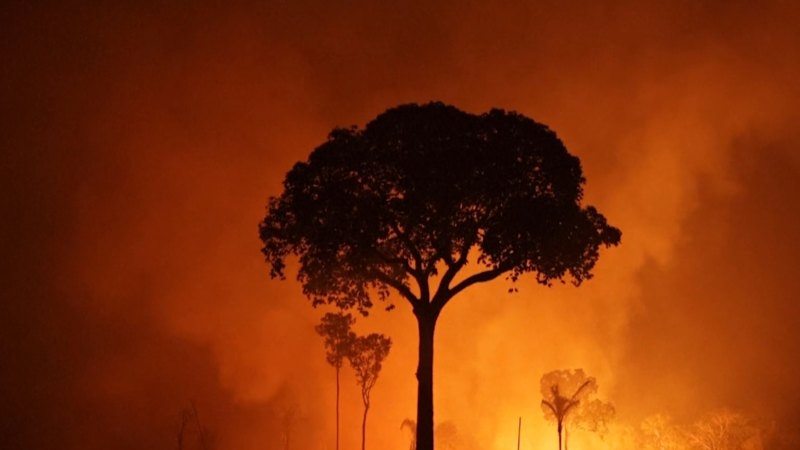
We need to talk about the Amazon. Every time smoke chokes the skies over South America, the internet explodes with panic. Headlines scream that the lungs of the planet are burning down to ashes. Celebrities share dramatic photos from decades ago. Panic sets in.
And honestly, most of it is completely wrong.
That doesn't mean the situation isn't serious. It's just that the real story is far more complex than a viral Instagram post. If you want to understand why the Amazon rainforest burns, you have to look past the sensationalism and face the actual mechanics of deforestation, climate shifts, and human action.
The Core Misconception About Natural Fire
Let's clear this up right now. Unlike the boreal forests of Canada or the eucalyptus groves of Australia, the Amazon is not a fire-adapted ecosystem.
Trees like lodgepole pines actually need fire to open their cones. The Amazon does not. Millions of years of intense humidity mean that under normal, pristine conditions, the rainforest is simply too wet to burn. You can drop a match on the damp floor of an untouched canopy and watch it fizzle out instantly.
So why are we seeing massive walls of flame?
Because the fires in the Amazon are almost never natural. Lightning strikes happen, sure, but they rarely spark widespread blazes in a healthy, standing rainforest. The vast majority of these fires are started by human hands. People clear land for cattle ranching, soybean farming, and speculative land grabs, then use fire to clean up the felled debris.
When the forest is fragmented, dried out by prolonged droughts, and degraded by illegal logging, those intentional agricultural fires escape their boundaries. They bleed into standing timber. That is the crisis. It's not a sudden spontaneous combustion of the wilderness. It's an industrial expansion tool gone terribly wrong.
Following the Money and the Chainsaw
You can't talk about Amazonian fires without talking about economics. Ground-level reality in places like Rondônia or Pará looks very different from a university lecture hall in Europe or North America.
Small-scale farmers slash and burn out of economic desperation, but industrial-scale actors drive the heavy damage. Speculators clear public land illegally, plant a few head of cattle to claim ownership rights, and flip the real estate for a profit. Once the soil depletes after a few years, they move deeper into the green heart of the basin and start the cycle over again.
Satellites operated by Brazil’s National Institute for Space Research, known as INPE, track these hotspots with incredible precision. The data consistently shows a direct correlation: where roads go, chainsaws follow. And where chainsaws go, fire comes next.
When you see spikes in fire alerts, you are looking at a political and economic pulse. Enforcement of environmental laws matters. When government agencies actively patrol and fine illegal deforesters, the numbers drop. When political leadership signals that environmental rules won't be enforced, the matches come out en masse.
The Feedback Loop Nobody Wants to Face
Here is where the stakes get terrifying. The Amazon doesn't just respond to climate change; it drives it.
Trees act as massive biological pumps. A single large tree can lift hundreds of gallons of water out of the ground every day and release it into the atmosphere through transpiration. This creates what scientists call "flying rivers"—massive atmospheric currents of moisture that drift across the South American continent, bringing rainfall to agricultural heartlands in southern Brazil, Argentina, and Bolivia.
When you burn down patches of the forest, you break that pump.
Drier regions mean longer dry seasons. Longer dry seasons mean the remaining forest becomes even more vulnerable to fire. Scientists warn that the Amazon is rapidly approaching a critical tipping point. Cross that threshold, and large swaths of the rainforest will permanently transition into degraded savanna.
You aren't just losing trees. You're losing a stabilizing pillar of the global climate system. Billions of tons of carbon stored in the biomass and soils get released back into the atmosphere, accelerating the very warming that made the forest dry in the first place.
What You Can Actually Do
It's easy to feel helpless sitting thousands of miles away while headlines flash red. You look at a map of a continent on fire and wonder how an individual can make a dent in a geopolitical crisis.
Real change starts with supply chains.
Much of the beef and soy produced on newly cleared Amazonian land gets exported or feeds domestic markets tied to global conglomerates. Paying attention to where your food comes from sounds cliché, but corporate pressure works. When major international brands refuse to buy commodities linked to deforestation, local producers take notice.
Governments respond to trade pressure, too. International trade agreements that tie market access to verifiable environmental standards have proven to be powerful levers.
Support organizations working on the ground with indigenous communities. Indigenous reserves consistently prove to be the most effective bulwarks against illegal deforestation. They protect their ancestral lands because their lives depend on them. Arming them with legal resources, technology, and direct support does more to stop the fires than a million shared social media posts.
Stop falling for outrage bait. Look for verified data from groups like INPE or independent science consortia. Understand the mechanics of how human greed and climate stress intersect in the basin. Share accurate information instead of recycled panic.
The Amazon isn't gone yet. But saving it requires sustained, boring, hard work long after the smoke clears and the cameras turn away.