Walk into a humid workshop in Moradabad at six in the morning and listen. Not to the news. Listen to the metal.
A hammer strikes brass. Clink. Another strike. Clink. Across the lane, someone stokes a kiln until the air smells faintly of woodsmoke and baked clay. Down the road, a crate of woven baskets sits stacked against a brick wall, waiting for a truck that may or may not arrive before the afternoon heat makes the asphalt shimmer.
To most people reading a policy brief, that scene reduces to a line item. Exports. Imports. Trade deficit. Numbers on a screen that rise or fall by a fraction of a percent while millions of people go about their day trying to keep the lights on.
I have spent years watching economic headlines slide past people who actually make things with their hands, and I still find trade policy confusing at times. When economists talk about narrowing a trade gap, the words feel sterile, almost clinical, as if money moves through vacuum tubes instead of dusty highways, crowded ports, and family workshops where a single delayed shipment can wipe out a month of margin.
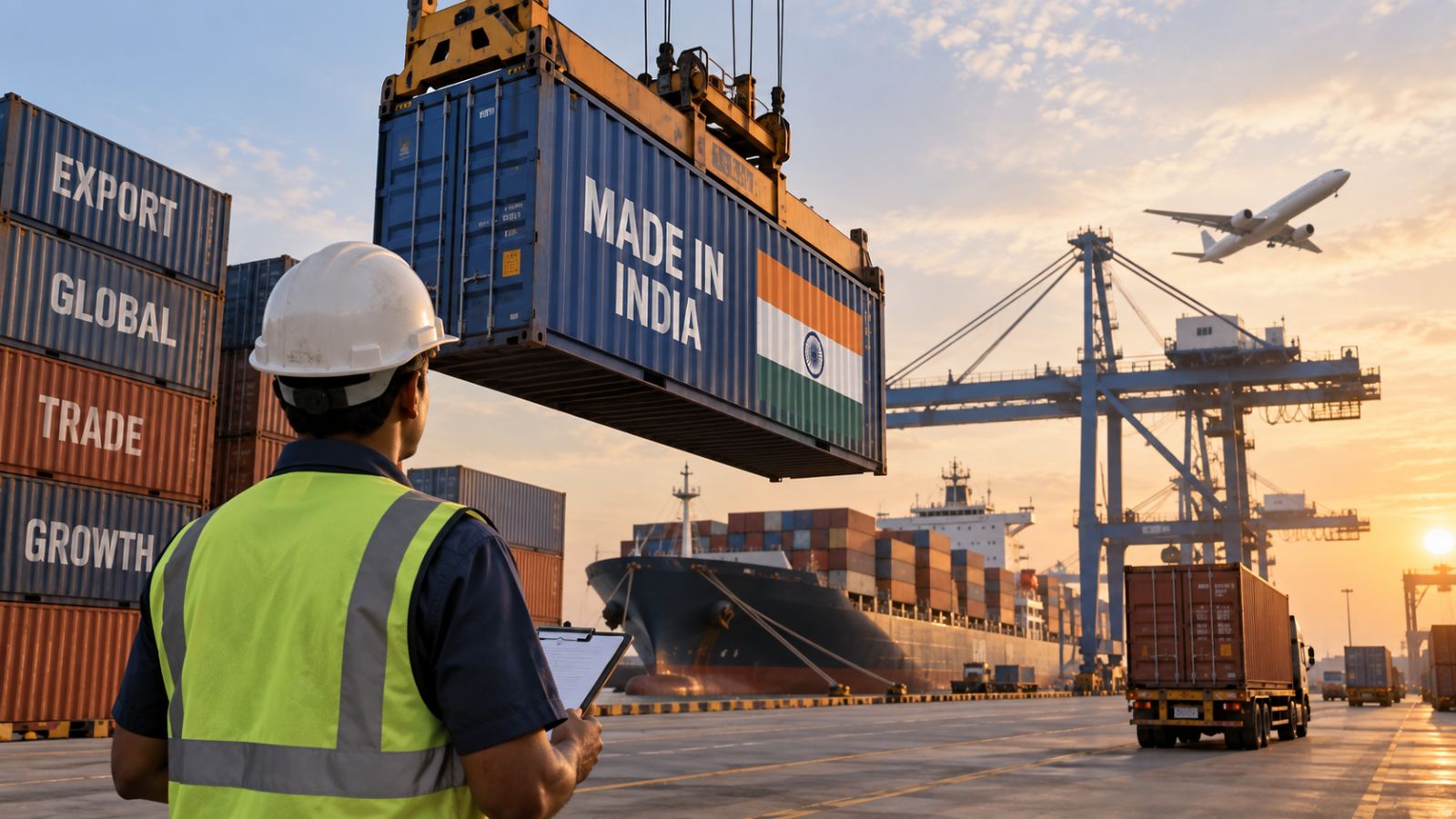
Honest truth? Early in my own career covering trade and manufacturing, I thought exports belonged to giant factories near big coasts. I pictured sleek containers sliding onto ships in Mumbai or Chennai while inland towns stayed quiet, watching from afar. I got that picture wrong. A country with more than seven hundred districts does not run on coastal megahubs alone. If most of the map sits on the sidelines of global trade, the weight falls on a narrow strip of land and a handful of industries, leaving the rest of the country to buy more from abroad than it sells to the world.
That imbalance is the trade deficit in plain clothes. When a nation imports more value in goods and services than it exports, money flows outward faster than it comes back in. Over time, that gap shapes currency pressure, industrial depth, and how resilient an economy feels when global supply chains wobble.
Push for exports from every single district, and the map changes. Suddenly a quiet town famous for handlooms, leatherwork, spices, auto parts, or pottery is no longer just supplying a local market. It is looking outward, asking a sharper question: What do we make better than almost anyone else, and how do we get it into someone else's hands across an ocean?
Why Big Trade Numbers Feel So Far Away
Trade deficits sound like a problem for central bankers and finance ministries, not a potter with clay under his fingernails.
Part of the disconnect comes from scale. A deficit measured in billions of dollars is too big to picture. Your brain shrugs because there is no human face attached to a billion. So people tune out. They read that imports outpaced exports, skim the next paragraph, and go make tea.
To make sense of the mechanics without turning this into a textbook, picture a household with two pockets. (This is a metaphor, so treat it as a lens rather than a literal ledger.) Every time the household buys something from outside—say, imported electronics, machinery, or energy—money steps out of the left pocket. Every time it sells something to the outside world—finished goods, components, agricultural products—money steps into the right pocket. When the left pocket drains faster than the right pocket fills, the household has to lean on savings, borrowing, or tighter belts elsewhere.
Nations are far more complex than a single household, of course. Importing raw materials or advanced equipment can actually help local industries grow stronger later. A deficit is not automatically a moral failure. Yet when export growth stays concentrated in a few pockets while import bills stay high, the strain shows up quietly: fewer local jobs tied to global demand, thinner foreign exchange buffers, and an economy more exposed when overseas buyers cut back.
Consider what happens next when a country decides to widen the base. Instead of relying solely on established export corridors, policymakers push each district to identify its signature products—often called One District, One Product style thinking in spirit—and build the plumbing around them. Testing labs. Better packaging. Easier customs clearance. Connections to buyers who never knew a particular town existed.
Sounds neat on paper. Messy in real life.
Inside a Workshop Where Global Trade Begins
Let's step into a hypothetical scenario to see how fragile that bridge can be. Imagine Meera, who runs a small family-run textile and home-furnishing unit in a mid-sized interior district. Let's be clear: Meera and her workshop are hypothetical, built to trace real friction points rather than report on a single real business.
Meera's weavers produce heavy cotton throws with geometric patterns that hold up after dozens of washes. A boutique buyer in Europe sees photos of the weave and wants a trial order. Good news, right?
Now watch the friction appear.
First, quality standards. A buyer overseas does not just care if the fabric looks pretty; they care about dye fastness, packaging moisture, labeling rules, and predictable delivery dates. A small workshop that has always sold to regional wholesalers may never have navigated export documentation or international compliance checks.
Second, logistics. Getting goods from an inland district to a major port or international airport takes time, coordination, and cost control. If road transport is slow or cold-chain and warehousing options are thin near the source, per-unit costs climb before the shipment even leaves the country.
Third, credit and confidence. Small exporters often wait weeks or months to get paid while paying workers and raw-material suppliers upfront. Without accessible working capital or clear guidance on finding vetted foreign buyers, many capable makers stay local because going global feels like jumping into deep water without knowing how to swim.
Even I have caught myself underestimating how intimidating that first cross-border invoice looks to someone running a ten-person operation. When a single mistake on paperwork or shipping can eat your profit—or cost you a client—caution makes complete sense.
What District-Level Exports Actually Change
Shift the angle from a single workshop back to the wider map, and you see why district-level export push matters so much.
Historically, economies that industrialize and trade broadly tend to spread opportunity wider than economies where high-value activity clusters in just two or three metros. When opportunity stays too concentrated, inland regions face a familiar tug-of-war: young workers leave for distant cities looking for steady pay, while local craft or manufacturing strengths wither from lack of scale.
Turning every district into a serious contributor to exports flips that script in practical ways:
- Local skills stay rooted: A town known for a craft, crop, or industrial niche can upgrade quality and scale production closer to home instead of watching its best talent drift away.
- Supply chains gain depth: When more districts plug into export logistics, regional transport, packaging, testing, and warehousing become viable local businesses themselves.
- Trade becomes less brittle: Relying on fewer regions or a narrow basket of goods leaves an economy vulnerable to local disruptions or sector slowdowns. Spreading export capability across hundreds of districts builds broader economic footing.
Still, do not mistake a policy push for a magic wand. Boosting exports from every district is a slow grind, not an overnight miracle. Some districts already have strong industrial clusters and port access; others start with agricultural goods, handicrafts, or light manufacturing that need years of skill upgrades, branding, and infrastructure.
And global markets do not wait politely. Overseas buyers compare prices, reliability, lead times, and sustainability standards across dozens of countries at once. Winning orders takes consistency—not just enthusiasm.
The Invisible Stakes Behind Every Crate
Why should someone sitting at a desk, scrolling on a phone, or running a shop far from any shipping lane care whether a district three hundred miles away exports more?
Because trade shapes the ground beneath all of us.
A narrower trade deficit, achieved through genuine export strength rather than artificial choke points, helps keep macroeconomic footing steadier. It supports healthier external balances, strengthens confidence in domestic production, and gives the country more room to invest in skills, infrastructure, and technology without constant external strain.
More personally, every exported product carries hours of human effort. Someone spun the yarn. Someone shaped the metal. Someone checked the seam, packed the box, drove the truck, or negotiated the shipment. When a district learns how to sell to the world without losing its soul, the dignity of local work gets a wider stage.
Look again at that morning workshop in Moradabad.
The hammer strikes brass. Clink. A spark jumps from the anvil and dies in the dim light. Outside, the day wakes up across hundreds of districts—some loud with looms and lathes, some quiet with orchards and kilns—all holding a piece of what the world might buy tomorrow if the road from town to port is finally wide enough to carry it.