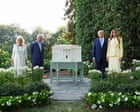
The long-standing diplomatic dance between the British Monarchy and the White House is about to enter its most volatile phase yet. At the center of this friction lies a fundamental, irreconcilable difference in how the world’s most influential figures view the planet’s future. King Charles III has spent five decades positioning himself as the world’s most prominent advocate for "organic" sustainability and climate preservation. Donald Trump, conversely, views environmental regulation as a parasitic drain on industrial growth. This isn't just a difference of opinion. It is a structural conflict between two men whose legacies depend on cancelling each other’s worldview.
While the British sovereign is constitutionally bound to remain "above politics," Charles has spent his life blurring that line when it comes to the environment. He does not see carbon neutrality as a political preference, but as a biological necessity. Trump views the same concept as a "hoax" or, at best, a strategic disadvantage in the global race against China. When these two forces meet, the traditional "special relationship" between the United Kingdom and the United States will face a stress test that no amount of tea and ceremony can mask.
The Constitutional Straightjacket vs the Executive Pen
The King operates under the suffocating constraints of the British constitution. He cannot pass laws. He cannot even publicly disagree with his own government. His power is purely "soft"—the ability to convene, to influence, and to signal. For a man who believes the Earth is at a breaking point, this impotence is a personal agony. He knows that his words must be measured, yet he also knows that the American President holds the literal power to derail global climate targets with a single executive order.
Donald Trump’s approach to the environment is transactional. During his first term, he withdrew the United States from the Paris Agreement, a move that felt like a personal insult to the then-Prince of Wales. Trump’s "America First" energy policy is built on the expansion of fossil fuel extraction. He views the vast oil and gas reserves of the United States as a competitive weapon. To Trump, a wind farm is an eyesore that kills birds; to Charles, it is a cathedral of modern engineering.
This creates a massive problem for British diplomacy. The UK government often uses the Monarchy as its ultimate "soft power" asset to secure trade deals and reinforce alliances. However, if Charles uses his audience with a second-term Trump to lecture him on biodiversity or the "Terra Carta," the reaction will likely be a blunt dismissal. Trump does not respond well to perceived condescension, especially from hereditary elites.
The High Stakes of the Terra Carta
In 2021, Charles launched the Terra Carta, a charter that aims to put sustainability at the heart of the private sector. It was his attempt to bypass slow-moving governments and speak directly to CEOs. He understands that capital moves faster than policy. By bringing trillions of dollars in assets under a sustainability umbrella, Charles hoped to make the green transition inevitable regardless of who sits in the Oval Office.
But the American private sector is currently undergoing a massive "anti-woke" pivot. Many US-based firms that originally signed onto environmental, social, and governance (ESG) goals are now quietly backing away under pressure from Republican-led states and the threat of litigation. If Trump returns to power, this retreat will accelerate. The King’s mission to "foster" a global corporate shift toward nature-based solutions will hit a brick wall if the world’s largest economy decides that environmentalism is a competitive liability.
The friction point will be trade. The UK is desperate for a free trade agreement with the US. Trump has made it clear that any such deal would require Britain to lower its environmental and food safety standards—the very standards Charles has championed at his Highgrove estate for years. The King may find himself in the position of hosting a state dinner for a man who is actively demanding the dismantling of the King’s life’s work.
The Failure of Royal Persuasion
History shows that Charles has already tried the "persuasion" route, and it failed spectacularly. In 2019, during Trump’s state visit to the UK, the two men had a scheduled 15-minute meeting that stretched into 90 minutes. Charles spent the entire time trying to convince Trump of the dangers of climate change. Afterward, Trump told reporters that he "listened" but remained unmoved, noting that the United States has some of the "cleanest air and water" on Earth—a classic pivot that ignores global atmospheric carbon levels in favor of local metrics.
Trump’s rhetoric is designed to appeal to a base that views environmentalism as an elite hobby. Charles, with his palaces and vast landholdings, is the literal embodiment of that elite. When Charles talks about the "harmony of nature," it sounds like a luxury to a worker in a Pennsylvania fracking field or a West Virginia coal mine. Trump knows how to weaponize this class divide. He can frame the King’s environmentalism as an assault on the American blue-collar worker’s way of life.
The Impact on Global Alliances
The real danger lies in the "ripple effect" of this discord. The UK has tried to lead the way in green finance and renewable technology. If the US pulls back, other nations may follow suit, feeling that their own sacrifices are moot if the world’s largest economy is "drill, baby, drill."
The Commonwealth, a group of 56 nations that Charles heads, includes many small island states that are literally sinking due to rising sea levels. For these nations, Charles is more than a figurehead; he is a witness. If he cannot influence the American President, his credibility within the Commonwealth takes a hit. They don't need a King who chats about the weather; they need a King who can move the needle in Washington.
A Divergence of Reality
We are witnessing two different versions of the future competing for dominance. In the King’s version, the global economy must align with the "circular" rhythms of nature to survive. In Trump’s version, the economy must dominate nature to provide immediate prosperity and national security. There is no middle ground here. There is no "win-win" scenario where both philosophies can coexist.
The British government is already preparing for the awkwardness. Diplomats are reportedly looking for ways to frame environmental discussions as "energy security" or "national sovereignty" to make them more palatable to a Trump administration. They are trying to translate the King’s idealistic prose into the President’s transactional slang. It is a desperate move.
The King’s environmental views will never face a more obdurate listener than Trump because Trump isn't just ignoring the message—he is actively dismantling the infrastructure required to act on it. While Charles looks at a 100-year horizon, Trump looks at the next quarterly report and the next election cycle. This temporal disconnect is the ultimate barrier.
The King may continue to plant trees and give speeches at COP summits, but the hard reality is that the American presidency remains the most powerful office in the world. If that office decides that the environment is a non-priority, the King’s five decades of work become a footnote. This isn't a clash of personalities; it's a clash of eras. One man is trying to save a world he feels is dying, while the other is trying to extract every bit of value from it while he still can.
The next few years will determine if the "soft power" of a thousand-year-old monarchy can hold any weight against the hard reality of American industrial populism. It is a battle between a crown and a bulldozer.
Watch the trade negotiations. Watch the guest lists at state dinners. Watch the language used in joint communiqués. If the word "climate" disappears from the official record during a Trump visit, you will know exactly who won.