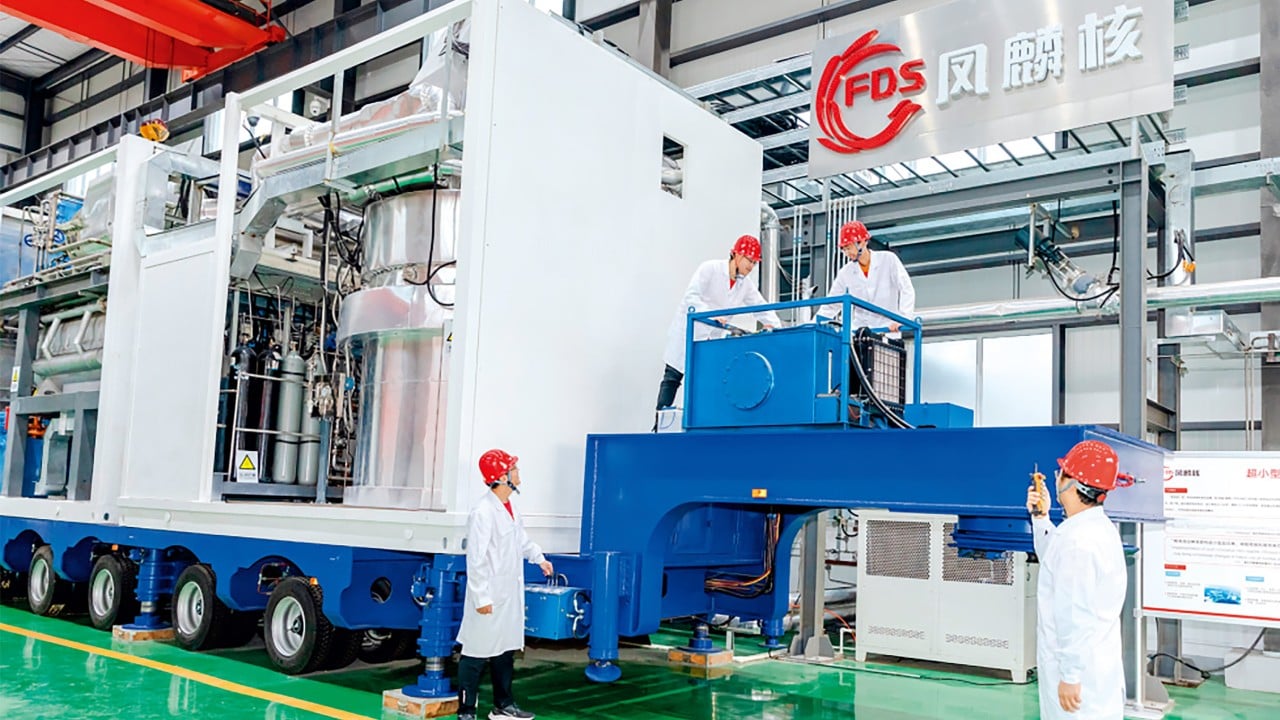
China’s transition from static power grids to mobile, modular nuclear assets represents a fundamental shift in the energy-compute bottleneck. By mounting a localized nuclear reactor onto a truck chassis specifically to sustain artificial intelligence data centers, the state is bypassing the physical constraints of traditional power transmission. Standard power grids suffer from resistive loss over distance and rigid infrastructure requirements; a mobile fission unit decouples the "intelligence factory" from the "power plant," allowing for the rapid deployment of high-density compute clusters in environments where the grid is either nonexistent or insufficient.
The Mechanics of Mobile Fission
The technology in question—a containerized lead-bismuth cooled fast reactor—operates on principles of thermal density and passive safety. Unlike traditional pressurized water reactors (PWRs), which require massive footprints and complex cooling loops, these mobile units prioritize energy density per square meter.
The efficiency of these systems is defined by three primary variables:
- Thermal Exchange Efficiency: Lead-bismuth eutectic (LBE) has a high boiling point ($1670^{\circ}C$), allowing the reactor to operate at higher temperatures without the risk of coolant vaporization. Higher temperature differentials lead to better Rankine cycle efficiency in electricity generation.
- Neutron Economy: Fast reactors do not require a moderator like water or graphite. This allows for a more compact core design, essential for road-legal transport constraints.
- Physical Footprint constraints: The reactor, heat exchanger, and shielding must fit within a standard heavy-duty transport dimensions (approximately 12 to 15 meters in length).
This is not a miniaturized version of a large plant; it is a specialized thermal engine designed for high-availability loads. In a data center context, power must be "always-on" (99.999% uptime). Traditional renewables like solar or wind require massive battery storage to reach this reliability; a mobile nuclear unit provides base-load power at the point of consumption.
The Logic of Compute-Power Convergence
AI training and inference workloads have a specific "power signature." They are characterized by massive, sustained energy draws with high thermal output. Current data center scaling is limited by "Grid Connection Latency"—the years it takes for utility companies to approve and build high-voltage lines to a new site.
By utilizing a truck-mounted reactor, a developer can choose a site based on land cost, proximity to fiber optics, or cooling water access, rather than grid proximity. The reactor becomes a "plug-and-play" energy module. This creates a new economic model: Energy-as-a-Service (EaaS) for the GPU cluster.
Thermal Dissipation Synchronization
The bottleneck for high-density AI chips (like the NVIDIA H100 or domestic Chinese equivalents B200) is cooling. A mobile reactor produces waste heat. If the data center and the reactor are co-located, the cooling infrastructure can be integrated. Integrated thermal management reduces the total energy cost of cooling (PUE - Power Usage Effectiveness), as the reactor’s own cooling systems can be leveraged to drive absorption chillers for the server racks.
Operational Redundancy
A single reactor represents a single point of failure. The strategic deployment pattern involves a "N+1" modular cluster. If an AI cluster requires 50MW of power, the deployment would consist of six 10MW mobile reactors. This allows for staggered refueling and maintenance cycles without shutting down the compute workload. The ability to swap out a "depleted" reactor unit with a fresh one via road transport eliminates the multi-month downtime associated with traditional reactor refueling.
Geopolitical and Tactical Implications
The mobility of these power sources introduces a strategic advantage in decentralized computing. In a scenario where central power grids are targeted or failing, "sovereign AI" remains functional.
Decentralization as Defense
Static data centers are easy targets. A mobile compute-and-power stack can be relocated. This is not merely about surviving kinetic conflict; it is about economic resilience. If a specific region faces an energy crisis, the "compute power" can physically move to where the resource constraints are lower.
The Nuclear-Compute Supply Chain
China’s dominance in the rare-earth and battery supply chain is being mirrored in the modular reactor space. By standardizing the "reactor-on-wheels" format, they are creating a repeatable, exportable product. The constraint shifts from "Who has the best grid?" to "Who has the most modular reactors?"
Risk Profiles and Structural Limitations
The strategy is not without significant friction. The primary hurdles are not just technical, but regulatory and logistical.
- Radiological Security: Moving nuclear material on public roads creates a massive security profile. Each unit requires a specialized security detail, turning a power plant into a high-value military convoy.
- Meltdown Risks vs. Mobility: While lead-bismuth reactors are "walk-away safe" (the coolant solidifies if the temperature drops, sealing the core), the structural integrity of a reactor during a high-speed vehicle accident is an unproven variable.
- Waste Management: Small modular reactors (SMRs) often produce more waste per unit of electricity generated than large-scale plants because of neutron leakage and the surface-area-to-volume ratio of the core. The logistics of managing spent fuel from hundreds of mobile units across a country is a massive operational burden.
The Strategic Shift in Energy Arbitrage
The ultimate goal of this technology is to lower the "Levelized Cost of Compute" (LCOC). In the current market, the cost of an AI model is $Hardware + Electricity + Talent$. As hardware becomes a commodity and talent scales, electricity becomes the primary differentiator.
China’s play is to decouple electricity costs from the fluctuations of the global energy market and the inefficiencies of the national grid. By manufacturing energy units at scale (factory-built reactors), they apply the "learning curve" of manufacturing to nuclear power.
Traditional nuclear is expensive because every plant is a bespoke civil engineering project. A truck-mounted reactor is a manufactured product. When you build 1,000 units of the same design, the cost per unit drops precipitously. This allows for a lower price per kilowatt-hour specifically for the AI sector, subsidizing the development of Large Language Models (LLMs) and computer vision systems at a rate the West cannot currently match.
Tactical Execution for Infrastructure Development
For an organization or state to compete with this model, the following sequence must be initiated:
- Regulatory Decoupling: Separate the licensing of SMRs from large-scale nuclear power plants. A 10MW mobile unit should not require the same 10-year environmental impact study as a 1GW coastal plant.
- Standardization of Interconnects: Develop a universal "power-bus" for data centers that can accept direct DC output from modular reactors, bypassing the need for AC conversion and traditional transformer substations.
- Mass Production of Shielding: The primary weight of these units is the lead/concrete shielding. Innovations in high-density composite shielding are required to keep the units within the 40-ton road weight limits.
The integration of mobile fission and AI data centers is the end of "General Purpose Energy." We are entering an era of "Task-Specific Power," where the reactor is as much a part of the computer as the GPU itself. The competition is no longer about who has the fastest chips, but who can bring the most concentrated energy to the chip the fastest.
Strategic priority must be placed on the mass production of these thermal modules. Organizations that rely on the grid for AI training will eventually be out-competed by those who own their energy generation. The final move is the total vertical integration of the "Intelligence Stack," from the uranium mine to the inference API. Ownership of the energy source is the only way to guarantee the long-term viability of high-compute industries.