France is quietly dismantling the wall between its national defense and the security of the European continent. For decades, the French nuclear "sanctuary" was a strictly hexagonal affair, defined by the protection of "vital interests" that remained purposefully vague. Today, that vagueness is being traded for a more aggressive, integrated posture. Emmanuel Macron’s recent signals regarding the European dimension of French nuclear deterrence aren't just diplomatic flourishes; they represent a fundamental pivot in how Paris views the bomb as a tool of collective bargaining rather than a solitary shield.
This shift is driven by a crumbling American security guarantee and the resurgence of high-intensity conventional warfare on European soil. Paris realizes that a "France first" nuclear doctrine is a relic of the Cold War. If a tactical nuclear strike hit a NATO base in Poland or Germany, the radioactive fallout and geopolitical shockwaves would disregard French borders entirely. The doctrine is evolving because reality has forced its hand.
The Death of the Sanctuary Myth
The traditional Gaullist doctrine rested on the concept of dissuasion du faible au fort—deterrence of the weak against the strong. The idea was simple: France didn't need to match the Kremlin missile for missile. It only needed the capability to "tear off an arm" to make any aggression against French soil a suicidal trade for an invader. This required a strict policy of independence. France would never place its nukes under NATO command, and it would never tell an adversary exactly where its "red lines" were drawn.
That independence is now colliding with the necessity of European "strategic autonomy." When the French President suggests that French nuclear forces have a "European dimension," he is essentially inviting his neighbors to sit under the French umbrella without giving them their hands on the trigger.
It is a delicate, often clumsy dance. Berlin remains skeptical, haunted by its own history and deeply wedded to the American nuclear sharing program. Warsaw wants more than just French promises; it wants boots on the ground. Yet, the shift is undeniable. France is moving from a posture of "don't touch my garden" to "this entire street is under my protection."
The Infrastructure of Escalation
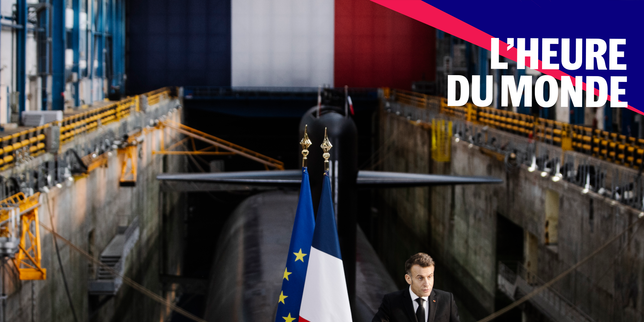
To understand the change, you have to look at the hardware. France is not just changing its speeches; it is overhauling its entire nuclear triad. The Force Océanique Stratégique (FOST) remains the backbone, with four Triomphant-class ballistic missile submarines (SSBNs) ensuring that at least one is always at sea, hidden in the depths of the Atlantic.
But the real movement is in the Forces Aériennes Stratégiques (FAS). The modernization of the ASMPA-R (Air-Sol Moyenne Portée Amélioré) missile—a supersonic, nuclear-tipped cruise missile carried by Rafale fighters—signals a commitment to "the final warning."
In French doctrine, the final warning is a single, limited nuclear strike designed to signal to an aggressor that they have crossed a line and that total destruction is the next step.
This specific capability makes French doctrine more flexible—and perhaps more dangerous—than the massive retaliation models of the past. It suggests that France is prepared to use nuclear weapons not just as a response to a total invasion, but as a tool to stop a conventional conflict from spiraling out of control.
Why the European Umbrella is Leaking
The primary hurdle for a Europeanized French doctrine is trust. For decades, Europe has relied on the American B61 gravity bombs stationed in places like Germany, Italy, and the Netherlands. These are tactical weapons, meant for the battlefield. The French, by contrast, focus on strategic deterrence.
When Paris offers to discuss the "European dimension" of its nukes, it isn't offering to share the launch codes. It is offering a seat at the table to discuss "strategic culture." To a fearful Baltic state, a lecture on strategic culture is a poor substitute for a US Army armored division.
Furthermore, there is the math of the budget. France is spending roughly 5 billion Euros annually on its nuclear forces, a figure set to rise to 6 billion or more as the next generation of submarines and missiles comes online. If France is to protect Europe, who pays the bill? If Germany contributes to the cost, they will demand a say in the target list. This is the "sovereignty trap." You cannot have a shared defense without shared command, and no French president is ready to give up the sole authority to fire.
The Russian Factor and the New Nuclear Brinkmanship
The Kremlin has spent the last three years reminding the world that its nuclear arsenal is not just for show. Moscow’s frequent brandishing of "tactical" nukes is designed to paralyze Western decision-making. France’s response has been a quiet hardening of its own stance.
We are seeing a move away from the "peace dividend" era. The French military is now openly training for high-intensity conflict where the line between conventional and nuclear is blurred. This is the trans-boundary threat. If Russia utilizes a low-yield weapon in a "limited" capacity to freeze a conflict, the current French doctrine of the "final warning" becomes the most relevant counter-move in the Western arsenal.
Unlike the US, which has a variety of tactical options, the French only have two speeds: conventional and nuclear. This lack of a middle ground was once seen as a weakness. Now, in a world of "gray zone" warfare and hybrid threats, it is being repositioned as the ultimate deterrent. It forces the adversary to calculate that any misstep could lead to the end of the world, rather than a manageable exchange of tactical fire.
The Industrial Reality of the Next Generation
Behind the geopolitical grandstanding lies a massive industrial effort. The SNLE 3G (third-generation) submarine program is the most complex engineering project in French history. These boats must be quieter than the ocean itself. They must be able to launch the M51.3 ballistic missile, which is designed to penetrate any foreseeable missile defense system through sheer speed and sophisticated decoys.
This isn't just about security; it's about the French economy. The nuclear sector supports over 200,000 jobs and maintains a technological edge that would otherwise vanish. When France defends its nuclear doctrine, it is also defending its status as a top-tier industrial power.
The M51 missile family is a marvel of physics.
$$F = m \cdot a$$
The force required to propel a multi-ton missile from a submerged tube into lower-earth orbit involves propulsion technology that only a handful of nations possess. By keeping this technology purely national, France ensures that it can never be "turned off" by a change in administration in Washington.
The Risks of a More Assertive France
There is a dark side to this doctrine shift. By making the French nuclear umbrella more explicit over Europe, Paris increases the risk of being drawn into a conflict it cannot control. If a skirmish in the Suwalki Gap escalates, and France has spent years claiming that its "vital interests" now include Polish sovereignty, the pressure to escalate becomes a self-fulfilling prophecy.
Moreover, this shift risks alienating the very allies it seeks to protect. Germany’s "Zeitenwende" (turning point) has seen a massive increase in defense spending, but most of that money is heading toward American F-35s, which are specifically designed to carry American nukes. This reinforces the "Atlanticist" bond at the expense of the "Europeanist" vision pushed by Macron.
France is essentially trying to sell a product that the rest of Europe isn't sure it wants to buy—especially when the American version comes with a global logistics network and a history of being the "world's policeman."
The Silent Redefinition of Vital Interests
The most significant change isn't in the missiles or the submarines, but in the definition of the word "vital."
In the 1960s, a vital interest was the soil of France. In the 1990s, it expanded to include the stability of the immediate neighborhood. Today, a vital interest is effectively the integrity of the European Union. This isn't just a linguistic trick; it's a recognition that the French state cannot survive in a vacuum.
If the European project collapses under the weight of an external military threat, France—no matter how many nukes it has—becomes a besieged island. Therefore, the bomb must follow the flag. The deterrent must cover the market, the currency, and the political union.
The era of the "solitary sanctuary" is over. France is moving toward a model of Integrated Deterrence, where the nuclear threat sits at the top of a pyramid of diplomatic, economic, and conventional military power. It is a high-stakes gamble that assumes the rest of Europe will eventually prefer a protector in Paris over a distracted one in Washington.
The ambiguity hasn't disappeared—it has just moved. We no longer ask if France would use the bomb, but rather where the French map now ends. The answer seems to be moving further east every year.
Monitor the upcoming NATO summits for the "SDA" (Strategic Deterrence Awareness) discussions; that is where the real friction between the French "independent" model and the American "shared" model will finally boil over.