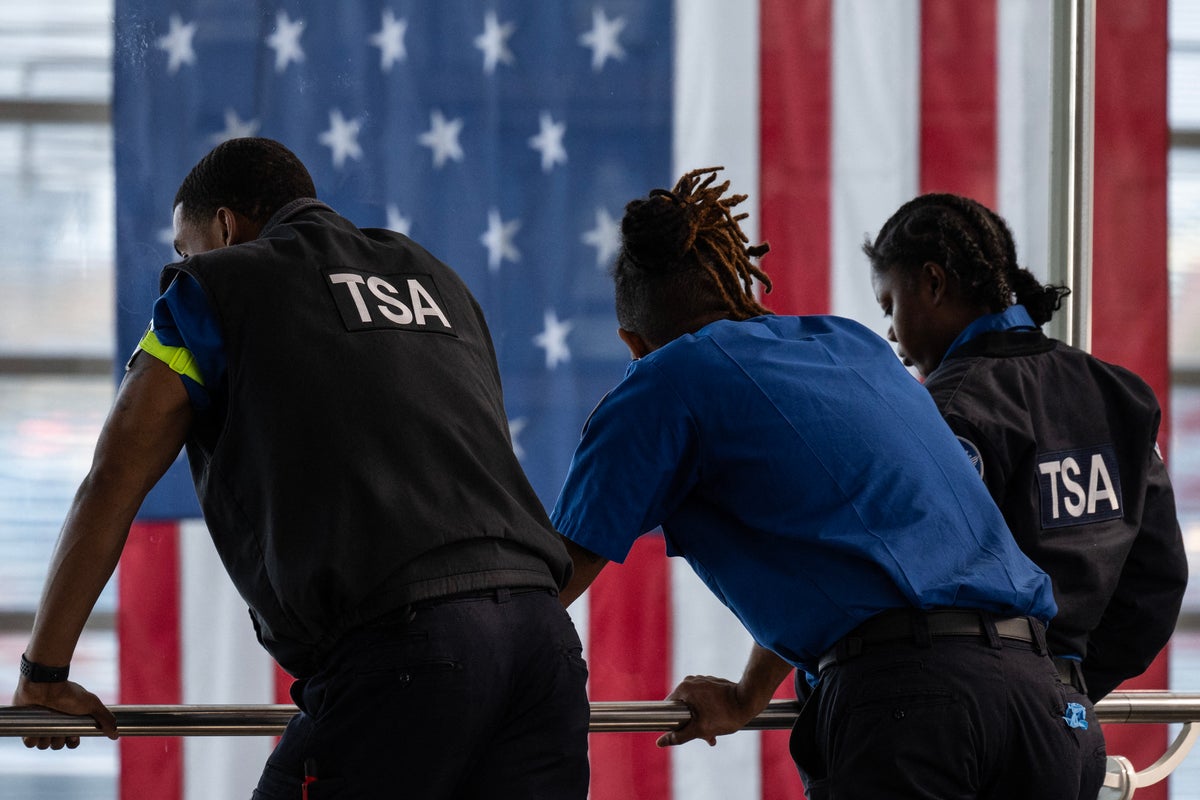
The alarm clock doesn’t care about political stalemates. At 4:00 AM, in a modest apartment outside of Chicago, it chirps with the same indifference it has shown for a decade. Maria reaches out, silences the noise, and stares at the ceiling. She is a TSA agent, a woman whose hands have patted down a thousand shoulders and whose eyes have scanned ten thousand suitcases for the shapes of shadows that shouldn't be there. She is essential. She is a frontline defender of the American sky.
She is also broke.
For weeks, Maria and hundreds of thousands of her colleagues across the Department of Homeland Security (DHS) have been living in a strange, suspended reality. They go to work. They put on the uniform. They stand for eight hours on polished linoleum floors. Then, they come home to mailboxes filled with bills they cannot pay because the government they serve has ceased to pay them. The shutdown wasn't just a headline on a flickering news screen. It was the silence of a bank account that had hit zero. It was the "reduced" sticker on a gallon of milk.
Then came the vote.
The House of Representatives finally moved. They passed a bill to end the DHS shutdown and, more importantly, to trigger the back pay that would allow people like Maria to breathe again. This wasn't just a legislative maneuver; it was a life raft thrown into a very cold sea.
The Mathematics of Survival
When people talk about government shutdowns, they often speak in the abstract. They talk about "agency funding," "appropriations," and "legislative deadlock." These words are bloodless. They don't capture the feeling of sitting at a kitchen table with a calculator and a pile of past-due notices.
Consider the "Gap," a hypothetical but painfully accurate representation of a mid-career DHS staffer’s finances during this period. For twenty-six days, the income stopped. But the rent didn't. The car note didn't. The interest on the credit card used to buy groceries certainly didn't.
The House bill was designed to bridge this chasm. By voting to fund the DHS through the end of the fiscal year, lawmakers didn't just reopen offices; they restored a social contract. The agreement is simple: you work, you get paid. When the government breaks that contract, the friction doesn't just stay in D.C. It ripples out to the security line at JFK, the Coast Guard station in Cape May, and the Secret Service detail in the capital.
The bill’s passage meant that the TSA—an agency where morale often hangs by a thread even in the best of times—could finally stop seeing its officers look for work at local fast-food joints during their off-hours. It meant the "essential" employees who had been working without pay for nearly a month were no longer being treated as volunteers for a cause they didn't choose.
The Invisible Stakes of a Tired Guard
We often take for granted the people who stand between us and chaos. We see the blue shirts at the airport as a hurdle, a delay, a minor annoyance in our journey to a vacation or a business meeting. We forget that these people are human beings with mortgages and sick parents.
During the shutdown, the stakes were higher than anyone wanted to admit. Financial stress is a distraction. A distraction is a vulnerability. When a border patrol agent is wondering if their electricity will be cut off the following Tuesday, they are not 100% focused on the sensor reading in front of them. Security is a game of margins.
The House vote was a recognition that we cannot ask people to protect us while we refuse to provide for them. The legislation didn't just address the immediate paychecks; it addressed the systemic instability that threatened the very mission of the DHS. By decoupling the funding of the department from broader, more contentious political fights, the House attempted to insulate national security from the theater of partisan warfare.
The Long Walk Back to Normal
Passing a bill is a moment of high drama in the Capitol, but the effects take time to reach the ground. For Maria, the vote didn't mean money appeared in her account that afternoon. It meant the promise of money.
She still had to walk into the airport the next day. She still had to face the passengers—some of whom were sympathetic, while others were oblivious or even hostile. But there was a shift in the air. The resentment that had been simmering in the breakrooms started to dissipate. The fear of the unknown was replaced by the logistics of recovery.
Recovering from a month of no pay isn't as simple as receiving a lump sum. There are late fees to negotiate. There are apologies to make to landlords. There is the slow, grinding process of rebuilding a credit score that took a hit because of a situation entirely out of your control. The bill provided the capital, but the workers had to provide the labor of putting their lives back together.
The legislative process is often criticized for being slow and disconnected from the "real world." In this instance, the disconnection was nearly fatal for the financial health of thousands. The vote was a correction. It was a late, necessary admission that some functions of a society are too important to be used as leverage.
Beyond the Paycheck
The core of the issue wasn't just the dollars and cents. It was the dignity.
To work for your country is a point of pride for many in the DHS. They view themselves as the "Thin Blue Line" of the sky and the sea. When that country tells them their labor isn't worth a timely paycheck, it erodes the foundation of that pride. It makes the uniform feel like a costume.
The House vote restored the weight of the badge. It sent a signal that, despite the noise and the bickering, the work matters. The bill moved to the Senate and eventually to the President’s desk, carrying with it the hopes of families who had been stretching a single box of pasta across three nights.
There is a specific kind of exhaustion that comes from being told you are "too important to stay home" but "not important enough to be paid." That exhaustion doesn't vanish overnight. It leaves a scar. It makes the next generation of workers think twice before entering public service.
But for now, the lights are staying on.
Maria sits at her table again, but this time, the calculator is put away. She drinks her coffee in the dark, watching the first hints of blue touch the horizon. She has a shift to start. She has a country to keep safe. And for the first time in a month, she knows that when she comes home, the work she did will have been recognized not just with a thank you, but with the means to live.
The vote was a piece of paper, a tally of "yeas" and "nays" in a marble room miles away. But in a kitchen in Chicago, it was the sound of a heavy burden finally hitting the floor.
Maria stands up, adjusts her belt, and heads for the door. The skies are waiting.