The Scapegoat Industry
Every summer in Edmonton, the routine repeats.
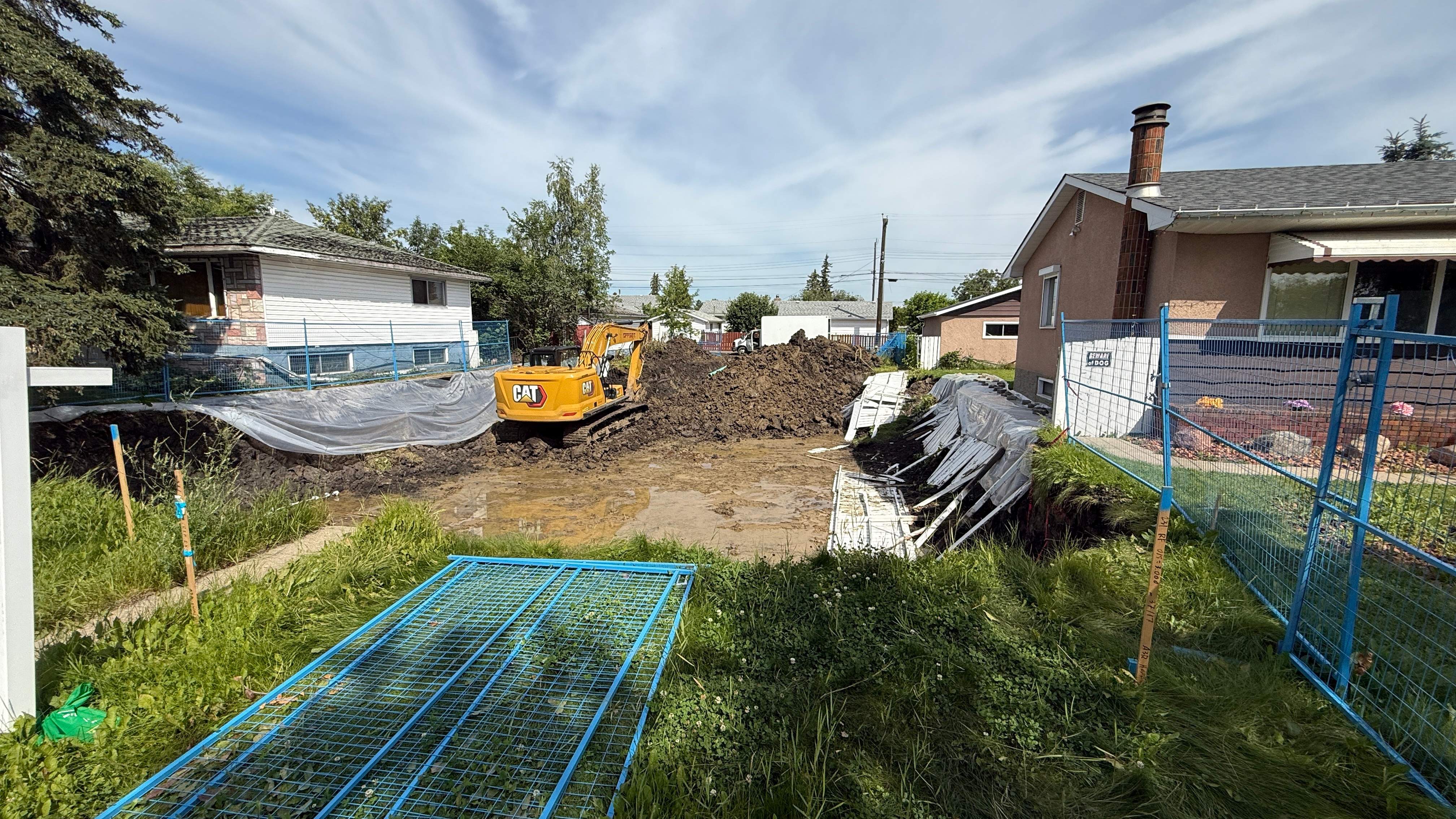
An infill developer digs a massive hole in a mature neighborhood to drop a modern narrow-lot duplex. A heavy July thunderstorm hits. Millions of gallons of prairie water rush down suburban slopes, the saturated clay gives way, and a neighbor’s driveway or fence line slumps into the excavation.
Local news crews show up with cameras rolling. Homeowners stand in front of collapsed sod, shaking their heads, pointing fingers directly at the guy with the excavator. Municipal politicians clutch their pearls, talking about developer greed, community character, and cracking down on bad actors.
It makes for great television. It also completely misses reality.
I have spent decades watching urban densification battles play out across Canadian municipalities. I have seen developers absorb hundreds of thousands of dollars in sudden remediation bills because a rainstorm acted like physics.
Blaming the builder for erosion at the edge of an excavation is an emotional crutch. It lets the city avoid facing the structural failure of its own infrastructure, its antiquated zoning bylaws, and its refusal to update historical civil engineering standards for a changing climate.
Stop blaming the guy who dug the hole. Look at the system that forced him to dig it right up to the property line.
The Physics of Prairie Soil Nobody Wants to Discuss
Let us clear up a fundamental engineering reality right out of the gate. Edmonton sits on glaciolacustrine silt and heavy plastic clay. When dry, this ground behaves almost like concrete. When it gets soaked, it loses its shear strength entirely.
Civil engineers call this the angle of repose. Common dirt wants to sit at a natural slope of roughly thirty-five degrees.
Now look at modern infill mandates. Municipal planners demand high-density housing on fifty-foot lots or split twenty-five-foot lots. To build a code-compliant structure with a functional basement on a narrow urban footprint, builders cannot leave a gentle thirty-five-degree dirt slope inside the property lines. They have to cut straight down. Vertical excavations require shoring, tie-backs, or engineered sheet piling.
When a homeowner complains that their yard eroded into their neighbor’s excavation, they are usually looking at a failure of temporary geotechnical retention during a historic weather event.
Municipalities love to write bylaws saying, You must protect adjacent properties. Sounds great on paper. But they completely ignore the fact that the city's own civil designs—narrow public right-of-ways, inadequate neighborhood storm trunk lines built in the 1960s, and saturated public boulevards—funnel water directly onto private property edges.
Imagine a scenario where a municipality forces high-density infill into older neighborhoods while keeping the storm sewer capacity of a sleepy 1950s suburb. That is Edmonton today. The excavation did not cause the erosion. The excavation simply exposed how fragile the surrounding neighborhood water management actually is.
The Cost of Zero-Lot-Line Hypocrisy
Let us talk about the rules of engagement.
City hall mandates densification. They tell the public that inner-city neighborhoods must grow inward instead of sprawling outward. They point to transit-oriented development and smart growth principles.
Then, they enforce zoning setbacks and spatial separations that make safe excavation practically impossible without trespassing on municipal or neighbor land.
When a builder applies for a permit, they work within constraints dictated by bureaucrats who have never stepped foot on a job site during a microburst storm. The city demands maximum lot coverage. They want houses pushed as far out as legally possible to maximize property tax assessments.
Then, gravity does what gravity always does. Water moves from high points to low points.
If a neighbor's sod shears off and slides into the pit, who is at fault? The instinct is to scream negligence. But look closer at the site logs. Look at the geotechnical reports that were stamped and approved by the city's own engineering departments.
The reports are followed to the letter. Shoring is installed according to provincial safety codes. Drainage pumps run around the clock. And yet, when an unprecedented downpour drops a month's worth of rain in twenty minutes, the clay liquefies.
You cannot sue meteorology. But you can fine a developer, which is much easier for a cash-strapped city council looking to appease angry voters in established wards.
Why the Traditional Builder Response Fails
For years, the industry defense has been weak. Developers issue polite statements about cooperating with neighbors, fix the damage out of pocket to avoid litigation delays, and quietly bake the cost of community relations into the next project.
That approach is dead. It feeds the narrative that builders are rogue operators tearing apart mature neighborhoods with zero regard for human collateral.
The truth is darker: the current model of urban infill is built on regulatory gaslighting.
Municipalities want the tax revenue of high-density housing without investing a dime in upgrading the surrounding trunk mains, curbs, and alley grading. They allow infill permits to surge while leaving century-old clay tile storm sewers underneath the pavement to choke under heavy loads.
When an excavation collapses, the neighbor loses a strip of lawn. The builder loses twenty grand in remediation costs and weeks of schedule delays. Meanwhile, the city walks away scot-free, collecting permit fees on a lot that they zoned for failure.
The Unconventional Playbook for Property Owners
If you own a home next to an infill site, stop waiting for the city to protect your property line. The municipal inspector is not your guardian angel. He is a checkbox clerk.
Here is what actually works when a lot next door goes vertical:
Do not wait for the dig. The moment a demolition permit is pulled for the tear-down house next door, hire an independent private structural engineer to document the baseline condition of your foundation, your driveway, and your property grade. Pay the three hundred dollars out of pocket. That document is your shield.
Talk to the site superintendent on day one. Bring him a coffee. Ask him directly about his shoring plan, his dewatering strategy, and where his sump discharge hoses are running. If he looks you in the eye and tells you everything will be fine without showing you engineered drawings, panic. If he hands you a clear plan detailing how they are managing surcharge loads from your concrete driveway, relax.
Understand your own roof runoff. Most homeowner erosion complaints during excavations happen because the homeowner's own downspouts dump roof water directly within three feet of the property line, saturating the exact clay wall the neighbor is trying to excavate. You are eroding your own yard before the backhoe even arrives. Extend your downspouts ten feet out into the middle of your yard. Starve the excavation of your own water.
Dismantling the People Also Ask Fallacy
Every time this issue flares up in local forums or news segments, the same predictable questions surface. Let us answer them without the corporate spin.
Are developers legally liable for any damage to neighboring land during excavation?
Legally, yes, through the doctrine of lateral support. You have a common-law right to have your land supported in its natural state. But liability does not mean the developer is morally or operationally corrupt. When an act of God—like an extreme weather event that exceeds municipal 100-year storm thresholds—overwhelms standard shoring, the courts often look at contributory negligence, including poor municipal drainage design. Blanket blame is lazy law.
Can you stop a neighbor from building an infill excavation right next to your fence?
No. If the land is zoned for it and the permits are issued, private property rights dictate that the owner can build. Fighting the excavation itself is a losing battle. Fighting for robust geotechnical oversight and mandatory pre-construction structural bonds is where energy should go.
The Real Fix Edmonton Refuses to Fund
Fixing Edmonton's infill erosion crisis requires political courage that city hall simply does not possess.
It requires freezing single-lot infill permits in neighborhoods with compromised, undersized drainage until the city upgrades the underlying civil infrastructure. It requires municipal governments to stop playing both sides—cashing the checks for high-density tax assessments while washing their hands of the hydrological chaos that high-density creates on narrow lots.
Until politicians stop treating every construction accident as a moral failing by private enterprise and start treating it as a symptom of municipal underinvestment, backyards will keep sliding into holes.
The dirt does not care about your zoning bylaws.
Neither should you.