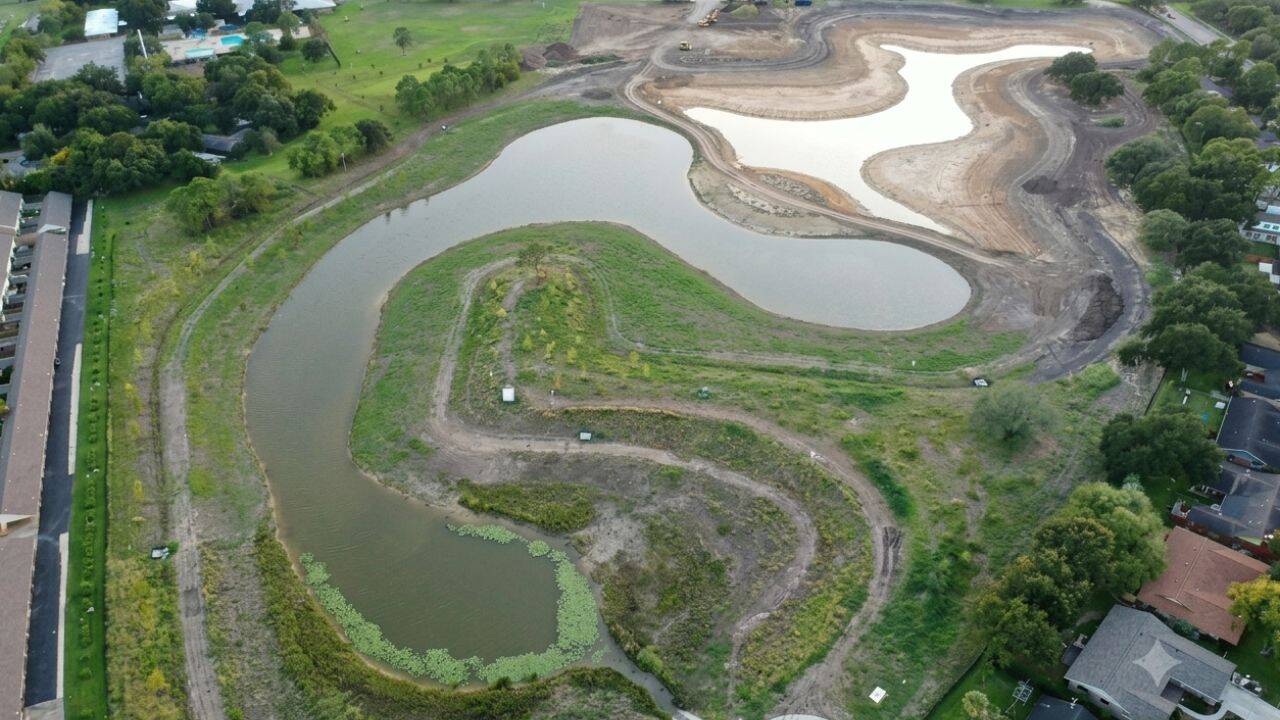
Urban hydrological collapse manifests when impervious cover outpaces drainage capacity, transforming standard rainfall events into catastrophic economic shocks. In Clear Lake, Texas, the municipal response to this structural failure bypassed traditional concrete channelization. Instead, stakeholders intercepted a defunct 200-acre golf course, converting a declining recreational footprint into a multi-tiered stormwater detention network. This intervention offers a blueprint for municipal asset repurposing, replacing vague ecological aspirations with cold, quantifiable hydraulic engineering and capital allocation metrics.
The Mechanics of Hydraulic Interception
Standard urban development replaces porous soil with impermeable concrete, multiplying surface runoff coefficients. When regional drainage basins reach saturation, kinetic energy from rising water levels destroys residential and commercial capital. The Clear Lake City Water Authority addressed this by shifting from conveyance-based drainage—which merely moves water downstream faster—to a retention-based architecture that stores volume at the point of vulnerability.
The engineering model relies on five interconnected wet-bottom detention basins engineered across the footprint of the former golf course. These basins are calculated to provide roughly 1,680 acre-feet of total floodwater storage capacity.
- Permanent water depth rests at six feet, maintaining baseline aquatic ecosystems.
- Surrounding terraced slopes extend upward to accommodate temporary flood storage up to thirteen feet deep during extreme events.
- The cumulative system retains approximately 500 million gallons of stormwater runoff sourced from roughly 2,000 acres of surrounding urban neighborhoods.
This topography functions as a physical buffer. By holding half a billion gallons of water off the streets, the infrastructure reduces peak hydraulic pressure on municipal storm sewers, preventing system-wide backflow.
Capital Allocation and the Cost Function
Transforming prime suburban real estate into public infrastructure requires navigating severe fiscal constraints. Commercial developers originally targeted the defunct golf course for high-density residential housing. Had that conversion occurred, the resulting increase in impervious surface area would have permanently escalated local runoff volumes and exacerbated regional flood liability.
The Clear Lake City Water Authority preempted this private acquisition through a targeted land purchase executed in 2011 for approximately $6.25 million, funded via existing drainage bond reserves. Over subsequent phases, the total capital expenditure for excavation, terraced landscaping, wetland planting, and trail construction scaled to approximately $38 million to $40 million.
The financial return on this capital expenditure is measured through avoided loss metrics rather than direct revenue generation:
- Empirical field data established that during Hurricane Harvey—while the first phase was only 80 percent excavated—the basin intercepted 100 million gallons of water, directly shielding 150 homes from structural inundation.
- Macro-level evaluations indicate the completed infrastructure has prevented an estimated $300 million in cumulative flood damages.
- Property value evaluations in the immediate impact zone recorded a $120 million appreciation surge, driven by reduced flood risk and the presence of permanent green space amenities.
Funding mechanisms avoided reliance on a single municipal tax vector. The portfolio integrated water district bonds, state and federal environmental grants, private donations, and thousands of hours of organized volunteer labor to compress operational expenditures.
Dual-Asset Utilization and Ecological Engineering
Traditional flood control engineering relies on single-purpose gray infrastructure—concrete basins and subterranean box culverts—that remain dry and economically dormant 99 percent of the time while creating maintenance liabilities. The Texas intervention reallocates this acreage into a dual-asset matrix.
When dry, the site operates as a community park featuring six miles of concrete trails, athletic fields, and native reforestation zones. When meteorological events trigger heavy runoff, the park seamlessly reverts to its primary engineering purpose as a high-capacity hydraulic reservoir.
Simultaneously, 40 acres of dedicated wetlands function as a biological filtration matrix. Plant roots, soil microbes, and biofilms process urban runoff before it reaches Galveston Bay, acting as a decentralized water-treatment facility that degrades heavy hydrocarbons, excess nitrogen, and particulate pollutants. This integration of ecological restoration with heavy civil engineering lowers long-term asset management costs while satisfying federal environmental compliance mandates.
Operational Constraints and Systemic Limitations
Municipalities attempting to replicate this model must account for structural limitations inherent to green-gray hybrid infrastructure.
- Geographic Dependency: The strategy requires large, contiguous parcels of open land located immediately adjacent to high-density runoff zones. In densely built urban cores, acquiring 200 contiguous acres at fair market value is financially prohibitive.
- Maintenance Velocity: Unlike concrete channels, biological retention basins require active vegetation management. Invasive species colonization and silt accumulation can degrade storage capacity over time if maintenance budgets are neglected.
- Capacity Ceilings: While retention basins absorb standard to severe tropical storm events, they operate under finite volume boundaries. A precipitation event exceeding the 1,680 acre-foot threshold will inevitably bypass the system, necessitating regional watershed coordination rather than localized retention.
Strategic Deployment
Municipalities facing chronic urban inundation should audit defunct recreational properties—such as golf courses, country clubs, and obsolete industrial yards—as primary candidates for hydraulic repurposing. Real estate acquisition costs for distressed recreational land are frequently lower than the cumulative economic damage of a single major flood event. Regional water authorities must partner with urban planners early to intercept parcels before high-density private development permanently locks in high runoff coefficients, utilizing phased bond financing backed by clear, data-driven hydrological impact modeling.