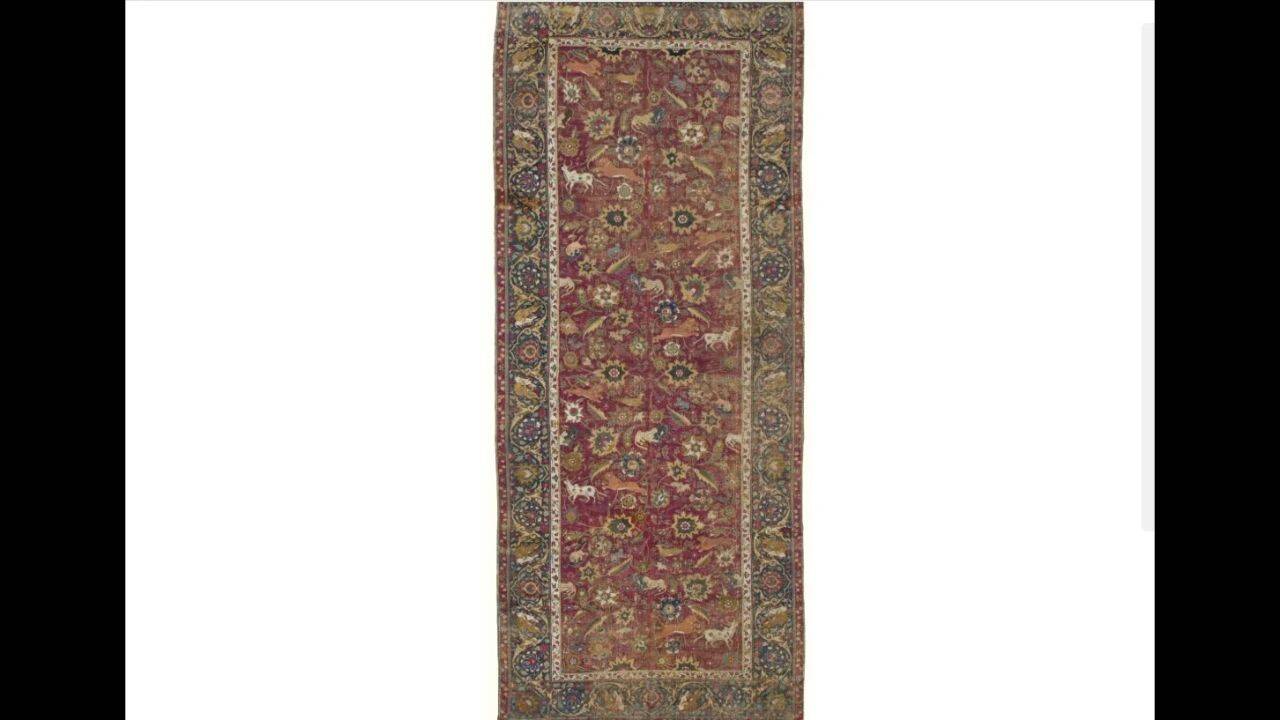
The return of a 17th-century Mughal carpet to the auction block—carrying an ownership chain spanning a U.S. financier, a prominent novelist, and the Thyssen industrial dynasty—exposes the exact pricing mechanics of the ultra-high-end antiquities market. In standard asset classes, price correlates linearly with intrinsic utility and supply-demand equilibrium. In museum-grade Islamic textiles, supply is strictly fixed at zero new production, shifting price determination entirely to a tri-variable valuation model: material survival, imperial origin, and biographical provenance.
The Structural Valuation Model of Imperial Textiles
When institutional collectors and sovereign wealth funds bid on surviving textiles from the reign of Shah Jahan or Jahangir, they are not purchasing decorative floor coverings. They are acquiring illiquid, non-fungible cultural capital. The market separates standard antique carpets from trophy assets through three distinct filters. Don't miss our recent article on this related article.
1. Material Entropy and Survival Mechanics
Wool, silk, and pashmina degrade rapidly under mechanical stress, light exposure, and humidity. Unlike bronze sculptures or ceramic vessels, a 400-year-old textile functions as an active thermodynamic anomaly. The survival of a large-format carpet from the early 1600s requires four centuries of uninterrupted, climate-stable indoor storage—a condition historically met only within royal treasuries, aristocratic European estates, or climate-controlled modern vaults.
Because textile conservation cannot reverse fiber embrittlement without destroying historical authenticity, condition acts as a binary gatekeeper. A carpet exhibiting original pile depth, intact selvedges, and unbleached natural dyes commands an exponential premium over a heavily restored peer of identical age. The market penalizes restoration aggressively because chemical stabilization alters the original knot structure, lowering institutional loan eligibility. To read more about the history here, Reuters Business provides an in-depth summary.
2. Imperial Workshop Attribution
The Mughal court operated imperial karkhanas (workshops) in Lahore, Agra, and Kashmir that functioned as vertically integrated luxury monopolies. These workshops did not produce for commercial export; they produced diplomatic gifts and palace furnishings. Attributing a carpet to an imperial karkhana relies on structural forensics rather than signature:
- Knot Density: Imperial weavers frequently executed asymmetrical (Persian) knots exceeding 400 to 600 knots per square inch, utilizing fine pashmina wool on silk warps.
- Botanical Precision: Designs from the Shah Jahan period mirror contemporary architectural pietra dura inlays (such as those at the Taj Mahal) and court miniature painting, featuring naturalistic, asymmetrical flowering plants rather than rigid geometric repeats.
- Dye Chemistry: High-grade crimson derived from cochineal or lac, paired with indigo and saffron, indicates access to global trade networks controlled directly by the Mughal treasury.
Without verifiable attribution to a specific imperial workshop, a 17th-century Indian carpet drops from a seven-figure trophy asset to a mid-six-figure decorative antiquity.
3. The Provenance Multiplier
Provenance in the art market operates as an asymmetric risk-reduction mechanism. Following the tightening of international cultural property laws and the 1970 UNESCO Convention frameworks, undocumented antiquities face severe liquidity discounts due to title-dispute risk. A documented chain of custody extending back to the early 20th century insulates the buyer from repatriation claims and customs seizures.
Deconstructing the Specific Ownership Chain
The headline appeal of this specific Mughal carpet rests on its three named custodians: a U.S. financier, a novelist, and the Thyssen family. Each owner category injects a different type of market validation into the asset's ledger.
The Industrial Dynasty (The Thyssen Effect)
Baron Heinrich Thyssen-Bornemisza and his heirs built one of the most scrutinized private art collections of the 20th century, alongside major holdings in classical carpets (such as the famous Thyssen-Bornemisza Mughal and Safavid textiles documented in major scholarly catalogues). When an object passes through the Thyssen collection, two things occur simultaneously:
- Scholarly Canonization: The object is photographed, measured, and published in peer-reviewed exhibition catalogues by leading textile historians. Once published in canonical literature, the carpet becomes a reference benchmark against which uncatalogued pieces are judged.
- Institutional De-Risking: The Thyssen name signals that the piece cleared top-tier curatorial vetting decades ago. Future buyers treat this historical curation as third-party due diligence, compressing the risk premium required to close a high-value transaction.
The U.S. Financier (Capital Allocation and Liquidity Signaling)
The inclusion of a prominent American financier in the ownership chain anchors the asset within the modern financialized art ecosystem. High-net-worth capital allocators treat rare Islamic art as an uncorrelated store of value—an inflation hedge that sits outside public equity markets. Financier ownership typically correlates with institutional-grade storage, updated conservation assessments, and strategic timing of market re-entry. When a financier consigns a trophy asset, the market interprets the move not as distress liquidation, but as portfolio rebalancing or estate structuring, which preserves price integrity during pre-sale marketing.
The Novelist (Cultural Narrative and Soft Power)
While industrialists and financiers establish financial and curatorial floors, literary ownership introduces cultural resonance. A celebrated novelist confers an intellectual aura onto the object, shifting its perception from a cold financial instrument to a lived-in artifact of high culture. In auction marketing, narrative friction drives competitive bidding among private buyers who bid with discretionary wealth rather than strict institutional acquisition budgets. The story of the object inhabiting a famous writer's study creates emotional differentiation that standard condition reports cannot replicate.
Market Mechanics: Why Trophy Carpets Return to Auction
Private treaty sales dominate the ultra-high-end art market when sellers prioritize discretion and price certainty. Choosing the public auction channel for a 400-year-old Mughal carpet with blue-chip provenance is a calculated strategic decision driven by three market dynamics.
Price Discovery in Thin Markets
Trophy Mughal carpets trade so infrequently—often once every twenty to forty years—that comparable sales data (comps) are effectively obsolete. Inflation, currency fluctuations, and the entry of new sovereign buyers from the Gulf states render past auction records unreliable. An auction forces real-time price discovery by pitting distinct buyer cohorts against one another: Western private collectors, Asian family offices, and Middle Eastern state museums (such as the Museum of Islamic Art in Doha or the Louvre Abu Dhabi). Only competitive public bidding can capture the upper tail of buyer willingness-to-pay when no baseline valuation exists.
The Auction House Guarantee Structure
To secure a consignment with Thyssen-level provenance, major auction houses routinely deploy financial engineering:
- Irrevocable Bids (Third-Party Guarantees): Before the auction catalog goes to print, the auction house secures a third-party backer who commits to buying the carpet at a pre-agreed minimum price. In exchange, the guarantor receives a share of the buyer's premium if the lot sells above that threshold.
- Enhanced Hammer Splits: Sellers of canonical works rarely pay standard vendor commissions; instead, they negotiate a percentage of the buyer's premium, aligning the auction house's marketing spend directly with maximizing the final hammer price.
Sovereign Demand as a Structural Price Floor
Over the past two decades, the primary marginal buyers of museum-grade Islamic art have shifted from European and North American collectors to state-backed cultural institutions in the Persian Gulf. These entities operate with multi-decade acquisition horizons and sovereign balance sheets, unencumbered by the return-on-investment hurdles that constrain private collectors. Because these institutions actively seek objects that represent the zenith of Islamic artistic production—and because Mughal court carpets are finite—sovereign demand creates a rigid price floor beneath any work with unimpeachable provenance.
Analytical Limitations and Valuation Risks
Even with blue-chip provenance and imperial attribution, treating a 17th-century textile as a frictionless financial asset carries distinct operational hazards:
- Extreme Illiquidity: Transaction costs in the auction market (combined buyer's and seller's premiums, specialized fine-art shipping, climate-controlled crating, and insurance) regularly consume 20% to 30% of the asset's gross value. To break even on a short-term hold, the underlying asset must appreciate by roughly a third.
- Export Licensing Bottlenecks: Depending on the jurisdiction where the carpet is currently housed, an export license may be required before the buyer can remove it from the country. National heritage boards in the United Kingdom and the European Union frequently place temporary export bars on canonical works to allow domestic museums time to match the auction price, freezing the buyer's capital for months.
- Attribution Drift: Textile scholarship evolves. Technical dye analysis (such as high-performance liquid chromatography) or radiocarbon dating can occasionally revise a carpet's dating or regional attribution by fifty years or shift it from an imperial court workshop to a provincial commercial center. Any downward revision in scholarly consensus immediately erodes secondary market liquidity.
Strategic Execution for Institutional Acquirers
For family offices, private collectors, or museum acquisition committees evaluating this consignment, bidding success depends on separating narrative appeal from structural value.
- Discount the Literary Provenance: Treat the novelist's ownership strictly as a marketing veneer. Assign zero basis points of valuation premium to non-institutional celebrity provenance; anchor your ceiling bid exclusively to the Thyssen scholarly publication record and physical fiber condition.
- Audit the Conservation Ledger: Demand full-spectrum UV photography and a back-of-carpet structural map prior to registering a paddle. Quantify the exact percentage of original pile versus re-woven foundation, discounting your maximum bid proportionally for any chemically stabilized areas that restrict future institutional lending.
- Exploit Pre-Sale Guarantee Mechanics: If your acquisition mandate allows, negotiate directly with the auction house to act as the third-party guarantor prior to the public sale. Providing the irrevocable bid locks in a floor acquisition price while generating a financing fee if a sovereign museum pushes the final hammer price beyond your valuation cap.