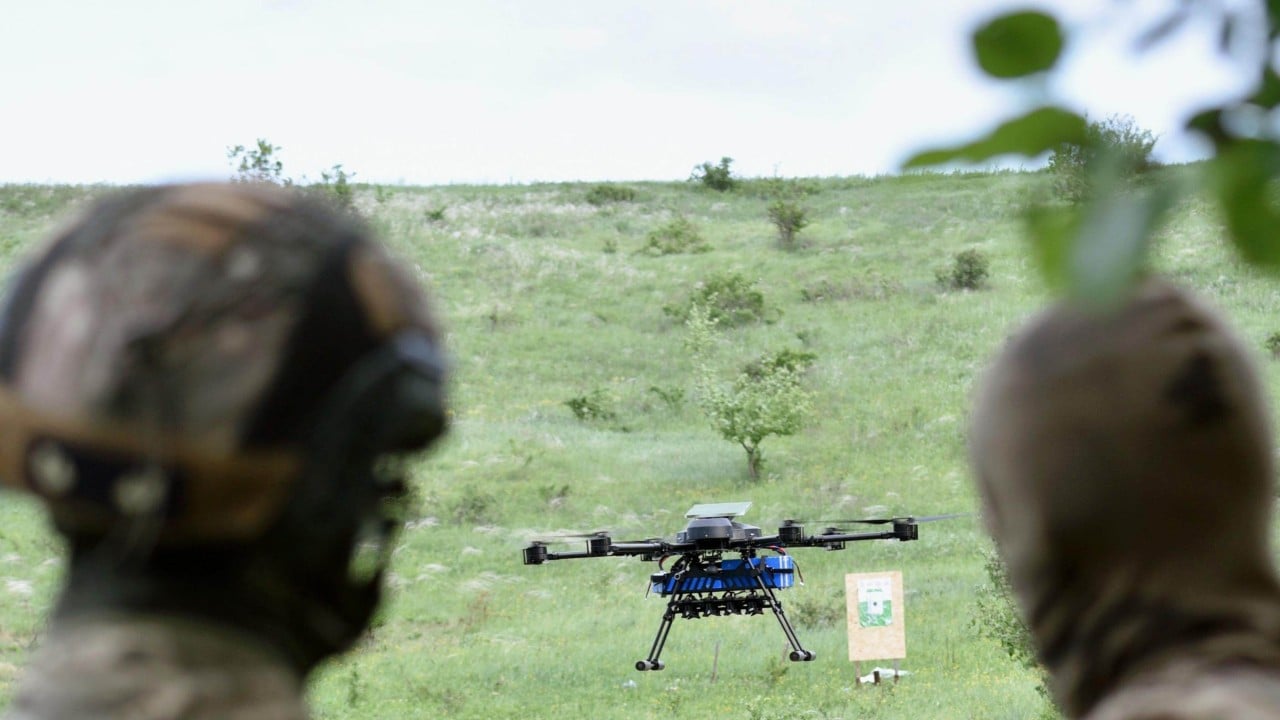
The issuance of the United Kingdom Ministry of Defence Investment Plan marks an explicit pivot from capital-intensive legacy hulls and crewed airframes toward low-cost, distributed, autonomous systems. The allocation of £5 billion over four years specifically for uncrewed platforms represents more than a technological upgrade. It represents an asymmetric optimization strategy designed to address a stark mathematical reality: the Royal Armed Forces cannot afford to absorb attrition under their current asset architecture.
Faced with a calculated £28 billion funding gap over the next four years, the state apparatus is attempting to re-engineer its cost function. The cancellation of the Type 83 destroyer program in favor of at least six Common Combat Vessels—designed specifically as networked command hubs for uncrewed systems—confirms that the era of relying on singular, multi-billion-pound platforms to project power is structurally over.
The Asymmetry of Modern Threat Metrics
Contemporary attrition warfare, demonstrated by the expenditure of roughly 200,000 uncrewed aerial vehicles monthly in Eastern Europe, has invalidated western procurement timelines. Traditional defense acquisition cycles require years to execute design reviews, whereas the modifications required to defeat electronic warfare jamming mechanisms now occur in weeks.
The defense infrastructure operates under a dual constraint model. First, the unit cost of legacy systems prevents mass deployment. Second, human personnel replacement rates are too low to sustain high-intensity operations. By shifting capital into uncrewed naval, aerial, and ground platforms, the state is attempting to decouple its offensive mass from its demographic and fiscal bottlenecks.
+------------------------------------------------------------+
|                TRADITIONAL REQUISITION MODEL               |
|  High Capital Investment -> Low Asset Volume -> Zero        |
|  Attrition Tolerance                                       |
+------------------------------------------------------------+
                             │
                             ▼
+------------------------------------------------------------+
|                 HYBRID DISTRIBUTED MODEL                   |
|  Fixed Command Hub (Crewed) + Scalable Expendable Nodes    |
|  (Uncrewed) -> High Attrition Tolerance                     |
+------------------------------------------------------------+
Structural Segmentation of the Hybrid Force
The technical execution of this strategy divides the operational environment into three core domains, each relying on a distinct mechanism of human-machine teaming.
Maritime Layer: The Transition to a Hybrid Fleet
The Royal Navy is restructuring its fleet architecture to shift the burden of sensing and engagement away from primary surface combatants. The cancellation of the Type 83 destroyer yields capital that will instead fund the acquisition of Common Combat Vessels. These vessels act as localized command nodes for four specialized classes of uncrewed systems:
- Type 91 Platforms: Uncrewed surface missile carriers designed to expand the vertical launch system magazine depth of the fleet without building additional frigates.
- Type 92 Platforms: Uncrewed sensor arrays deployed across the North Atlantic for persistent anti-submarine warfare tracking.
- Type 93 Vehicles: Extra-large uncrewed underwater vehicles designed to operate alongside crewed hunter-killer submarines, acting as force multipliers for sub-surface interdiction.
- Type 94 Systems: Aerial uncrewed nodes providing continuous wide-area radar surveillance to defend the homeland and surface groups from low-altitude cruise missiles.
This architecture removes the requirement for every ship to be a multi-mission platform. By isolating the sensing mechanism (Type 92 and 94) from the strike mechanism (Type 91), the destruction of a single node does not collapse the entire localized defense network.
Aerial Layer: Mass Over Contested Airspace
The Royal Air Force is addressing the high cost of fifth-generation crewed airframes through the Collaborative Combat Air programme. The financial reality of operating a small pool of crewed fighter aircraft means they cannot be risked in high-threat environments without substantial suppression of enemy air defenses.
To resolve this, the Storm Shroud uncrewed electronic warfare drone enters service this year. The system operates as an expendable forward screen, absorbing enemy radar illumination and executing localized jamming. The underlying logic dictates that a demonstrator for autonomous fighter jets must fly by 2030 to establish a long-term production pipeline where the ratio of uncrewed to crewed aircraft is at least four to one.
Land Layer: Organic Tactical Integration
The British Army is focusing its immediate funding on tactical lethality at the small-unit level. This is structured through specific projects:
- Project NYX: The integration of up to 24 armed autonomous drones with the upgraded Apache attack helicopter fleet by 2030. The uncrewed nodes perform forward reconnaissance and strike execution, keeping the crewed helicopter outside the engagement envelope of tactical air defense systems.
- Project Corvus: A direct replacement for the legacy Watchkeeper system, utilizing up to 24 surveillance drones optimized for rapid deployment and high-frequency data distribution.
- The RAPSTONE Programme: Supported by an immediate £50 million funding infusion, this project prioritizes first-person view interceptor drones and low-cost loitering munitions to give infantry squads organic precision-strike capabilities.
Industrial Bottlenecks and Execution Risks
The strategic plan faces severe execution constraints that cannot be solved solely by capital allocation. The Treasury has provided approximately £15 billion in additional funding, leaving a structural deficit of £13 billion against the military’s calculated requirement. This deficit creates distinct operational points of failure.
Software Integration and Data Processing
The plan allocates nearly £2 billion to a Digital Targeting Web underpinned by algorithmic data processing. The operational risk lies in data latency and bandwidth saturation. If hundreds of uncrewed naval and aerial nodes are streaming raw sensor data back to a Common Combat Vessel or a crewed command post, the local communication infrastructure becomes a primary point of electronic attack. Without a high degree of edge-computing capability on the uncrewed platforms themselves, the network remains vulnerable to systemic disruption.
Industrial Scale and Ordnance Production
The plan mandates the construction of at least six energetics factories by 2030 to rebuild national munitions capacity. The UK defense industrial base has spent decades optimized for low-volume, high-margin production. Transitioning to high-volume, low-cost assembly lines for expendable systems requires a fundamentally different supply chain logic. If the components for these uncrewed platforms depend on international supply chains for semiconductors, lithium-ion battery cells, or rare-earth electric motors, the sovereign production line remains fragile during a prolonged crisis.
Operational Limitations of the Strategy
The primary limitation of an uncrewed-centric strategy is its dependency on a permissive electromagnetic environment. Autonomous platforms rely heavily on a combination of satellite navigation, inertial guidance systems, and radio-frequency data links. In a peer-conflict scenario where electronic warfare is pervasive, uncrewed systems frequently lose contact with human operators.
If the autonomous systems are programmed with overly restrictive rules of engagement, a loss of communication renders them ineffective. Conversely, if they are granted high levels of kinetic autonomy to operate without human authorization, the risk of misidentification and unintended escalation increases. The military must therefore accept a compromise between operational control and mission effectiveness in contested environments.
The defense apparatus must prioritize immediate contract placement for domestic manufacturing infrastructure rather than extended prototyping cycles. The establishment of the Uncrewed Systems Centre in Swindon and the specialized Taskforce must be judged purely on procurement velocity—specifically, the time required to advance a platform from initial design to front-line distribution. To successfully balance the remaining £13 billion funding deficit, the Ministry of Defence must enforce a strict design-to-cost methodology on all subsequent hardware acquisitions, ensuring that unit costs remain low enough to treat these systems as true consumables on the modern battlefield.