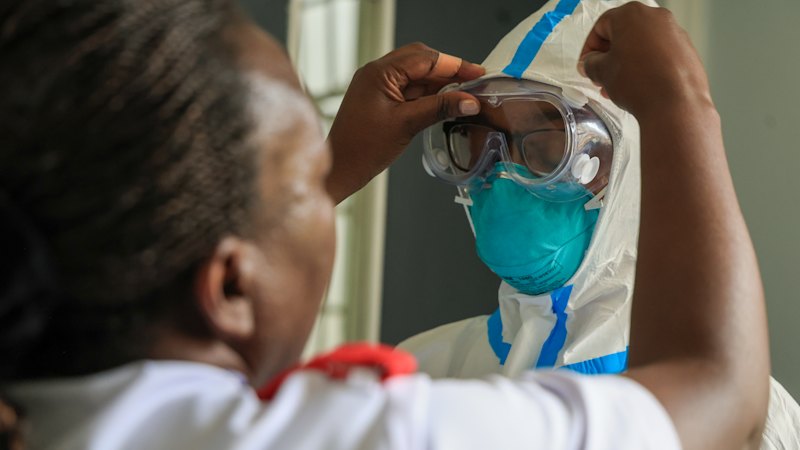
Panic is a predictable commodity. Whenever a sensationalized headline about ancient pathogens or rumored outbreaks in distant regions dominates the digital cycle, public attention hardens into a tunnel of immediate fear. Right now, the media machinery fixates on speculative murmurs and sensationalized dispatches regarding plague in Russia. Meanwhile, a far more insidious and immediate biological threat quietly breaches regional boundaries: Ebola.
The real crisis unfolding across vulnerable borders does not arrive with cinematic explosions or instant global panic. It moves through quiet rural transit corridors, underfunded border outposts, and healthcare systems stretched to their absolute breaking point. While commentators obsess over distant anomalies, filoviruses are exploiting systemic fatigue. Epidemiologists tracking real-time transmission vectors know the truth. The danger is not that a pathogen exists; the danger is that our collective surveillance architecture is looking the wrong way. Discover more on a related subject: this related article.
The Anatomy of Border Leakage
Contained outbreaks are fragile ecosystems. They rely entirely on a triad of swift contact tracing, isolation protocols, and community trust. When any one of these pillars fractures, the containment perimeter fails. Recent movements of the virus across porous national boundaries reveal a chilling pattern of institutional exhaustion.
Consider how regional commerce actually functions in central and West African trade zones. Official checkpoints are often separated by dozens of miles of unpatrolled dirt roads, river crossings, and footpaths heavily utilized by cross-border traders. When an outbreak hits a trade hub, individuals carrying the incubation stage do not stop at immigration desks. They move to feed their families, seeking medical care in neighboring districts where they hope to escape social stigma or infrastructural collapse. More reporting by Everyday Health highlights related perspectives on the subject.
This human reality collides violently with bureaucratic inertia. Local health ministries frequently lack the rapid-response liquidity required to deploy diagnostic kits before symptoms turn systemic. Contact tracing breaks down not because investigators are incompetent, but because they are outnumbered by a factor of hundreds. A single infected traveler moving through a crowded transit market can generate dozens of secondary exposures within hours, rendering manual tracking logs obsolete before the ink dries.
The Cost of Operational Fatigue
International funding agencies love high-profile announcements. Emergency grants make for impressive press briefings and polished legislative updates. But cash promised in Geneva or Washington takes months to translate into personal protective equipment, cold-chain storage for experimental vaccines, and hazard pay for local nurses on the front lines.
The front lines are currently exhausted. Healthcare workers who survived previous waves of viral hemorrhagic fevers are dealing with severe post-traumatic stress, chronic understaffing, and delayed salaries. When a nurse hasn't been paid in four months, institutional loyalty frays. When protective gear runs low, corners are cut. These are the unglamorous mechanics of epidemic propagation.
Governments often resort to heavy-handed restrictions when borders are breached. Travel bans and military-enforced quarantines are slapped onto maps with little regard for local economic survival. History shows that when quarantine means starvation, populations go underground. They hide sick family members, bury bodies secretly, and evade surveillance teams out of sheer desperation. Fear of the cure becomes greater than fear of the disease.
Shifting the Diagnostic Paradigm
If public health authorities wish to stop treating every outbreak as an unprecedented surprise, the entire approach to surveillance must change. Relying on symptom screening at formal ports of entry is an outdated strategy designed for a slower era. Modern containment demands decentralized diagnostic capacity that places rapid antigen testing directly into the hands of local clinics, rather than centralized urban laboratories.
Furthermore, framing these events purely as localized health anomalies is a dangerous geopolitical miscalculation. Pathogens do not respect sovereign borders or media cycles. When surveillance systems are starved of resources because attention is hijacked by sensationalized distractions elsewhere, the global safety net frays for everyone.
The silence surrounding these border breaches is deafening, punctuated only by the quiet hum of viral replication in populations abandoned by international triage. Unless priorities shift from reactionary panic to sustained logistical fortification, the next major epidemic will not be stopped by borders. It will simply cross them while the world looks away.