Silence.
Before the engines arrive, before the armored hulls grind against the limestone hills of the northern West Bank, there is always a specific kind of silence that settles over the valleys just before dawn—a heavy, breathless pause where the night air cools the stone walls and even the stray dogs seem to hold their tongues. Discover more on a similar topic: this related article.
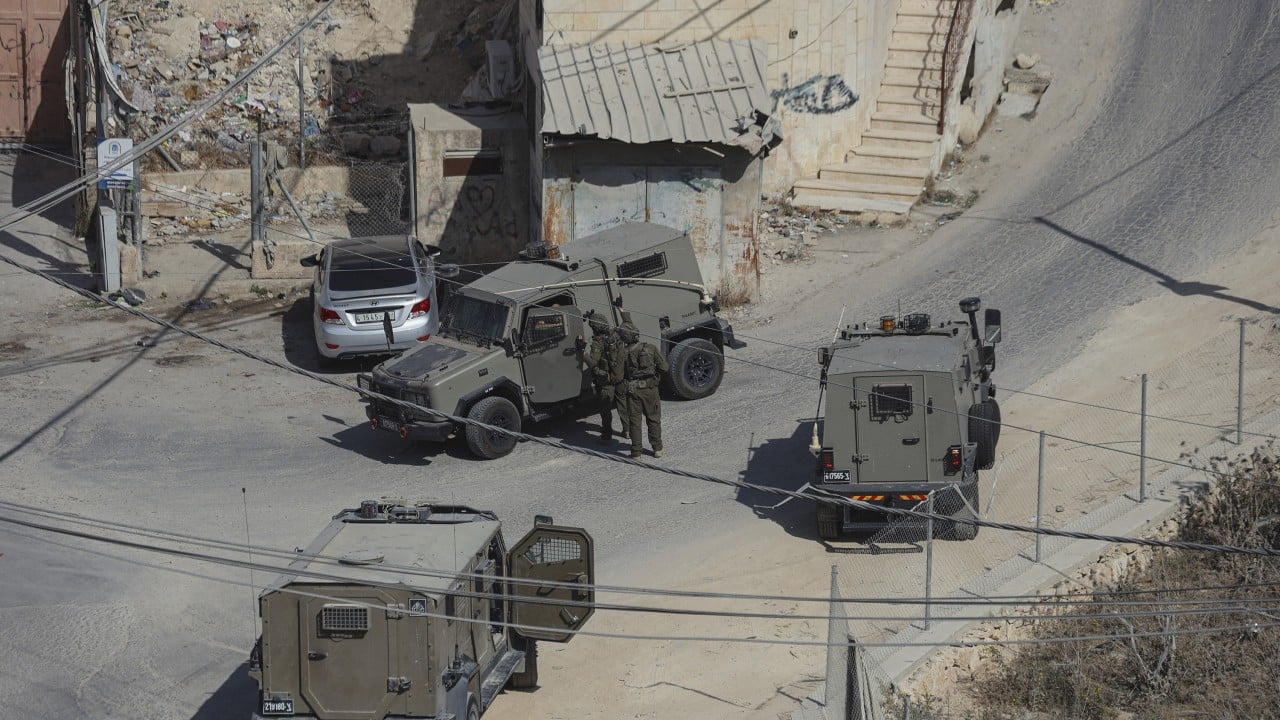
If you read the standard wire reports this morning, you already know the skeleton of the story. You know that following the deaths of Israeli soldiers in a recent ambush, the Israel Defense Forces launched a major, multi-brigade military operation across several cities and refugee camps in the occupied West Bank. You know the numbers of troops deployed, the tactical objectives stated by defense officials, and the immediate diplomatic reactions echoing out of Washington, Brussels, and Ramallah. Those facts are accurate. They are also incomplete, because a bullet-pointed summary of troop movements cannot capture what happens to a human nervous system when the geography of daily life transforms into a theater of war overnight.
To understand what this escalation actually means, we have to step away from the Situation Room maps and look at the kitchen tables on both sides of the concrete barriers. Additional reporting by USA Today highlights similar views on the subject.
The Anatomy of a Threshold
Consider a hypothetical scenario—a composite drawn from thousands of real lives caught in this recurring cycle. Imagine two families waking up forty miles apart on the same Tuesday morning.
In a quiet apartment in central Israel, a mother named Miriam stares at her phone screen, waiting for the two blue checkmarks on a messaging app that tell her twenty-year-old son, a combat medic stationed near Jenin, has survived the night. Her coffee goes cold on the counter. For Miriam, the major operation in the West Bank is not an abstract geopolitical maneuver; it is the terrifying arithmetic of probability. When soldiers are killed in targeted attacks—whether by roadside improvised explosive devices buried beneath torn-up asphalt or in sudden close-quarters firefights—the grief in Israeli society is immediate, intimate, and deafening. In a country where military service is mandatory, every fallen soldier is someone’s neighbor, someone’s former high school classmate, someone’s kid who still has laundry in the hamper at home.
Forty miles away, in the dense, narrow alleyways of the Tulkarm refugee camp, a father named Tariq hears the low, unmistakable thrum of surveillance drones circling above his corrugated metal roof. He does not need a news alert to know an operation has begun. He knows by the way the electricity flickers and dies, by the distant rumble of heavy bulldozers clearing streets to neutralize buried explosives, and by the sudden realization that his eight-year-old daughter will not be going to school today, or tomorrow, or perhaps next week.
Tariq and Miriam have never met. They speak different languages, pray in different cadences, and read entirely different versions of history. Yet both of them are trapped inside the same mechanical trap—a cycle of action and reaction where security for one side is experienced as suffocation by the other.
Why This Escalation Feels Different
People often ask why the West Bank—a territory roughly the size of Delaware, dotted with ancient olive groves, sprawling Israeli settlements, and densely packed Palestinian cities—suddenly erupts into large-scale military campaigns when global attention has been fixed elsewhere.
The answer lies in the slow erosion of containment. For years, security analysts operated under the assumption that the West Bank could be managed through localized, surgical raids—nighttime arrests designed to disrupt militant cells before they could organize. Think of it like trying to hold back a rising tide with buckets. For a long time, the buckets seemed to work.
They do not work anymore.
Over the past two years, the nature of armed resistance in northern West Bank cities like Jenin, Nablus, and Tulkarm has fundamentally shifted. What used to be fragmented, poorly armed groups have evolved into more organized networks utilizing sophisticated roadside bombs, smuggled weaponry, and coordinated ambush tactics. When Israeli soldiers are killed in these engagements, the political and military pressure inside Israel to restore deterrence becomes overwhelming. Defense officials argue, with cold tactical logic, that you cannot allow militant infrastructure to entrench itself ten minutes away from major Israeli population centers. To leave those networks intact, from their perspective, is to invite a catastrophe on the scale of October 7 from the eastern front.
So the strategy changes. Instead of surgical raids, the military deploys armored personnel carriers, combat engineers, and air support. Roads are torn up to expose hidden detonators. Water pipes and electrical grids, buried beneath those same roads, are inevitably severed in the process.
The Invisible Infrastructure of Fear
When you live through prolonged instability, you stop measuring time in months or years. You measure it in checkpoints, curfews, and the battery percentage on your phone.
I remember standing on a hillside overlooking Nablus several years ago during an earlier wave of closures, watching a line of white and yellow shared taxis stretched for two miles behind a metal gate. Inside those cars were university students missing final exams, diabetic patients running low on insulin, and construction workers watching their daily wages evaporate by the minute. A young man stepped out of a battered Ford transit van, lit a cigarette with trembling hands, and looked up at the watchtower overlooking the road. He didn't look angry. He looked exhausted—the kind of bone-deep fatigue that comes from realizing that your entire future depends on the mood of a stranger holding a rifle behind reinforced glass.
That exhaustion is the invisible fuel of this conflict.
When an economy is choked—when hundreds of thousands of Palestinian workers lose their permits to enter Israel, and internal movement between West Bank cities becomes a gauntlet of flying checkpoints—desperation ceases to be an emotion and becomes an economic reality. According to data from international labor organizations, unemployment across the West Bank has skyrocketed since late 2023, pushing hundreds of thousands of families below the poverty line. When young men have no jobs, no freedom of movement, and no political horizon, militant recruitment doesn't require sophisticated propaganda. It only requires handing a disillusioned twenty-year-old a rifle and telling him that dying on his feet is better than starving on his knees.
At the same time, look at the psychological toll on the young Israeli soldiers sent into those alleyways. Many of them are barely out of their teens, thrust into urban combat environments where every window, every parked car, and every pile of rubble could conceal an explosive device. They are asked to be soldiers, police officers, and border guards all at once—an impossible mandate that breeds hyper-vigilance, trauma, and tragic mistakes. When one of their own is killed, the grief hardens into a collective resolve that demands decisive force, even when the veterans among them quietly wonder where the tactical victory ends and the strategic quagmire begins.
The Illusion of the Clean Solution
Here is the uncomfortable truth that neither military communiqués nor diplomatic statements like to admit: there is no purely military solution to a political vacuum, and there is no purely diplomatic solution to an immediate security threat.
Let us be honest about the confusion and dread this creates for anyone watching from the outside. It is entirely reasonable to feel lost when trying to make sense of a conflict where every headline seems to contradict the last. You hear one voice say that Israel has an undeniable right and duty to defend its soldiers and civilians from lethal attacks. You hear another voice say that collective punishment, mass displacement, and the destruction of civilian infrastructure violate international law and guarantee another generation of hatred.
Both statements can be true at the exact same time. That is the tragedy.
Think of a house with a leaking roof during a hurricane. The military operation is an attempt to nail boards over the broken windows while the storm is still raging outside. It is loud, violent, and desperate, driven by the immediate fear that the walls will collapse if nothing is done right now. Yet nailing boards over the windows does nothing to stop the hurricane, and in the process, you are smashing the very frames that hold the glass.
Meanwhile, the political institutions meant to govern and mediate have withered. The Palestinian Authority, strapped for cash and deeply unpopular among its own public, struggles to exert control over the northern cities where armed groups operate openly. International mediators issue urgent calls for restraint that sound increasingly like echoes in an empty canyon. And on the ground, extremist settler violence against Palestinian farming communities—burning olive trees, vandalizing homes, driving shepherds from grazing lands—adds another volatile accelerant to an already roaring fire.
What Happens When the Bulldozers Leave
Every major military operation eventually reaches a phase where the armored vehicles pull back to the outskirts, the drones thin out, and the immediate headlines fade to the back pages of international newspapers.
What remains in the wake of the withdrawal is rarely peace. It is a landscape scarred by fresh graves and fresh grievances.
In central Israel, Miriam will eventually welcome her son home for a forty-eight-hour leave. She will cook his favorite meal, wash the grey dust of the West Bank out of his uniform, and watch the way he flinches when a heavy truck backfires on the highway outside their apartment. She will be grateful he is alive, even as she realizes that the boy who left for basic training is never fully coming back.
In Tulkarm, Tariq will walk outside with a plastic bucket and a shovel, joining his neighbors to clear shattered concrete from the doorway of the local bakery. His daughter will ask him why the street looks like an earthquake hit it, and he will struggle to find words that protect her childhood without lying to her about the world she inherits.
The wire reports will summarize the operation in neat, sanitized paragraphs—listing targets struck, weapons seized, casualties counted, and objectives achieved. They will close the file and move on to the next crisis.
Down in the valleys between the limestone hills, however, the dust settles slowly on the silver-green leaves of the olive trees, covering everything in the exact same shade of grey, waiting for the next dawn to break.