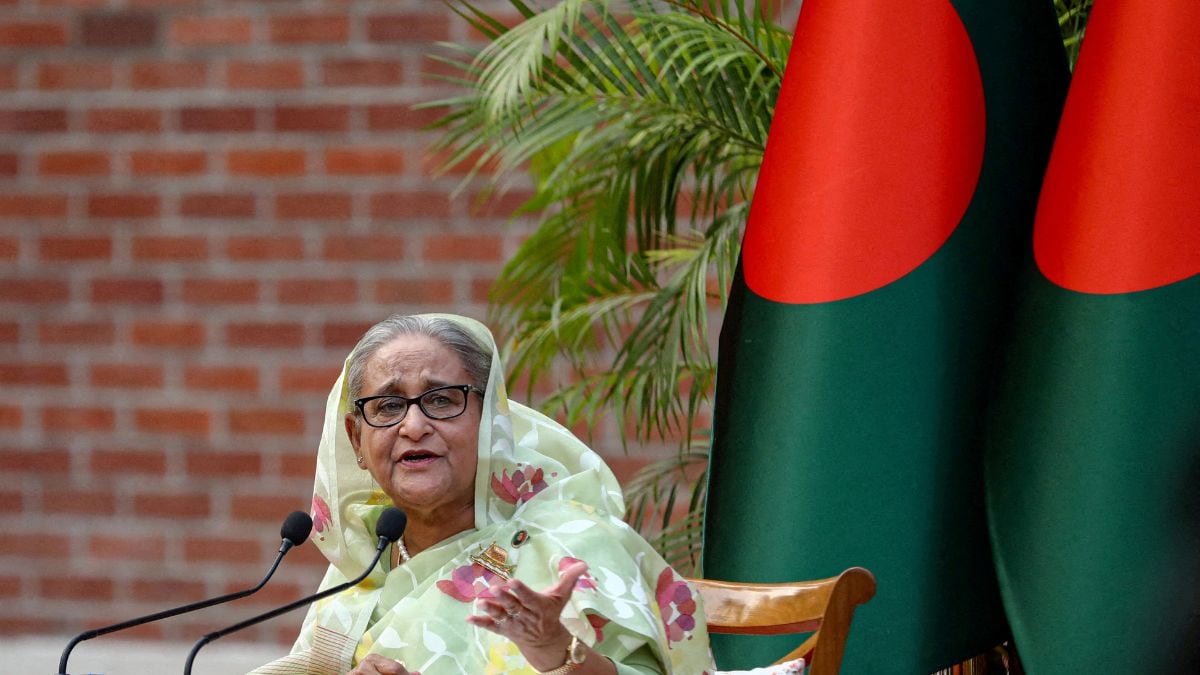
The abrupt cancellation of high-level organizational gatherings hosted by exiled leadership in New Delhi exposes the fragile equilibrium governing bilateral statecraft between India and Bangladesh. When physical strategy sessions involving displaced political entities are shelved under diplomatic friction, it signals that host nations are recalibrating their risk tolerance regarding cross-border political interference. To understand why these operational resets occur, one must analyze the intersection of bilateral signaling, host-state security management, and the structural pressures faced by exiled political machines attempting to engineer a domestic comeback.
The Host State Risk Function
For any host government harboring a deposed head of state or ousted political leadership, strategic calculus is governed by a strict cost-benefit analysis. The primary variable is bilateral stability. When Dhaka registers formal protests against public or semi-private political coordination occurring on foreign soil, the host capital faces an immediate diplomatic friction cost.
Allowing exiled leaders to orchestrate organizational revivals, press briefings, or strategy conclaves creates two distinct vulnerabilities for the host administration:
- Bilateral Friction: Official channels become choked with diplomatic notes of concern, complicating broader trade, security, and transit negotiations.
- Security Externalities: Large gatherings of opposition figures attract heightened surveillance, counter-protests, and intelligence liabilities, turning a diplomatic asset into an operational security burden.
Consequently, when diplomatic pressure mounts—such as following contentious public forums or statements perceived as destabilizing by the incumbent administration in Dhaka—the host state often exercises administrative levers, ranging from informal advisories to explicit police denials, to curtail physical political assemblies.
The Organizational Dilemma of Exile
An ousted political party operating from foreign territory faces a severe logistical and strategic constraint known as the exile coordination deficit. Without territorial control, institutional access, or domestic protection, the party must rely on decentralized communication channels and discrete physical meetings.
However, shifting these operations to digital formats or relying on fragmented local networks introduces severe liabilities:
- Information Leakage: Digital coordination among dispersed cadres increases interception and surveillance vulnerabilities by domestic intelligence agencies.
- Erosion of Chain of Command: Without centralized, in-person conclaves, factionalism flourishes, and tactical coherence degrades.
- Signalling Failure: The inability to project physical organizational strength diminishes the morale of remaining domestic networks and signals weakness to regional rivals.
The attempted convening in New Delhi was designed to mitigate these exact structural deficits by establishing a centralized quorum to chart electoral narratives, leadership updates, and timelines for political reentry. Its cancellation forces the organization back into a defensive posture, exposing the limits of conducting domestic opposition politics from external sanctuaries.
The Diplomatic Fallout and Statecraft Realities
The intervention by local authorities to prevent high-profile political alignments serves a dual purpose for the host capital. Domestically, it provides tangible evidence of non-interference to the neighboring administration, offering a diplomatic currency that can be leveraged to normalize high-level state visits and security dialogues. Internationally, it demonstrates adherence to diplomatic norms regarding political refugees, blunting accusations of harboring hostile actors.
For the incumbent regime in Dhaka, these cancellations are interpreted as positive indicators of bilateral compliance, yet they also highlight the lingering reality of cross-border political friction. As long as former leadership remains physically positioned within the region, the structural tension between humanitarian asylum and political containment will persist.
Strategic Outlook
The suppression of physical organizational assemblies in regional capitals does not eradicate underground political networks; rather, it forces structural adaptation. Exiled political apparatuses are compelled to decentralize, relying on obfuscated communication channels and proxy coordination rather than high-visibility summits. For regional stability, the operational calculus dictates that host nations will continue to tightly police expatriate political activities whenever bilateral diplomatic capital outweighs the utility of maintaining leverage through exiled proxies. The trajectory of these political movements will depend less on scheduled conclaves in foreign capitals and more on their capacity to reconstitute domestic relevance under severe structural constraints.


