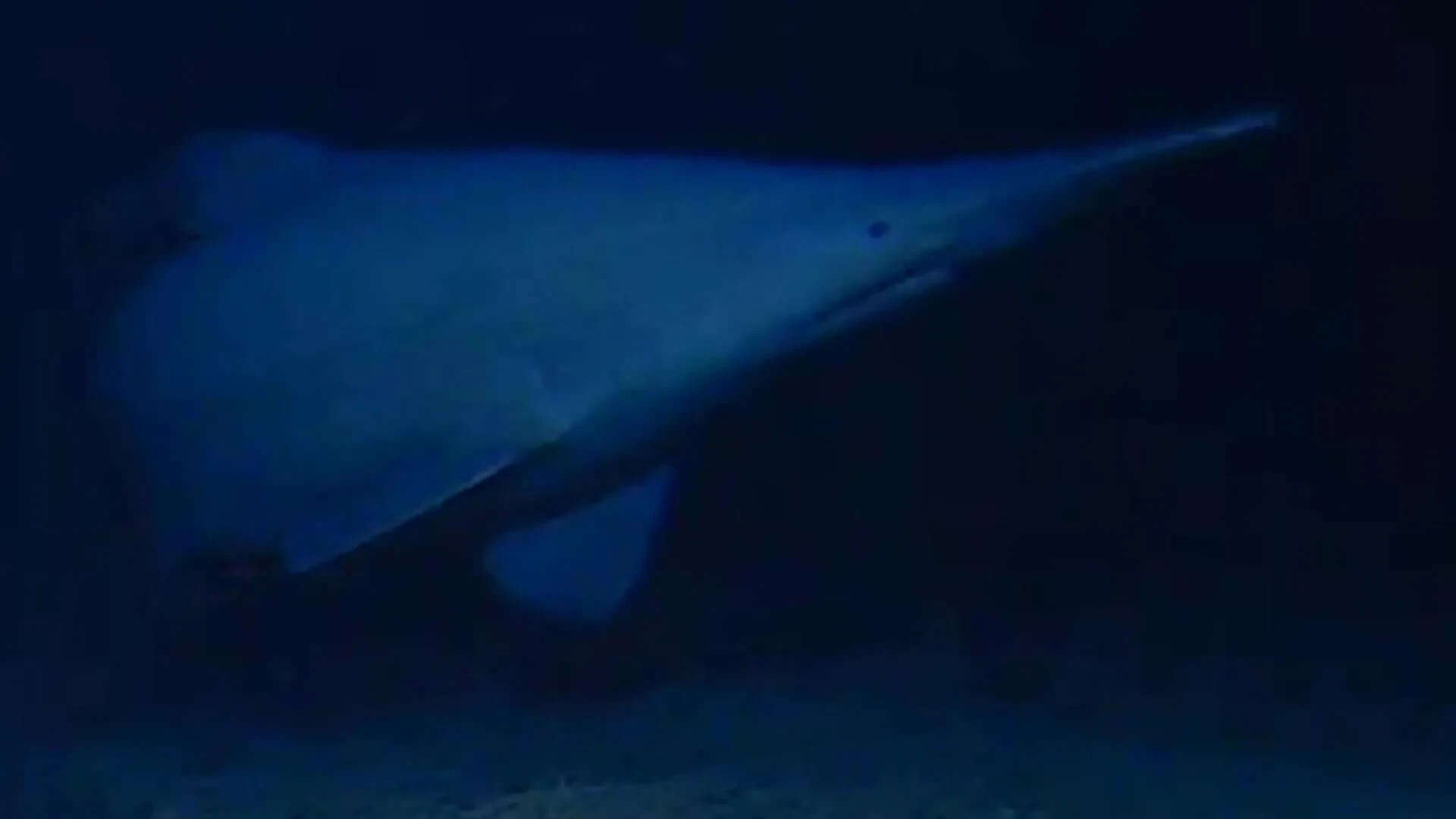
The internet is currently losing its mind over a piece of shaky, high-definition footage showing a goblin shark drifting through the ink-black waters of the deep Pacific. Mainstream science outlets are running breathless headlines about a historic breakthrough, a new depth record, and a rare glimpse into a 125-million-year-old world.
It is pure theater. It is flashy, expensive, high-altitude PR masquerading as foundational marine biology.
If you are celebrating this video as a monumental victory for oceanography, you have been hoodwinked by the charismatic megafauna industrial complex. Capturing a few minutes of a disoriented predator illuminated by 10,000-lumen ROV floodlights tells us almost nothing new about deep-sea ecosystems. Instead, it exposes the fundamental flaws in how we fund, execute, and communicate ocean science.
We need to stop treating the deep ocean like a monster movie and start treating it like data.
The Evolutionary Lie of the Living Fossil
Let us start with the most egregious line of copy repeated by every lazy aggregation site on the web: the claim that scientists filmed a 125-million-year-old shark.
No, they did not. They filmed Mitsukurina owstoni, a modern species.
The phrase "living fossil" is a biological oxymoron that actual taxonomists have been trying to kill for decades. It implies that an organism stumbled into an evolutionary cul-de-sac millions of years ago and simply forgot to adapt. This is flatly wrong. While the family Mitsukurinidae dates back to the Early Cretaceous, the goblin shark swimming around today is not the same creature that shared the seas with pterosaurs.
What you are looking at is the result of stabilizing selection. The deep-sea environment is highly conservative in terms of temperature, light, and pressure. If a body plan works efficiently in a low-energy, food-scarce environment, natural selection keeps the external architecture relatively stable.
But beneath the skin, the goblin shark has been evolving continuously. Its immune system, its metabolic pathways, its sensory receptors, and its reproductive physiology have all adapted to the shifting baselines of the modern ocean. Calling it a living fossil is not just inaccurate; it actively erases the complex, ongoing reality of deep-sea evolution. It reduces a highly specialized modern apex predator to a cheap museum novelty.
Flashy Hardware vs. Actual Data
The competitor piece wants you to marvel at the sheer technological triumph of sending a multi-million-dollar Remotely Operated Vehicle (ROV) down to record this footage. They want you to think this is the only way to understand the deep ocean.
I have watched research institutes burn through $50,000 a day in ship time just to chase a single compelling video frame that can go viral on social media. It is an astronomical waste of resources.
Underwater paparazzi work is not scalable science. If we want to genuinely map the distribution, genetic health, and behavior of deep-sea elasmobranchs, we need to abandon our obsession with optical verification. We need to stop insisting on seeing everything with human eyes or HD cameras.
The real future of deep-sea ecology lies in tools that do not make for good Instagram reels:
- Environmental DNA (eDNA) Metabarcoding: By filtering a few liters of water collected at depth, we can detect the cellular debris, slime, and waste left behind by goblin sharks, sleeper sharks, and ghost jacks without ever seeing them. It provides a massive, high-throughput dataset for a fraction of the cost of an ROV dive.
- Acoustic Tomography and Passive Listening Arrays: The deep ocean is surprisingly loud. By deploying long-term autonomous hydrophone moorings, we can track the movements and population densities of deep-sea organisms based on their acoustic footprints and interactions with the environment.
- Deep-Sea Baited Longline Surveys with Satellite Tagging: Catching, tagging, and releasing deep-water species yields hard numbers on metabolic rates, vertical migration patterns, and thermal tolerances.
The viral video tells us that one shark was at one specific coordinate at one specific time. eDNA tells us how many sharks live in that trench, what they ate yesterday, and how genetically isolated they are from populations in the Atlantic. But eDNA does not get millions of views, so the funding keeps flowing toward the camera rigs.
The Flawed Premise of the Depth Record
The media is making a massive deal out of the "new depth record" established by this sighting. This reveals a profound ignorance of how deep-sea sampling bias works.
If you only look for sharks in places where you can afford to drop a camera, your data will inevitably show that sharks only exist where you dropped the camera. The fact that this goblin shark was spotted a few hundred meters deeper than previous records is not proof of a sudden range expansion or a shifting ecological niche. It is simply proof that we finally pointed a camera at a depth we previously ignored.
We are celebrating our own historical lack of data as if it were a new biological discovery.
Imagine an alien probe landing in the middle of the Sahara Desert, spotting a single camel, and concluding that camels only exist in a 10-meter radius around that specific sand dune. That is the exact level of statistical rigor we are applying here. The goblin shark’s range has always been vast; our willingness to look for them has been incredibly narrow.
The Conservation Funding Trap
There is a dark side to this obsession with charismatic deep-sea monsters. When we frame deep-sea conservation entirely around bizarre, photogenic predators like the goblin shark or the giant squid, we create an eco-system hierarchy that damages actual conservation efforts.
The real engines of the deep ocean are the organisms that look like nothing more than snot, mud, or tiny white bugs.
+------------------------------------+------------------------------------+
| The Hype Cycle Targets             | The Unsung Ecological Engines      |
+------------------------------------+------------------------------------+
| Goblin Sharks (Mitsukurina)        | Xenophyophores (Giant Amoebas)     |
| Giant Squid (Architeuthis)         | Polychaete Worms (Benthic Micro)   |
| Vampire Squid (Vampyroteuthis)     | Deep-Sea Holothurians (Sea Cucs)   |
+------------------------------------+------------------------------------+
Xenophyophores are giant, single-celled organisms that blanket the abyssal plains. They act as the literal foundations of the deep-sea food web, trapping sediment, creating micro-habitats for hundreds of smaller species, and cycling carbon at depths that sustain the entire benthic ecosystem.
But nobody is making a documentary about xenophyophores. No tech billionaire is funding an expedition to film a giant amoeba sitting in the mud.
By allowing viral videos of goblin sharks to dictate what the public values about the deep sea, we leave the door wide open for devastating industrial exploitation. Right now, mining conglomerates are preparing to scrape the Clarion-Clipperton Zone for polymetallic nodules. This process will completely obliterate thousands of square miles of benthic microbial life, permanently destroying ecosystems we do not even understand yet.
If we keep looking for sharks while ignoring the seafloor they hunt over, we will watch the entire foundation of the deep ocean collapse while admiring a 4K video of a predator that no longer has anything to eat.
Stop cheering for the underwater paparazzi. Demand the unglamorous, high-volume data that actually keeps the ocean alive.