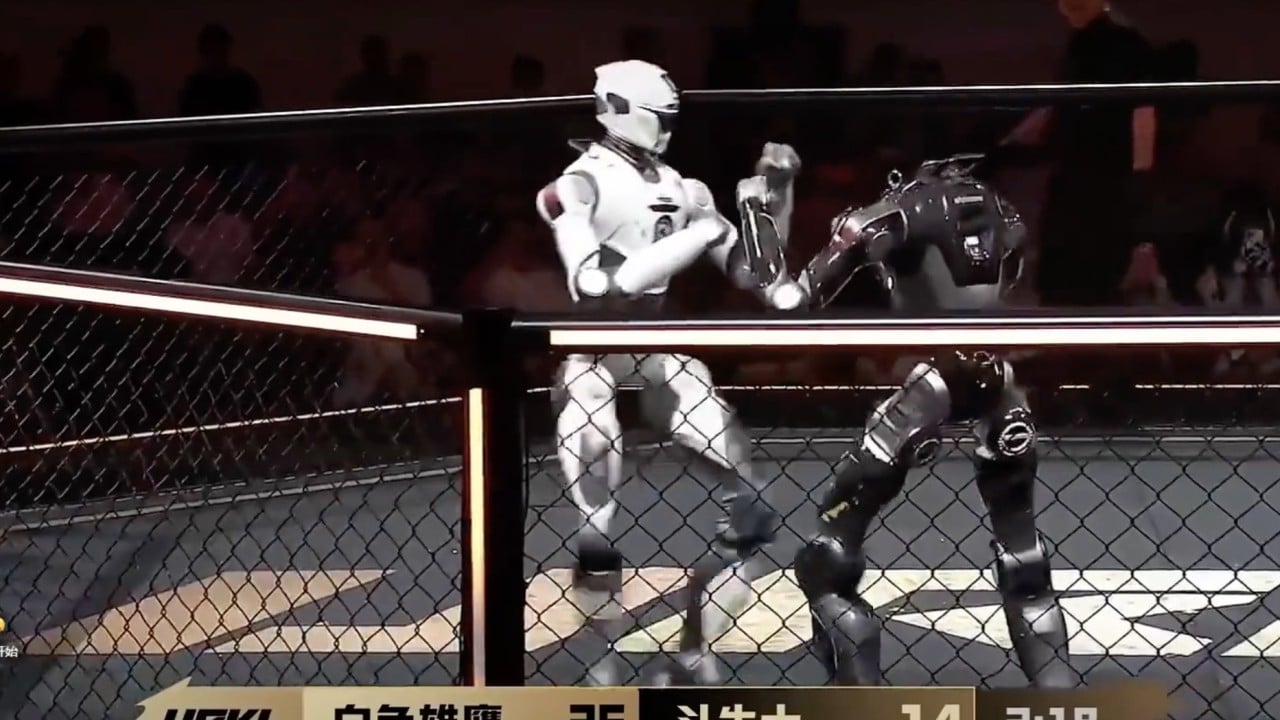
A mechanical neck snaps. A titanium head bounces off the canvas. The crowd gasps, social media erupts into a frenzy, and tech bloggers rush to type out headlines about the terrifying dawn of autonomous gladiators.
The media wants you to believe that the recent humanoid mixed martial arts bout, which ended with one machine literally losing its head, is a historic milestone for artificial intelligence and robotics. They are calling it a glimpse into a high-stakes, hyper-advanced future.
They are completely wrong.
What you actually witnessed was not a breakthrough in engineering. It was expensive, glorified puppet theater. The mainstream commentary surrounding this event exposes a massive misunderstanding of what makes robotics functional, why humanoids are built, and how real mechanical force operates. The "lazy consensus" views a headless robot as a sign of extreme, boundary-pushing competition. The reality? It is a sign of horrific structural design, subpar control loops, and a desperate grab for clicks.
The Illusion of Humanoid Combat
Mainstream sports writers looked at the decapitation and saw high drama. If you have spent any time in a robotics lab or working on industrial kinetic systems, you saw something else entirely: a catastrophic failure of basic load distribution.
Humanoid robots are inherently terrible platforms for combat.
Humans evolved for dynamic movement, impact absorption, and self-preservation over millions of years. Our joints use a complex network of tendons and muscles that act as variable dampers. When a human fighter takes a punch, their entire body dissipates the energy.
When a 300-pound humanoid robot strikes another, that kinetic energy does not just disappear. It travels through rigid metal links and slams directly into actuators, harmonic drives, and structural fasteners.
[Kinetic Impact] -> [Rigid Titanium Limb] -> [Shear Stress at Neck Joint] -> [Catastrophic Fastener Failure]
The robot that lost its head did not lose it because the opponent possessed devastating power. It lost it because the engineers failed to calculate basic shear stress on the neck assembly. A robot decapitation is not proof of a brutal fight; it is proof of poor mechanical tolerancing. Designing a robot that falls apart from a highly predictable impact is the engineering equivalent of building a sports car whose wheels fall off the moment you hit a pothole.
The High Cost of the Wrong Form Factor
Building a robot shaped like a human to do battle is the most inefficient way to solve the problem of mobile kinetic force.
If the goal is purely to destroy another machine in a ring, the humanoid form factor is a massive liability. It raises the center of gravity, creates massive leverage advantages for an opponent to exploit, and introduces dozens of unnecessary points of failure. The field of combat robotics figured this out decades ago. A low-profile, tracked vehicle with a spinning weapon will dismantle a bipedal robot every single time.
Why then do companies insist on spending millions of dollars to build bipedal fighters?
Because humanoids capture the public imagination. It is a marketing stunt disguised as a technological frontier. Having spent years analyzing capital allocation in tech hardware, I can tell you that these public spectacles are usually driven by one thing: the need to appease investors who do not understand physics but do understand viral videos.
When a company builds a humanoid for combat, they are sacrificing actual utility for aesthetics. They are prioritizing how the machine looks while getting broken over how the machine actually operates.
The True Metrics of Robotics
To understand why this exhibition was a step backward, we have to look at the metrics that actually matter in hardware development:
- Mean Time Between Failures (MTBF): A reliable system operates for hundreds of hours without intervention. A combat humanoid that disintegrates in three minutes has an MTBF that renders it useless for any practical application.
- Energy Efficiency: Bipedal balancing consumes immense amounts of power just to stand still. Throwing a punch requires an exponential spike in current that drains onboard batteries at an unsustainable rate.
- Force Density: True industrial breakthroughs come from getting more torque out of smaller, lighter motors. Hitting a robot until a poorly tightened bolt shears off proves nothing about force density.
Dismantling the Autonomy Myth
The narrative surrounding these fights implies that these machines are rapidly evolving fighters, learning to counter strikes in real-time.
Let us be entirely transparent about the software driving these spectacles. These machines are not utilizing deep reinforcement learning to invent new martial arts strategies on the fly. The latency alone makes real-time, autonomous physical combat at a human level nearly impossible with current onboard compute limitations.
Most of these exhibition bouts rely heavily on pre-programmed macro sequences or high-level teleoperation with local stabilization loops. When one robot lands a hit, it is usually because a human operator timed a button press correctly, or because a pre-scripted routine happened to align with the opponent's trajectory.
When you strip away the flashy lights and the sports commentary, you are left with RC cars clad in expensive bipedal shells.
The crowd is cheering for a simulation of intelligence. The real work in robotics is happening in mundane, unsexy environments: logistics centers where arms repeat the same precise pick-and-place movement millions of times without deviation, or autonomous mining equipment operating in sub-zero temperatures. A robot that can reliably move boxes for five years without a single maintenance issue is a technological marvel. A robot that fights for three minutes and loses its head is a toy.
The Physical Reality of Steel and Carbon
To those who believe this is the start of a legitimate new sporting industry, consider the physical limits of materials.
If these companies actually begin utilizing high-output hydraulic actuators and carbon-fiber composites designed for maximum destructive capability, the fights will not be entertaining. They will be incredibly short, absurdly expensive, and entirely predictable. Either one machine will instantly shatter the structural frame of the other in a single blow, or both machines will suffer immediate thermal runaway in their battery packs due to the extreme current draws required for high-velocity movement.
There is no middle ground where robots trade elegant blows like cinematic characters. Physics dictates that metal-on-metal violence at scale results in rapid, ugly deformation.
The downside of pointing this out is obvious: it ruins the fun. It strips away the sci-fi fantasy that the media loves to sell. But continuing to celebrate these spectacles as technological leaps only hurts the industry. It misallocates capital away from viable engineering solutions and directs it toward expensive parlor tricks.
Stop looking at the headless robot as a glimpse of the future. It is a relic of the present—a monument to hype, bad physics, and marketing departments running wild. The real revolution in robotics will not be televised, it will not carry a championship belt, and it will definitely keep its head attached.