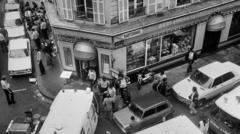
Justice doesn't always move fast. Sometimes, it crawls through decades of geopolitical shifts, bureaucratic stalling, and backroom negotiations before it finally lands a suspect in a courtroom. The recent news that Palestinian authorities handed over a key suspect in the 1982 attack on a Jewish restaurant in Paris isn't just a legal update. It's a massive moment for victims who've waited over forty years for accountability. On August 9, 1982, the Marais district of Paris was shattered when grenades and machine-gun fire ripped through Jo Goldenberg’s restaurant. Six people died. Twenty-two were injured. For years, the trail went cold, or rather, it was kept cold by international complexities.
The suspect in question, Mahmoud Khader Abed Adra, also known as Abu Zayed, has been a ghost for a long time. French investigators linked him to the Abu Nidal Organization, a militant group that was basically a hired gun for various regimes throughout the late 20th century. While the world moved on from the Cold War to the digital age, the French judiciary never closed the file. They kept digging. Now, after years of living in the West Bank, Abu Zayed is facing the music.
Why this extradition took forty years
You might wonder why it takes half a lifetime to move a suspect from one jurisdiction to another. The answer is usually politics. Extradition isn't just about evidence; it's about diplomacy. In the case of the 1982 rue des Rosiers attack, the suspects weren't exactly hiding in caves. They were often living in plain sight in countries that didn't have extradition treaties with France or simply didn't feel like cooperating.
French judge Marc Trévidic breathed new life into the case about fifteen years ago. He used new forensic techniques and re-interviewed witnesses to identify three or four main suspects. But identifying someone is only ten percent of the battle. Getting them onto French soil is the hard part. One suspect was in Norway, another in Jordan, and Abu Zayed was in the West Bank. The Palestinian Authority's decision to cooperate marks a shift in how these historical terrorism cases are handled. It’s a signal that even "protected" figures can eventually become expendable when the diplomatic price is right.
The brutal reality of the 1982 Marais massacre
To understand why this handover matters, you have to look at what actually happened that afternoon in Paris. It wasn't a military target. It was a deli. People were eating lunch. The attackers threw a grenade into the dining area and then sprayed the room with "wz" submachine guns. They didn't stop there. As they fled down the narrow streets of the Jewish quarter, they kept firing at anyone in their way.
It was the most significant anti-Semitic attack in France since the Second World War. For the French Jewish community, it wasn't just a crime; it was a trauma that defined a generation. It also sparked a massive debate about French security. There were persistent rumors—later fueled by former intelligence officials—that the French government had made a "secret pact" with the Abu Nidal Organization. The alleged deal was simple: the group wouldn't attack French targets again if their members could move through France freely. If true, it explains why the investigation moved at a snail's pace for decades.
The Abu Nidal Organization and the business of terror
The group behind the hit, the Abu Nidal Organization (ANO), wasn't fighting for a specific piece of land or a clear political goal in the way we see today. They were mercenaries. Led by Sabri al-Banna, they broke away from the PLO because they thought Yasser Arafat was being too soft. They became a tool for Iraq, then Syria, then Libya.
Breaking down the ANO's tactics
- Extreme Secrecy: They were so paranoid that members often didn't know the real names of the people they worked with.
- State Sponsorship: They relied on the protection of regimes that wanted to strike at Western or Israeli interests without getting their hands dirty.
- Internal Purges: Abu Nidal was famous for killing his own people if he suspected even a hint of disloyalty.
Abu Zayed’s handover is a rare victory against a group that was designed to be untraceable. Most of the ANO’s leadership is dead or disappeared. Abu Nidal himself died under mysterious circumstances in Baghdad in 2002. Catching a low-level or mid-level operative like Abu Zayed is often the only way to get a public record of what actually happened.
The legal hurdles ahead in Paris
Don't expect a verdict tomorrow. The French legal system is notoriously thorough and, frankly, quite slow. Abu Zayed’s defense will likely argue that the evidence is stale. They'll claim that witnesses' memories have faded after forty years and that the forensic links to the ANO are circumstantial.
French prosecutors have a different view. They’ve built a case based on "consistent evidence" that places Abu Zayed as part of the commando unit. The goal isn't just a conviction. It's a public airing of the facts. For the families of the six victims, the trial represents a chance to finally hear the names of the men who ruined their lives read out in a court of law. It’s about the "right to truth," a concept that’s become a cornerstone of international human rights law.
Justice has no expiration date
What does this mean for other cold cases? It means the world is getting smaller for people involved in historical political violence. We’ve seen this with the hunt for Nazi war criminals and more recently with perpetrators of the Rwandan genocide. Improvements in international police cooperation, like the use of Red Notices through Interpol, make it much harder to hide in the long run.
The Palestinian Authority’s involvement is especially interesting. By handing over a suspect, they’re trying to demonstrate that they can function as a responsible state actor. They want to show they’re part of the international legal order, even if it means giving up someone who was once seen as a "revolutionary." It’s a cold, calculated move, but for the victims in Paris, the motivation doesn't matter as much as the result.
If you’re following this case, watch the French news cycles for the "instruction" phase. This is where the judge will weigh the evidence before a full trial begins. It’s a long road, but the hardest part—actually getting the man in the room—is finally over. The Marais has changed a lot since 1982, but the memory of that day is still etched into the walls of the rue des Rosiers. This trial is the last chapter of a story that should have been finished decades ago.
Keep an eye on the official statements from the French Ministry of Justice and the representative bodies of the French Jewish community (CRIF). They’ve been the primary drivers behind keeping this case alive. Their persistence is the only reason Abu Zayed isn't finishing his life in quiet anonymity. The lesson here is simple: if you wait long enough and keep the pressure on, the political walls eventually crumble.