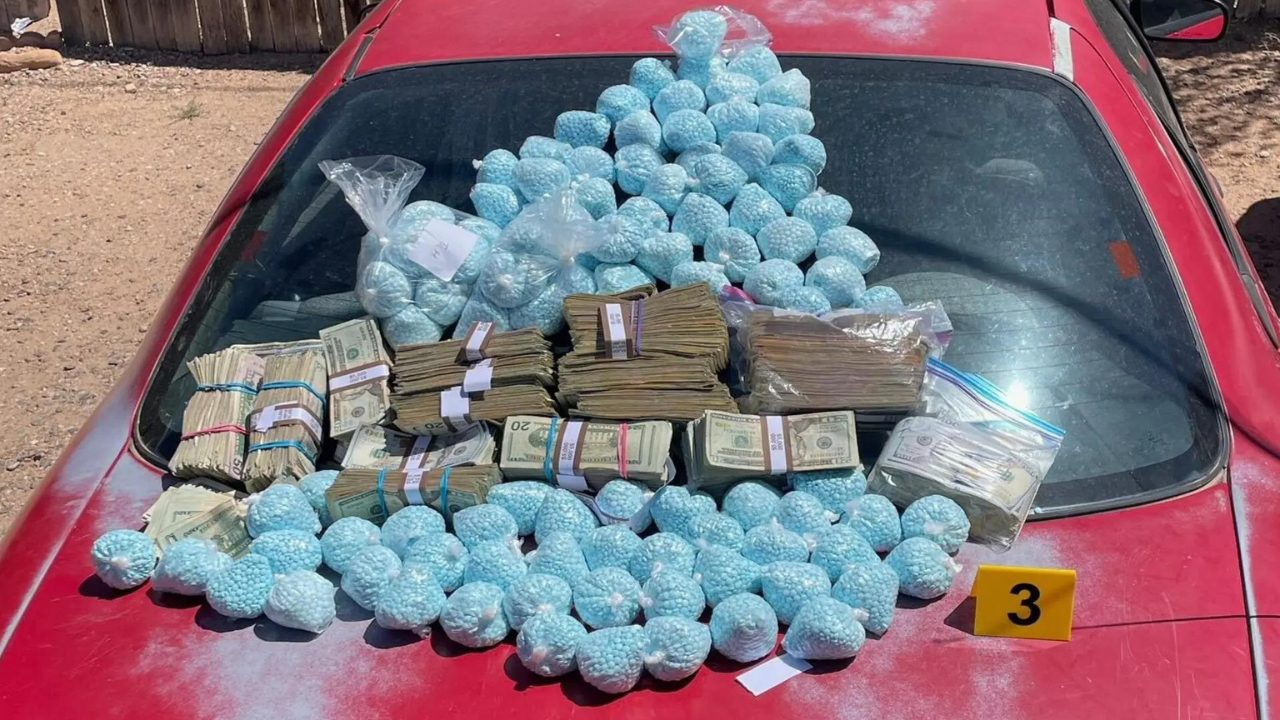
Federal law enforcement agents are supposed to take drugs off the street. That is the core expectation. Yet, government records and internal whistleblowers show that between 2023 and 2025, the U.S. Drug Enforcement Administration knowingly allowed hundreds of thousands, and potentially millions, of counterfeit fentanyl pills to flow straight into New Mexico neighborhoods.
Agents watched the deals happen. They listened to the traffickers on wiretaps. They tracked the vehicles. Then, they chose not to intercept the shipments.
This strategy was not a mistake or an accident. It was a conscious calculation. Federal prosecutors and agency leaders wanted to build massive conspiracy cases to dismantle entire cartels rather than just bust low-level couriers. They wanted the bosses. But while investigators accumulated evidence to map out criminal networks, real poison flooded local communities.
The public safety trade-off has ignited a fierce internal civil war within federal law enforcement, pitting boots-on-the-ground agents against high-level prosecutors who treat local communities as acceptable collateral damage.
The Deadly Gambling of Controlled Deliveries
In traditional drug enforcement, allowing a shipment to move under surveillance is a standard tactic. Investigators call these controlled deliveries. For decades, agents used this method to track shipments of cocaine, marijuana, or heroin. The goal was simple. You follow the courier to find the warehouse, the distributor, and the money men.
Fentanyl changes all the math. It is entirely different. It is an synthetic opioid so brutally potent that a tiny dose of just two milligrams can be lethal. Because of this extreme danger, the U.S. Justice Department established specific Fentanyl Protocols back in 2017. Those internal rules directed federal personnel to seize or otherwise prevent the distribution of fentanyl as soon as practicable. The policy states that protecting public safety comes before everything else.
The operations run by the DEA New Mexico District Office and the U.S. Attorney’s Office in Albuquerque seemed to operate under a completely different philosophy. Veteran investigators say the agency treated these highly lethal counterfeit pills with a level of leniency that defied basic logic and ignored the department's own safety mandates.
Instead of treating fentanyl like an immediate threat to human life, leadership treated it like bulk contraband. They let it roll.
Inside the Albuquerque Operations That Alarmed Agents
The scale of the unseized narcotics is staggering. In June 2023, DEA investigators intercepted coded phone conversations and established physical surveillance at a mobile home park in Albuquerque. They watched traffickers complete a transaction involving roughly 74,000 counterfeit fentanyl pills. Federal prosecutors later confirmed that exact number in subsequent court filings.
The agents did not move in. They did not seize the pills. They packed up their surveillance gear and left.
Just days earlier, the exact same investigative unit tracked a separate shipment from the same trafficking network. This time, the illicit cargo was stuffed inside a spare tire attached to a suspect vehicle. Again, the investigators watched. Again, they chose not to intervene.
According to David Howell, a veteran DEA Special Agent who eventually filed a formal whistleblower complaint with the U.S. Office of Special Counsel, this was part of a systemic pattern. Howell documented instances where investigators observed and documented deliveries of 150,000 pills and 50,000 pills without taking enforcement action.
Another former DEA supervisor in Albuquerque, speaking anonymously out of fear of professional retaliation, admitted that the total volume of unseized narcotics across these operations easily scaled into millions of pills.
The justification from the top was always the same. Investigators needed to keep the wiretaps active. Under federal law, a Title III wiretap authorization requires continuous justification. If you arrest a suspect or seize their stash, the targets change their phone numbers, shred their ledgers, and go dark. The wiretap dies. To keep the intercept order alive, prosecutors often argue they must let the conspiracy play out to identify the high-ranking cartel managers.
Howell and other agents warned their superiors that this approach was an absolute disaster for the local population. They argued that by maintaining willful blindness, the federal government was actively complicit in distribution. The response from management was bureaucratic silence and a demand to keep collecting intelligence.
The Legal Shield and the Strategy of Catching Bigger Fish
The official defense of these operations rests on a long-term strategic vision. Alex Uballez, who served as the U.S. Attorney for the District of New Mexico during the height of these operations, defended the investigative choices. The logic is corporate and clinical. Prosecutors argue that if you seize a single shipment of 50,000 pills, the cartel simply writes it off as the cost of doing business and sends another courier the next day.
By allowing shipments to pass, investigators can map the entire logistics network. You find the local stash houses. You identify the money launderers. You connect the dots directly to cartel leaders in Mexico. Uballez summarized the strategy bluntly, stating that the bigger fish are worth catching because dismantling an entire network ultimately saves more lives in the long run than stopping individual drug transactions.
The DEA leadership backs this approach up with recent results. In 2025, federal authorities executed a series of coordinated raids across five states that resulted in the largest single fentanyl pill seizure in DEA history. The operation took more than 400 kilograms of fentanyl pills off the black market, alongside dozens of firearms and millions of dollars in illicit cash. The core of that network was rooted in Albuquerque.
From a statistical standpoint, the agency claimed a massive victory against the Sinaloa Cartel. They proved that letting the network grow allowed them to execute a decapitation strike against an entire multi-state distribution cell.
The DEA headquarters continues to reject any claim of wrongdoing. Agency spokesperson Amanda Wozniak issued a public statement clarifying that descriptions suggesting the DEA knowingly permitted fentanyl to destroy communities are fundamentally false. The agency insists that every decision was lawful, heavily scrutinized by federal judges who signed off on the wiretaps, and fully aligned with Department of Justice guidelines.
The Department of Justice’s own Office of Professional Responsibility backed up management. Following an internal investigation triggered by Howell’s whistleblower disclosures, the office concluded that the U.S. Attorney’s office and the DEA acted reasonably. Their official report determined that the investigative inaction posed no specific danger to public health.
What Happens When Federal Guidelines Contradict Local Reality
The disconnect between federal investigative theory and the reality on the ground is brutally apparent in New Mexico’s mortality data. While national overdose deaths across the United States actually dropped by about 14 percent last year, New Mexico went in the exact opposite direction. Government health data shows that overdose fatalities in New Mexico surged by 21 percent over the same period.
The state has become a primary corridor for synthetic opioids crossing the southern border. Albuquerque is the main hub. Local police departments, emergency medical personnel, and county sheriffs are completely overwhelmed by the daily fallout of the epidemic.
While federal agents were sitting in unmarked vehicles recording transactions for future indictments, local first responders were using Narcan on the pavement just blocks away.
The internal guidelines from Washington emphasize that public safety is paramount. Yet, the systemic pressure to deliver massive, headline-grabbing conspiracy busts creates an incentive structure where local safety is routinely sacrificed for federal metrics.
When a federal agency determines that letting 100,000 lethal doses hit the street poses no specific danger to public health, it reveals a profound disconnect from the communities they are sworn to protect.
The Real Toll on New Mexico Communities
The human cost of this investigative strategy is not abstract. It is measured in morgues and ruined families. Agent Howell’s concern turned to outrage when he began cross-referencing the dates and locations of unseized DEA-monitored shipments with local overdose reports.
One case he highlighted involved a 15-month-old child in Española who died after ingesting burned fentanyl residue. The tragedy occurred in an area directly fed by the distribution networks the DEA was actively watching.
When federal agencies choose to play the long game against transnational cartels, the immediate consequence is a steady supply of cheap, lethal narcotics in vulnerable towns.
The street price of counterfeit pills in Albuquerque plummeted during this period, a clear sign of an uninhibited, highly liquid market. The cartels suffered no supply shocks because federal law enforcement intentionally chose not to disrupt the flow.
If you are a local community leader, a parent, or a local cop, the federal strategy looks less like sophisticated intelligence gathering and more like state-sanctioned negligence.
The DEA may have secured its record-shattering indictments in 2025, but those legal victories were paid for with the lives of New Mexicans who overdosed on the very pills federal agents watched enter the market.
Local community groups and state lawmakers are already demanding a full congressional investigation into the DEA’s operational boundaries. The central policy question is simple. Does the pursuit of a major cartel indictment ever justify turning a blind eye to a poison that kills within minutes?
If the federal government cannot guarantee that its investigations won't actively harm the public, local jurisdictions may need to rethink how they cooperate with federal task forces.
The immediate next step requires absolute transparency. The Department of Justice must release the full, unredacted operational logs of the New Mexico District Office from 2023 through 2025.
Citizens have a right to know exactly how many pills were tracked and abandoned by federal authorities. True accountability means forcing federal prosecutors to justify their investigative timelines in public hearings, rather than hiding behind confidential informant rules and sealed judicial dockets.
Until the operational calculus changes, local communities remain the testing ground for a dangerous law enforcement gamble.


