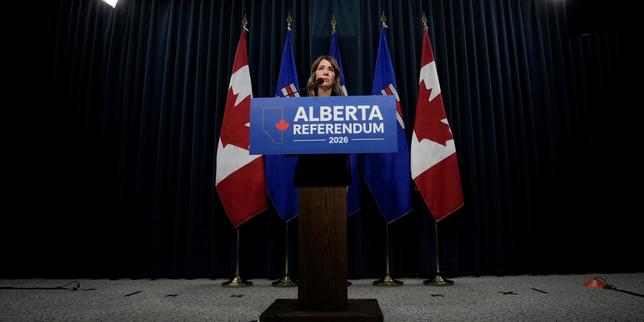
You don't need a history degree to spot a political panic move, but what's happening right now in Edmonton feels uniquely desperate. Premier Danielle Smith just booked Albertans a date at the ballot box for October 19. They won't just vote on the normal provincial squabbles. Instead, they'll face a convoluted question about whether the province should jump-start the legal process to hold another vote to quit Canada entirely.
If this sounds incredibly messy, it's because it is.
The real driver behind this isn't a sudden, overwhelming public urge to rip up the Canadian map. It's a calculated attempt by an embattled Premier to keep her own United Conservative Party from tearing itself apart. If you want to understand the modern Canadian political climate, you have to look past the dramatic headlines about national rupture. Look instead at a classic right-wing populist trap. Smith is trying to appease an angry, loud separatist faction inside her own ranks without alienating the moderate majority who just want their oil pipelines built and their taxes low.
It's a gamble that looks suspiciously like David Cameron's disastrous Brexit playbook. We all know how that turned out.
The Illusion of Control and the Bizarre Ballot Question
Let's look at the actual words Albertans will read in October. The question doesn't ask if the province should separate. That would be too straightforward. Instead, it asks:
"Should Alberta remain a province of Canada or should the Government of Alberta commence the legal process required under the Canadian Constitution to hold a binding provincial referendum on whether or not Alberta should separate from Canada?"
Talk about a mouthful. Honestly, it's a political masterpiece of moving the goalposts.
By framing the vote this way, Smith creates an escape hatch. If voters choose the second option, nothing happens immediately. No border guards appear. No new currency gets minted. It simply mandates the provincial government to start a constitutional wrestling match with Ottawa to set up a real secession vote later.
Why the sudden urge to build this multi-layered voting apparatus? Because a judge forced her hand.
Earlier in May, Justice Shaina Leonard of the Alberta Court of King's Bench threw out a massive, citizen-led separatist petition organized by a group called Stay Free Alberta. The group had triumphantly delivered over 301,000 signatures to Elections Alberta, demanding an immediate independence vote. The judge killed it because the organizers completely ignored the legal necessity to consult with First Nations, whose historical treaties with the Crown actually predate the formation of Alberta itself.
Instead of accepting the ruling or quietly appealing, Smith used it as a springboard. She claimed the courts were blocking the democratic voice of ordinary folks. This new, watered-down question is her way around that ruling. Since it doesn't directly trigger secession, her legal team thinks it side-steps the duty to consult Indigenous communities. It's a cynical maneuver, and everyone sees right through it.
The Great Alberta Grievance Mechanics
To understand why 300,000 people would sign a petition to break up the country, you have to look at the economic numbers. Alberta has about five million residents. It sits on the fourth-largest oil reserves on the planet, trailing only Venezuela, Saudi Arabia, and Iran.
For decades, the province has been the financial engine of the Canadian federation. Under Canada's equalization program, federal tax dollars collected from wealthy provinces get redistributed to help poorer regions maintain standard public services. Because of its massive energy wealth, Alberta is always a massive net contributor.
- The core frustration: Albertans feel like they write the checks while politicians in Ottawa actively try to shut down their oil and gas sector with federal carbon pricing and strict environmental regulations.
- The political reality: This economic friction turns into deep, regional alienation every time a Liberal government runs the country.
But here's the catch that the loudest independence voices ignore. Secession doesn't magically solve the geographic reality. Alberta is landlocked. If it leaves Canada, it still needs its neighbors' permission to run pipelines to the coast to export its oil to global markets.
Mount Royal University political scientist Duane Bratt notes that the separatist class seems driven by a fantasy of a conservative monoculture republic. They don't look closely at what they'd lose. For instance, the province's energy sector relies on intricate economic ties with the rest of Canada and the United States. Rupturing those ties would mean economic chaos, not a sudden windfall of prosperity.
Why Both Sides Feel Betrayed
If Smith thought this clever ballot question would make everyone happy, she miscalculated terribly. She managed to alienate both sides within minutes of her televised address.
During that same broadcast, Smith explicitly stated that she, her cabinet, and her caucus would actively campaign for Alberta to remain in Canada. She basically told her hardline base: I'm giving you the vote you wanted, but I'm going to spend millions of taxpayers' dollars telling you to vote no.
The reaction from the independence movement was swift and brutal. Separatist leaders publicly accused Smith of looking Albertans in the eye and lying to them. They see the non-binding, indirect question as a total betrayal of the 300,000 people who pounded the pavement to collect signatures. To them, she's a career politician using their passion as a shield to survive her next internal party leadership review.
Meanwhile, federalists and moderate conservatives are horrified. Federal Conservative leader Pierre Poilievre immediately distanced himself, stating that all federal Conservatives will campaign for Alberta to stay in Confederation.
Progressive critics and Indigenous leaders are equally furious. The Sturgeon Lake Cree Nation called the provincial government's actions authoritarian and undemocratic, pointing out that Smith is willing to bend the entire province's democratic system to satisfy a loud, fringe minority.
The Shadow of Foreign Ambition
There's an even weirder element to this story that isn't getting enough attention. People outside Western Canada don't realize how much American political cross-currents are fueling this fire.
In early 2026, figures close to the Trump administration openly mused about the benefits of an independent Alberta. Scott Bessent, a key economic voice in US political circles, publicly suggested that an Alberta separation could be a good development, hinting at a cozy relationship between a resource-rich prairie state and Washington.
This talk of annexation or heavy US influence has sent shivers through the Canadian establishment. It changes the stakes completely. It's no longer just an internal Canadian family argument about tax transfers. It's a geopolitical vulnerability.
What Happens on October 20?
The tracking data shows that a clear majority of Albertans don't actually want to leave Canada. When people are forced to consider the practical realities—losing their Canadian passports, creating a new central bank, negotiating trade deals from a position of weakness—the separatist sentiment usually shrinks back to around 20% or 30% of the population.
But a referendum campaign is a wild animal. It shifts focus away from normal government responsibilities like health care, rising housing costs, and public safety. For the next five months, Alberta politics will be entirely consumed by an existential debate about whether the province should exist.
If you live in Alberta or invest there, don't get distracted by the fiery rhetoric you'll hear over the summer. Watch the actual policy moves instead. The smart move here is to treat this as a internal party management strategy that got out of hand.
If you want to prepare for the fallout of this vote, focus on these three concrete steps:
- Monitor the federal policy shifts: Watch how Ottawa handles major infrastructure approvals over the summer. If the federal government eases up on certain regulatory hurdles, it will take a lot of the anger out of the separatist sails before October.
- Watch the provincial corporate migration: Keep an eye on whether major energy firms begin shifting legal addresses or capital to other provinces to hedge against constitutional uncertainty. That will be the real indicator of economic anxiety.
- Prepare for a messy ballot: If you're voting in Alberta this October, look closely at the other nine questions on immigration and constitutional powers that Smith is packing onto the ballot. The separation question is getting the headlines, but the other measures could quietly reshape provincial law while everyone is distracted.
Smith tried to use a complex question to bury a political crisis. Instead, she just handed a match to a crowd standing in an oil field.
For a deeper dive into how this referendum announcement is shaking up federal politics across Canada, check out this insightful Canadian Political Panel Discussion on the Alberta Referendum, which breaks down the immediate reactions from Ottawa and Quebec.