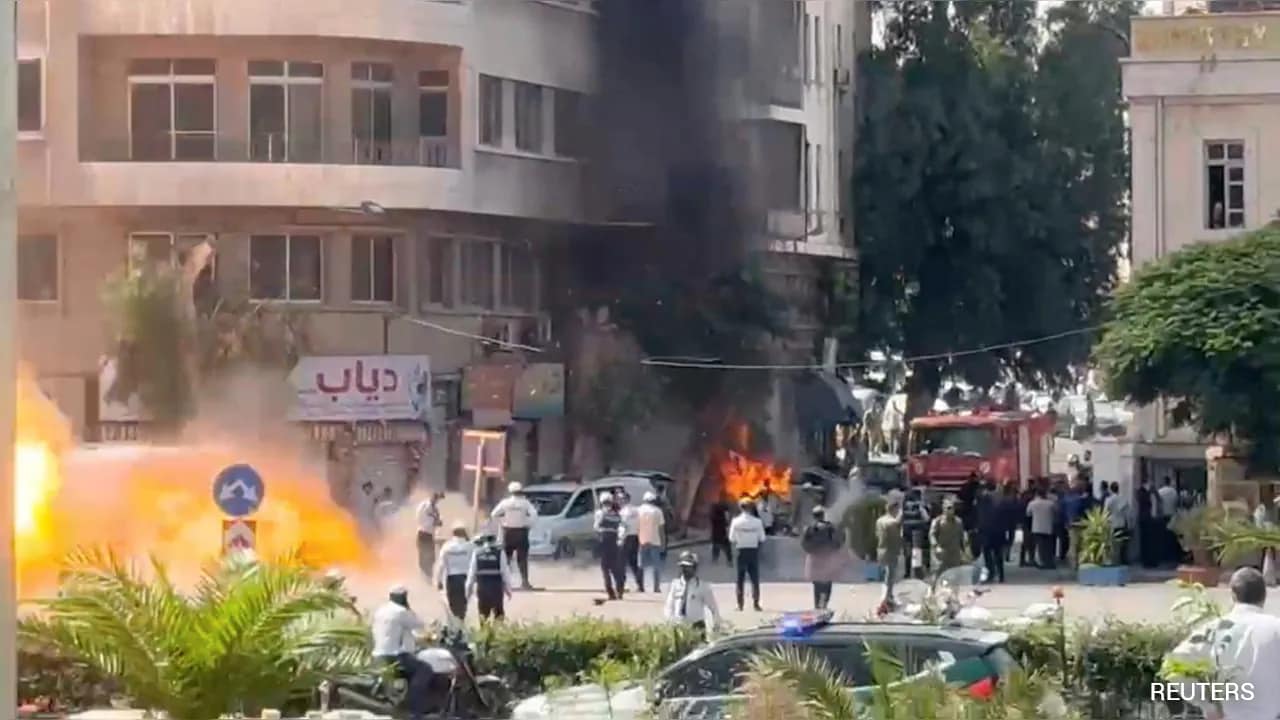
The dual improvised explosive device (IED) detonations near the Four Seasons Hotel in Damascus during French President Emmanuel Macron’s bilateral summit with Syrian President Ahmed al-Sharaa expose a critical vulnerability in the post-Assad state apparatus. While state media attributing the attack to Islamic State (ISIS) sleeper cells serves a specific narrative function, a rigorous threat-modeling analysis reveals a much deeper operational problem. The incident demonstrates that Syria's new leadership cannot maintain tactical denial of the capital's core perimeter. This creates a severe bottleneck for foreign direct investment (FDI) and diplomatic normalization.
To evaluate how this security breach affects Syria's geopolitical stabilization, we must analyze three key areas: the mechanics of urban asymmetric penetration, the state's messaging strategy, and the economic friction caused by persistent low-intensity conflict. For another look, check out: this related article.
The Mechanics of Urban Asymmetric Penetration
The Damascus explosions were not sophisticated standoff attacks or complex multi-vector ambushes. According to the Syrian Interior Ministry, the attack used two crude explosive devices: one placed in a refuse bin and the other inside a parked vehicle, detonating approximately eight minutes apart. This sequential timing indicates a classic bait-and-switch tactic designed to maximize casualties among first responders and security personnel drawn to the initial blast site.
The location of the blasts—the intersection between the Tourism Ministry and the National Museum, directly opposite the heavily fortified Four Seasons Hotel—is highly significant. This zone represents the high-rent, high-security core of the capital, an area where the state must maintain absolute control to attract foreign delegations. The failure to secure this perimeter reveals three distinct breakdowns in the Syrian security architecture: Similar coverage on this trend has been published by The Guardian.
- Intelligence Failure in the Human Layer: The placement of stationary assets (a parked vehicle and a rigged refuse bin) requires physical access and reconnaissance within a high-security zone. This shows that hostile actors can easily navigate local checkpoints and exploit blind spots in municipal surveillance.
- Deficiencies in Technical Countermeasures: The transition government lacks the technical infrastructure—such as electronic countermeasures, signal jammers, and continuous explosive trace detection—needed to sweep and secure vital transit corridors outside the immediate presidential convoy.
- Flawed Explosive Ordnance Disposal (EOD) Protocols: Internal security forces spotted the devices before detonation but failed to neutralize them safely. The resulting explosions injured 18 individuals, including four police officers, revealing a clear lack of professional EOD equipment and training.
This security breakdown cannot be viewed in isolation. It follows a similar attack just days prior, where an IED at a café near the Justice Palace killed 10 people and wounded 20. Together, these incidents demonstrate that while the al-Sharaa administration can protect specific high-value individuals using close-protection details, it cannot establish a broad area-denial capability across the capital.
The Attribution Function: Weaponizing the ISIS Narrative
The official state response, which pointed to ISIS sleeper cells, serves a calculated political purpose. By blaming an internationally recognized terrorist organization, the al-Sharaa government positions itself as an indispensable counterterrorism partner for the West. This strategy helps shift attention away from internal security flaws and aligns with the state's broader diplomatic goals.
[Urban Security Failure]
       │
       ▼
[State Attributes Attack to ISIS] ──► [Validates Counterterrorism Partnership]
       │                                              │
       ▼                                              ▼
[Obscures Internal Fractures]        [Accelerates Western Sanctions Relief]
This narrative strategy aims to achieve three main objectives:
First, it seeks to fast-track Western sanctions relief. President al-Sharaa, formerly a commander within Hayat Tahrir al-HTS, must continuously demonstrate a break from his past Islamist ties. Framing the bombings as an ISIS attack allows the administration to portray itself as a secular, stabilizing bulwark against global extremism. This supports France's ongoing efforts to convince its allies to lift economic restrictions on Damascus.
Second, it helps secure foreign security assistance. During the post-blast press conference, President Macron noted that France is working to reshape its security and military cooperation with Syria, hinting at deploying French special forces to assist in anti-ISIS operations. By accepting the ISIS attribution, Damascus can bring Western military resources into the country under a counterterrorism mandate, strengthening its defense capabilities without appearing dependent on foreign powers.
Third, it minimizes the visibility of other domestic opponents. Attributing the violence to ISIS helps the government avoid acknowledging resistance from remaining pro-Assad loyalists or fractured rebel groups unhappy with the new distribution of power. This creates an impression of internal political unity that is disrupted only by external, transnational threats.
Economic Friction and the Reconstruction Bottleneck
The primary target of these bombings was not President Macron’s motorcade, which was 10 kilometers away at the time of the explosions. Instead, the attack targeted investor confidence. The al-Sharaa government relies heavily on foreign capital to rebuild a country where 90% of the population lives in poverty and infrastructure is severely damaged after 14 years of civil war.
Macron’s delegation included high-level executives from major French corporations, such as Rodolphe Saadé of shipping giant CMA CGM and Patrick Pouyanné of TotalEnergies. The bilateral meetings yielded over a dozen preliminary agreements, including deals to rebuild water and power infrastructure in Homs, provide technical support to the Syrian Central Bank, and grant CMA CGM capacity-building rights at the Damascus airport.
However, the reality of these business commitments depends on a predictable security environment. For multinational corporations, the economic calculus of operating in a post-conflict zone involves balancing high potential returns against significant security risks.
$$Risk_Premium = f(Physical_Insecurity, Legal_Instability, Infrastructure_Failure)$$
When IEDs can be detonated in the capital's secure zones, the risk premium increases sharply. Insurance underwriting costs rise, personnel protection expenses grow, and project timelines become highly unpredictable. TotalEnergies’ discussions regarding offshore exploration require stable supply lines and secure ports. If the government cannot protect a hotel housing a foreign head of state, it cannot guarantee the security of isolated energy infrastructure or transit routes. This dynamic could turn signed agreements into non-binding letters of intent, delaying actual capital investment.
The Syrian government faces a difficult challenge. To attract the capital needed for reconstruction, it must demonstrate stability. Yet, achieving that stability requires resources it can only secure through foreign investment and international normalization. This vulnerability allows small, agile insurgent cells to disrupt major state initiatives with low-cost attacks.
Rather than relying on broad security sweeps, the transition government needs to build a multi-layered urban defense system. This requires shifting resources toward electronic signals intelligence, implementing strict municipal vehicle monitoring, and modernizing EOD units with Western technical assistance. Until Damascus can systematically prevent low-tech urban attacks, its efforts at international integration will remain vulnerable to disruption by irregular forces.