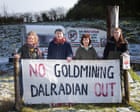
The conflict surrounding the Curraghinalt gold deposit in County Tyrone, Northern Ireland, is not merely a localized environmental dispute; it is a textbook case of asymmetric capital deployment clashing with non-tradable community assets. Dalradian Gold’s proposal to extract an estimated 6 million ounces of gold—valued at roughly £21 billion under current market spot prices—represents one of the largest undeveloped high-grade gold reserves in the Northern Hemisphere. The friction originates from a fundamental divergence in how value is measured: the developer utilizes a Net Present Value (NPV) framework based on mineral yields and discount rates, while the local opposition operates on a model of ecological preservation and multi-generational land utility.
The Economic Geometry of the Curraghinalt Deposit
The feasibility of the Omagh mine rests on a specific geological configuration. The Curraghinalt vein system is characterized by high-grade narrow-vein gold, which dictates an underground mining methodology rather than an open-pit approach. This choice is a technical necessity that doubles as a strategic mitigation tactic to reduce the surface footprint. In related developments, read about: The ISA Silence Why British Savers are Abandoning the Market.
From a capital allocation perspective, the project functions through three primary economic drivers:
- Ore Grade Concentration: Unlike lower-grade deposits that require massive earth-moving operations for minimal yield, Curraghinalt features grades often exceeding 15 grams per tonne ($15g/t$). This density allows for high margin-per-ounce ratios, even when accounting for the higher operating costs of underground extraction.
- Sovereign Risk vs. Resource Quality: Northern Ireland presents a unique jurisdictional paradox. While it offers a stable legal framework compared to emerging market mining frontiers, the political sensitivity of the Sperrin Mountains introduces a "social license" risk premium that threatens to offset the geological advantages.
- The Processing Bottleneck: The plan involves on-site processing using cyanide carbon-in-leach (CIL) technology. This is the pivot point of the community's resistance. While CIL is the global industry standard for gold recovery, the introduction of chemical processing into an Area of Outstanding Natural Beauty (AONB) transforms a subsurface mining issue into a surface environmental threat.
The Externalities of Cyanide-Based Extraction
The opposition to the mine is rooted in the perceived inadequacy of the developer's risk-mitigation architecture. When a private entity internalizes profits while externalizing the risk of catastrophic failure, a structural imbalance occurs. The primary environmental concern focuses on the management of "tailings"—the waste material left after gold is extracted. The Economist has analyzed this critical issue in extensive detail.
Dalradian’s strategy involves "dry-stacking" tailings, a method superior to traditional wet-tailings dams which are prone to breach. Dry-stacking involves filtering the waste into a sand-like consistency and layering it to prevent seepage. However, the logic of the local opposition (represented largely by groups like GREAN and Save Our Sperrins) identifies two critical failure points in this model:
- Chemical Residuals: Even with "de-tox" circuits designed to neutralize cyanide before storage, the long-term stability of these chemicals in a high-rainfall climate like Northern Ireland remains a contested variable.
- Water Table Contamination: The Sperrins feed the River Foyle system. Any breach in the containment liners or unforeseen seismic activity could introduce heavy metals and chemical residue into a watershed that supports local agriculture and salmon populations.
The conflict here is a battle over the Precautionary Principle. The developer argues that modern engineering renders the risk "as low as reasonably practicable" (ALARP). The community argues that in a high-value ecosystem, the only acceptable risk level for permanent contamination is zero—a figure incompatible with industrial mining.
Socio-Political Friction and the Social License to Operate
The "Social License to Operate" (SLO) is an intangible asset that Dalradian has struggled to secure, despite a multi-million-pound community investment program. The resistance is not a monolithic group of environmentalists; it is a coalition of farmers, local business owners, and residents who view the mine as an existential threat to the region's primary industries: agriculture and tourism.
The community's logic follows a Permanence vs. Transience framework. The mine has a projected lifespan of roughly 20 to 25 years. During this period, it promises approximately 500 to 1,000 jobs and significant tax revenue. However, the community views these benefits as transient "boom-and-bust" cycles. Once the £21 billion in gold is extracted and exported, the geological wealth is gone, leaving behind a modified landscape and the long-term liability of monitoring waste stacks.
Conversely, the agricultural and tourism sectors provide lower annual yields but offer indefinite sustainability. The trade-off—high-intensity short-term wealth versus low-intensity perpetual utility—is the core reason why standard economic impact assessments often fail to persuade local stakeholders.
The Regulatory and Planning Gridlock
The planning process for the Curraghinalt mine is currently one of the most complex in the history of Northern Ireland. It involves thousands of individual objections and a Public Inquiry that has been delayed several times. This gridlock stems from a breakdown in Institutional Trust.
The regulatory framework must reconcile the Northern Ireland Executive’s desire for foreign direct investment (FDI) with its statutory duty to protect the environment. The skepticism regarding the Department for the Economy’s dual role as both a promoter of mining and a regulator creates a perceived conflict of interest.
- Financial Guarantees: A major point of contention is the "reclamation bond." If the project fails or the company declares bankruptcy, who pays for the cleanup? If the bond is insufficient to cover the decades of monitoring required for a cyanide-processing site, the liability reverts to the taxpayer.
- Transboundary Implications: Because the watershed affects the Republic of Ireland, the project has evolved into an international diplomatic concern. This adds a layer of geopolitical complexity, as the Irish government has expressed concerns regarding the potential for cross-border water contamination.
Capital Intensity and the Cost of Delay
For the investors backing the project—primarily private equity and institutional funds—the delay in the planning process represents a significant Opportunity Cost. In mining, time is a lethal variable. The IRR (Internal Rate of Return) of the project degrades with every year the gold remains in the ground while overhead costs and legal fees accumulate.
This creates an incentive for the developer to "overspec" the project—adding more safety features and community benefits than originally planned—simply to break the stalemate. However, this also increases the "Sunk Cost" of the project, making it harder for the company to walk away even as opposition hardens.
The strategy currently employed by the developer is one of Hyper-Compliance. By aiming to exceed every environmental standard set by the UK and EU, they seek to make a refusal of the planning permission legally indefensible. If the project meets all technical requirements, a rejection based purely on "community sentiment" would set a precedent that could chill FDI across all sectors in Northern Ireland.
Strategic Forecast and the Path to Resolution
The resolution of the Omagh gold war will not be found in a compromise, as the objectives of the two parties are mutually exclusive. One side requires the extraction of the resource; the other requires its preservation.
The most probable outcome is a Conditional Approval following the Public Inquiry, characterized by unprecedentedly high financial bonds and independent, third-party environmental monitoring. However, this does not solve the underlying structural conflict. The "success" of the mine will ultimately depend on whether it can prove its safety within the first five years of operation.
For the developer, the move must be toward Total Transparency. This means providing real-time, public-facing data on water quality and air particulates, managed not by the company, but by a board of local trustees. For the community, the strategic play shifts to the Legitimacy of Monitoring. If the mine proceeds, the power of the opposition moves from stopping the project to becoming its most rigorous auditors.
The Curraghinalt project stands as a warning to the global mining industry: high-grade geology is no longer enough to guarantee a project’s viability. In the modern era, the cost of extracting gold is measured less in diesel and dynamite and more in the legal and social capital required to enter the earth. The "Gold War" in Omagh demonstrates that when a community perceives an existential threat to its landscape, the price of the commodity becomes irrelevant compared to the value of the territory.