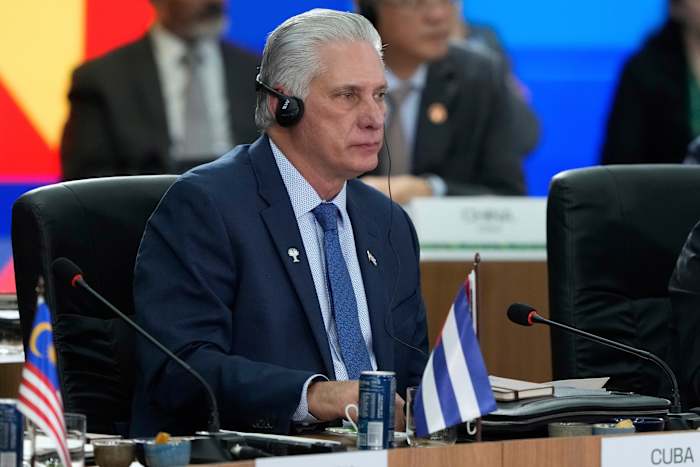
The internal gears of Cuban society are grinding against a geopolitical ultimatum that few saw coming but many felt was inevitable. When the White House signals "imminent action" against the Cuban government, the ripple effect isn't just felt in the halls of the Plaza de la Revolución; it vibrates through the empty storefronts of Havana and the whispered conversations in Miami’s Little Havana. The primary driver of this sudden escalation is a calculation that the Cuban state is at its weakest point since the Special Period of the 1990s, plagued by a collapsing power grid and a mass exodus of its youth. Washington is betting that a sharp, decisive shove will trigger a systemic transition, yet the historical record suggests that external pressure often hardens the very structures it intends to dismantle.
The Anatomy of an Ultimatum
Policy shifts of this magnitude do not happen in a vacuum. The current rhetoric stems from a fusion of domestic political necessity and a genuine intelligence assessment that the Cuban administration is struggling to maintain basic services. Food rations are inconsistent. The electrical grid is held together by aging Soviet-era infrastructure and literal prayers. By calling for immediate change, the U.S. executive branch is attempting to seize a moment of perceived peak vulnerability.
This isn't just about sanctions anymore. The language of "imminent action" implies a move beyond the standard economic embargo—perhaps a full maritime blockade, a designation of the country as a state sponsor of terrorism with teeth that actually bite into third-party trade, or a more direct support for internal dissidents. The goal is to create a "perfect storm" where the cost of maintaining the status quo becomes higher for the Cuban military than the cost of a transition.
However, the "how" of this action remains shrouded in the ambiguity of modern diplomacy. If the action is purely economic, it risks further immiserating the population without guaranteed political turnover. If it is more assertive, it risks a migration crisis that would wash up on Florida’s shores within forty-eight hours. The Cuban government knows this. They have used the "migration valve" for decades to relieve internal pressure, and they are likely preparing to do it again.
The Street Level Perspective
Walking through Central Havana today reveals a population that is exhausted. The "anger" cited by many observers is real, but it is frequently overshadowed by a profound, soul-crushing fatigue. When a superpower threatens your government, the first thought for a Cuban father isn't about the philosophy of democracy; it is whether the nearby port will be closed to the oil tankers that keep his refrigerator running.
Survival is the primary ideology.
The hope that exists is often found in the private sector, the mipymes. These small and medium-sized enterprises represent the only functional part of the Cuban economy. They are the ones importing flour, oil, and spare parts. Paradoxically, the "imminent action" threatened by the U.S. could inadvertently crush these nascent capitalists if the measures are too broad. If a blanket ban on financial transactions is enacted, the very people the West wants to empower—the independent entrepreneurs—will be the first to go bankrupt.
Historical Echoes and the Failure of Prediction
We have been here before. From the Bay of Pigs to the Helms-Burton Act, the strategy of "squeezing until they snap" has a 100% failure rate in terms of total regime change in Havana. The Cuban Communist Party is remarkably adept at bunker mentality. They have spent sixty years preparing for this exact scenario. Their security apparatus, the G2, is one of the most effective domestic surveillance networks in the world. They don't need a functioning economy to maintain control; they only need a functioning police force and a loyal officer corps.
The flaw in the current U.S. strategy is the assumption that the military will defect. In many authoritarian collapses, the generals eventually refuse to fire on the crowds. In Cuba, the military owns the economy. Through GAESA, the military conglomerate, the generals run the hotels, the gas stations, and the shipping lanes. To ask them to overthrow the government is to ask them to liquidate their own bank accounts and potentially face international tribunals.
The Geopolitical Chessboard
Cuba is not an island in the figurative sense. It remains a strategic outpost for Russia and a growing economic partner for China. If the U.S. moves toward "imminent action," it creates a vacuum that Moscow or Beijing may feel compelled to fill, if only to spite Washington.
Russia has already signaled a willingness to provide fuel shipments in exchange for long-term land leases or technical cooperation. China sees Cuba as a key node in its Caribbean maritime interests. Any U.S. action that doesn't account for these secondary players is doomed to be a localized skirmish in a much larger global competition.
The danger of the "imminent action" rhetoric is that it leaves no room for off-ramps. Once a superpower declares that a situation is urgent and requires a finale, it loses the ability to negotiate incrementally. It puts the Cuban leadership in a corner. A cornered animal is rarely interested in a peaceful transition; it is interested in making the cost of its demise as high as possible for its captor.
The Fragility of the Status Quo
What is different this time is the sheer level of internal decay. The state can no longer guarantee electricity for more than six hours a day in many provinces. This isn't just an inconvenience; it is a total breakdown of industrial and domestic life. When the lights go out, the fear of the secret police dims with them.
We saw this on July 11, 2021, when thousands took to the streets. The government suppressed that movement through a wave of arrests and heavy sentencing, but the underlying grievances have only intensified. The "action" Washington speaks of may not be a missile or a new law, but a spark that lands on the very dry tinder of Cuban public frustration.
The Problem with Sanctions as a Tool of Change
Sanctions are a blunt instrument. They are excellent at punishing, but they are terrible at directing. To move Cuba toward a different future, there must be a clear path for the Cuban people that doesn't involve starvation. If the U.S. wants to be effective, the "action" must include a massive, transparent carrot alongside the stick—a "Marshall Plan" for a post-transition Cuba that is communicated directly to the people, bypassing the state media.
Without that, the rhetoric of "imminent action" sounds to many Cubans like another chapter in a long book of external threats used by the government to justify internal repression. The Cuban state has survived for decades on the narrative of the "David vs. Goliath" struggle. Every time a U.S. president raises the temperature, the Cuban government uses it to explain why there is no bread in the bakeries.
The Intelligence Gap
There is a significant risk that the U.S. is overestimating the unity of the Cuban opposition and underestimating the resilience of the state’s repressive machinery. Intelligence reports often highlight the "anger" of the populace while failing to account for the "inertia" caused by dependency on state rations. Even a failing state can provide enough to ensure that the risk of rebellion remains higher than the risk of hunger for the majority of the population.
Furthermore, the "hope" mentioned in various reports is often a hope for exit, not for reform. The fastest-growing segment of the Cuban population is the one currently crossing the Rio Grande. This "brain drain" is a tragedy for the island's future, but it is a short-term win for the government, as it removes the most likely agitators for change from the domestic equation.
The Role of the Diaspora
The Cuban-American community is no longer a monolith. While the older generation in Miami demands "action" and total isolation, younger Cuban-Americans often want to maintain links to support their families directly. This tension complicates any U.S. policy. "Imminent action" that cuts off remittances or family travel would be met with fierce resistance from a significant portion of the very community it is meant to appease.
The Potential Outcomes
The most likely scenario following this escalation isn't a sudden collapse, but a period of intense volatility. We should expect:
- Increased maritime patrols by the U.S. Coast Guard in anticipation of a mass migration event.
- A surge in cyber-activity aimed at bypassing Cuban government internet shutdowns.
- Stricter enforcement of the Helms-Burton Act, targeting foreign companies doing business on "confiscated" property.
Each of these steps brings the two nations closer to a confrontation that neither side can fully control. The "imminent" nature of the threat creates a ticking clock, but it’s a clock where the hands are being moved by players who don't necessarily see the same time.
The reality on the ground in Havana is one of quiet, desperate preparation. People are hoarding what they can. The government is conducting "civil defense" exercises that are thinly veiled rehearsals for domestic crackdowns. Both sides are digging in.
If the goal of the current administration is to force a transition, they must realize that "action" is not a strategy; it is a catalyst. For a catalyst to work, the right elements must be in place. Currently, the Cuban people are ready for change, but they are also terrified of the chaos that a sudden, unmanaged collapse would bring.
The real investigative question isn't whether the U.S. will act, but whether it has a plan for the day after the action. History is littered with "imminent actions" that led to decades of unintended consequences. In the case of Cuba, the margin for error is non-existent.
The next few weeks will determine if this is a genuine turning point or merely another peak in a cycle of hostility that has outlived its original participants. For the person standing in a bread line in Matanzas, the distinction is academic. They simply want to know if the lights will stay on tonight.
Identify the specific channels through which the "imminent action" will be delivered—whether through a formal Department of Treasury update or a naval deployment—to understand if this is a policy shift or a political posture.