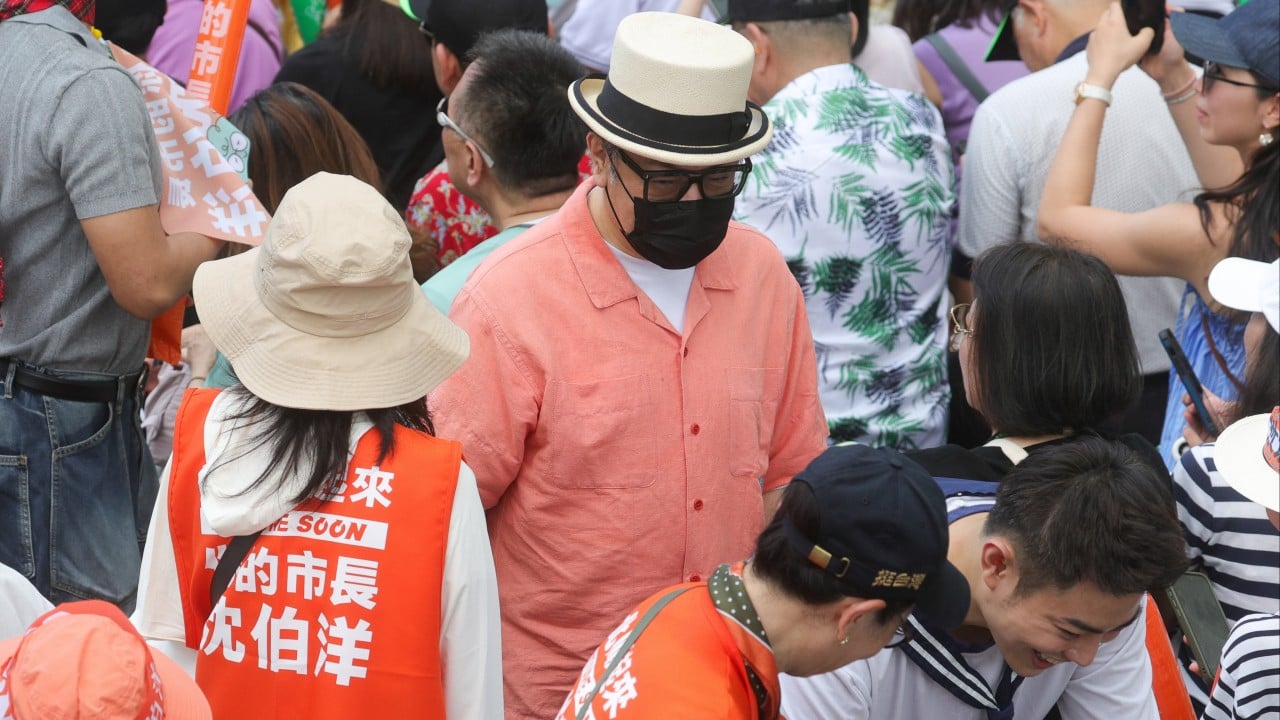
When television host Kevin Tsai attended the October 4, 2026 campaign headquarters opening for Democratic Progressive Party Taipei mayoral candidate Puma Shen, a routine local election appearance escalated into a cross-strait signaling dispute. Standard news coverage treats the episode as a celebrity flare-up: a mainland-popular entertainer visits a rally for a figure Beijing views as a separatist, Chinese state and military-linked commentators attack "two-faced" behavior, and the entertainer later posts a disclaimer on Weibo. That narrative misses the underlying mechanics of asymmetric political leverage across the Taiwan Strait.
To understand why a single public appearance near a campaign stage carries disproportionate weight, readers need to separate what is publicly documented from what is inferred. Known facts include Tsai's October 4 attendance at Shen's campaign event, subsequent criticism on Chinese social media and from a People's Liberation Army-affiliated Weibo account, Beijing's Taiwan Affairs Office warning against profiting in mainland markets while associating with what it labels separatist forces, commercial distancing by brands, Tsai's October 26 Weibo statement denying support for Taiwan independence while framing his attendance around interview research, and responses from Taiwan's Mainland Affairs Council and Taipei mayoral contenders ahead of the November 28, 2026 municipal elections. Educated hypotheses include whether Beijing's public warnings were calibrated specifically to influence voter sentiment in Taipei's high-profile race or to enforce broader compliance boundaries among cross-strait cultural figures.
How Cross-Strait Pressure Converts Visibility Into Leverage
Standard commentary often assumes that political pressure works through direct commands. In cross-strait cultural and commercial life, the mechanism is more indirect and relies on market asymmetry and reputational risk. Mainland China offers scale and commercial revenue that no local media market can match, while political authorities and state-aligned online ecosystems set sharp ideological boundaries around sovereignty and cross-strait ties.
A public figure operating across both environments faces a structural squeeze whenever domestic political life in Taiwan intersects with themes Beijing treats as red lines. Even without a formal ban issued in a single stroke, commercial sponsors monitor online backlash closely because brand association with political controversy carries immediate sales and public-relations risk in the mainland market.
This dynamic creates a second bottleneck for public figures: the collapse of ambiguity. In everyday democratic politics in Taiwan, attending an event, greeting a candidate, or observing a campaign for professional research is widely treated as normal civic or journalistic behavior. Outside Taiwan's political system, that same act can be reinterpreted as a loyalty signal. Once a label attaches on platforms like Weibo, neutral explanations rarely restore the prior status quo on their own.
Four Structural Pillars of the Dispute
Deconstructing the episode into four analytical pillars clarifies why every actor responded the way they did.
- The Signaling Pillar: Beijing's messaging—exemplified by warnings against being "two-faced" and statements that there is "no room for ambiguity" on sovereignty—targets not only Kevin Tsai but any cross-strait figure tempted to treat mainland commerce and Taiwanese political participation as separable spheres.
- The Commercial Exposure Pillar: Entertainers and hosts with active mainland audiences or endorsements carry concentrated commercial exposure. When brands distance themselves during an online pile-on, the financial cost hits before any formal legal or regulatory action occurs.
- The Framing Contest Pillar: Tsai framed his presence through the lens of an interviewer observing nearly 10,000 guests over decades without adopting their views. Taiwan's Mainland Affairs Council framed the issue around democratic norms, freedom of association, and the constitutional reality of the Republic of China rather than a push for formal independence. Beijing's narrative rejected that separation, treating proximity to a sanctioned critic as political alignment.
- The Election Timing Pillar: Because the event occurred weeks before Taiwan's November 28, 2026 local elections, candidates and officials had immediate incentives to interpret the backlash through domestic governance and anti-interference lenses.
Why Standard Explanations Miss the Cause-and-Effect Chain
Superficial coverage treats a statement like Tsai's October 26 Weibo post as the end of the story. In reality, a defensive clarification often exposes a deeper structural trap.
The first cause-and-effect link runs from symbolic association to domestic polarization. When Beijing criticizes a Taiwanese entertainer for attending a DPP candidate's event, the pushback does not stay contained in mainland social media. Inside Taiwan, it feeds arguments about external pressure on everyday civic life and election campaigns, turning an entertainer's schedule into a test of democratic resilience.
The second cause-and-effect link runs from public clarification to credibility strain. A public figure who disclaims political alignment to protect commercial ties risks alienating domestic audiences who view external pressure as illegitimate, while still failing to satisfy hardline critics abroad who demand unconditional political conformity. That narrows the middle ground that cultural hosts traditionally rely on.
Consider a hypothetical media producer planning cross-strait programming ahead of an election cycle. If the producer books a controversial political figure or visits a high-profile campaign rally without clear editorial separation or pre-agreed institutional backing, an image of that appearance can circulate stripped of context. Once detached from its original setting, the photograph becomes raw material for rival narratives—one emphasizing democratic openness, the other emphasizing ideological disloyalty.
Tactical Logic for Navigating High-Stakes Cross-Strait Visibility
For public communicators, media teams, and analysts tracking cross-strait dynamics, reacting after a hashtag trends is already late. A more disciplined operating sequence reduces avoidable exposure.
- Map exposure before public appearances. Before attending any politically charged event or campaign launch, list every commercial relationship, platform dependency, and audience segment that could react to a photograph taken out of context.
- Establish institutional context in real time. When an appearance is journalistic or observational, contemporaneous documentation—such as clear editorial framing or pre-announced interview coverage—is far more credible than a retrospective explanation weeks later.
- Separate legal/sovereignty claims from personal intent. Official bodies and individual communicators operate on different tracks; conflating a private individual's social or professional presence with state policy escalates friction unnecessarily.
- Prepare for multi-audience fallout. Assume any statement posted on a mainland platform will be read in Taipei, and any statement made in Taipei will be scrutinized on mainland feeds. Consistency across venues matters more than clever phrasing.
- Track second-order indicators. Watch brand partnerships, official press briefings, and election commentary rather than isolated social media posts alone to judge whether an incident is fading or hardening into a broader precedent.
Limitations of Any Counter-Strategy
No communication playbook eliminates structural asymmetry. When a state apparatus and a massive commercial market align around strict political definitions, even careful boundary-setting has limits. A host can state that interviewing a figure does not equal endorsement, and a government agency can reiterate that citizens are free to attend events, but neither can compel commercial sponsors or online commentators to accept that distinction.
Over-correcting carries its own risk. Attempting to sanitize every public appearance or pre-empt every hypothetical backlash can paralyze normal cultural and journalistic activity, handing leverage away by default before any pressure is applied.
Strategic Play
Analysts and decision-makers covering cross-strait flashpoints should stop treating celebrity controversies as side stories and instead track them as early-warning indicators of boundary enforcement ahead of major political milestones. Focus attention on where commercial dependency meets domestic election campaigning, document how official institutions respond to external pressure, and treat every public clarification as a signal of how narrow the space for ambiguity has become.
Did Kevin Tsai’s “No Support for Taiwan Independence” Post Get Rejected by Beijing?
This video provides additional broadcast commentary on how Beijing reacted to Kevin Tsai's statement following his campaign rally appearance.


