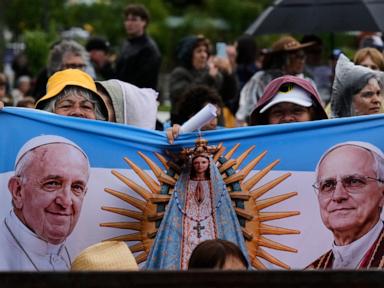
Thousands packed into a public park in Uruguay to witness Pope Leo celebrate his first Mass in South America. Most headlines treat this like just another stop on a standard papal itinerary. They're missing the bigger picture entirely.
When a pontiff chooses Uruguay—the most secular nation on the continent—for a debut South American liturgy, it isn't an accident. It's a deliberate statement.
Why Uruguay Was the Deliberate Choice
If you look at South American demographics, Brazil, Mexico, or Colombia usually top the list for massive Catholic gatherings. Uruguay sits at the opposite end of that spectrum. For over a century, the country has maintained a strict separation of church and state, even renaming traditional religious holidays like Christmas to "Family Day" and Holy Week to "Tourism Week."
Starting in Montevideo sends a clear signal. Pope Leo didn't travel across the Atlantic just to preach to the choir in an easy stronghold. He went straight to a society where religious affiliation has steadily declined, testing how his message lands in a modern, skeptical environment.
People showed up anyway. Families, elderly locals, and young travelers filled the park hours before the liturgy began, waving yellow-and-white Vatican flags alongside Uruguay's blue-and-white stripes.
What Happened Inside the Park
The atmosphere in the park felt less like a rigid state ceremony and more like a massive neighborhood gathering. Security barriers stayed relatively unobtrusive, letting the crowd press close to the main altar platform.
A few details stood out if you paid attention to the ground-level logistics:
- Early arrivals set the tone. Locals brought thermos flasks of mate—the traditional Uruguayan herbal tea—sharing gourds while waiting under the morning sun.
- Regional pilgrims crossed borders. Because Montevideo sits right on the Río de la Plata, thousands of Argentines took the ferry across from Buenos Aires just to attend, turning a local Uruguayan event into a broader regional moment.
- Music bridged the gap. Instead of sticking exclusively to heavy European choral arrangements, the liturgy incorporated local acoustic rhythms that kept the crowd visibly engaged.
Honestly, watching a crowd in a famously secular capital sing along in unison shows how much cultural pull the papacy still commands when it steps outside traditional basilicas.
The Real Meaning Behind Pope Leo's First South American Mass
Every pope's early international trips define their papacy. John Paul II used his early travels to confront political repression. Francis used his to spotlight the global margins. Pope Leo's decision to celebrate his first South American Mass in an open Uruguayan park points toward direct, unvarnished public engagement.
He skipped ornate cathedrals. Choosing an open-air park strips away institutional barriers and forces the Church to meet people on neutral, civic ground. In a country where public parks belong fiercely to the citizens rather than religious institutions, holding Mass there required genuine goodwill from both city officials and residents.
The homily itself avoided dense theological jargon. Instead, it focused on community solidarity, economic fairness, and rebuilding trust in fractured societies—themes that resonate just as strongly with secular Uruguayans as they do with practicing Catholics.
Common Misconceptions About Papal Visits in the Region
Whenever news breaks about massive crowds greeting a pope in South America, commentators tend to jump to two wrong conclusions.
First, they assume huge attendance equals a sudden surge in weekly churchgoers. It doesn't. In places like Uruguay, people show up out of cultural respect, historical curiosity, and a desire to be part of a rare global event. Treating crowd size as a simple metric of religious conversion misses the nuance of Latin American civic culture.
Second, critics often dismiss these trips as purely symbolic photo ops. That ignores the diplomatic weight behind them. Papal visits routinely unlock quiet channels between the Vatican, local governments, and regional nonprofits working on poverty, education, and migration.
How to Follow the Rest of the South American Tour
If you want to track how this visit shapes regional politics and Church dynamics over the coming days, skip the surface-level wire summaries and look at the primary sources directly:
- Read the full text of the homilies on Vatican.va. News outlets usually pull a single soundbite, stripping out the specific local references Pope Leo makes to regional history and social challenges.
- Watch local Uruguayan and Argentine broadcasts. Coverage from Montevideo-based outlets captures the street-level interviews and municipal reactions that international correspondents routinely overlook.
- Track the follow-up meetings with civil society groups. Pay less attention to the formal palace greetings and more to who gets invited to private roundtables with local educators, labor representatives, and community organizers.
Pope Leo's first Mass in South America wasn't about flexing institutional muscle in an easy crowd. By filling a public park in the continent's most secular capital, he proved that thoughtful, grounded outreach still draws people out of their homes and into the public square.