Two weeks off. That's usually enough to kill the momentum of almost any street movement, especially when freezing rain replaces mild autumn afternoons. Yet when French school protests resume on a smaller scale as holidays end, the mainstream press treats the lower turnout like a victory lap for the Ministry of National Education. They're reading the room completely wrong.
I've watched French labor and student disputes play out for years, and the post-break dip is practically a law of physics. You can't expect thousands of teenagers and exhausted teachers to march at full strength on the exact Monday morning they're scrambling to find lost locker keys and catch up on grading. A smaller crowd outside a lycée gate doesn't signal surrender. It signals a shift in tactics from mass street theater to targeted, localized disruption that's actually much harder for Paris to contain. For a different view, read: this related article.
Why French School Protests Always Shrink After a Break
To understand what's happening at school gates across France right now, you have to look at how the French academic calendar works. Unlike systems with one massive summer break and a couple of long weekends, France chops its school year into tight six-to-seven-week sprints separated by two-week vacances scolaires. And those breaks are staggered across three geographic zones—Zone A, Zone B, and Zone C—specifically to keep ski resorts and highways from collapsing under traffic.
That staggered calendar is a massive headache for union organizers like FSU-SNUipp, SNES-FSU, and student unions like the Union Syndicale Lycéenne. Related insight regarding this has been provided by The Washington Post.
When Zone C is in class, Zone A is on holiday. By the time everyone is finally back in the same week, the initial spark that drove people onto the streets before the break has cooled off. People have spent fourteen days talking about family dinners, travel delays, and heating bills instead of education budgets or curriculum reforms. Getting the engine turning again takes time.
The Logistics of Rebuilding Momentum
Organizing a high school blockade—a blocus—isn't as spontaneous as news clips make it look. Students have to coordinate via encrypted messaging apps, haul wooden pallets and trash bins to the main entrance at 6:00 AM, and deal with local police who usually show up before the first bell rings.
Teachers face a different kind of friction. Every day on strike costs a full day's pay under French public sector rules, and with inflation eating into civil servant salaries over the last few years, calling an indefinite walkout right after holiday spending is a brutal financial ask. So unions play it smart. They call for smaller, rolling actions—a morning assembly here, a two-hour walkout there—to keep the pressure simmering without bankrupting their members before the next major national day of action.
What Is Actually Driving Teachers and Students Out the Door
If you only read quick wire summaries about French school protests resuming on a smaller scale as holidays end, you'd think people were just complaining out of habit. That's lazy analysis. Behind every trash bin pushed in front of a school entrance in Paris, Lyon, or Marseille, there's a specific set of grievances that haven't budged an inch while schools were closed.
Chronic Staff Shortages and Unfilled Classrooms
Ask any parent in the Paris suburbs—especially in departments like Seine-Saint-Denis—about the state of public schooling, and you won't hear abstract political theory. You'll hear about kids going months without a permanent math or French teacher.
The recruitment crisis in French education isn't a secret. Competitive teaching exams (CAPES and CRPE) have repeatedly failed to fill thousands of open positions over recent academic cycles. To plug the holes, the ministry has leaned heavily on short-term contract workers (contractuels), sometimes hired after brief interviews with minimal pedagogical training. Permanent staff feel their profession is being devalued, while parents watch their kids fall behind before national exams even begin.
Class Sizes and Sorting Reforms
France consistently ranks near the top in European comparisons for average class sizes in both primary and lower secondary schools, according to OECD Education at a Glance data. Cramming thirty-plus teenagers into aging classrooms makes individualized support basically impossible.
On top of crowding, recent policy pushes around ability grouping—sorting students by level in core subjects like French and mathematics—have sparked fierce pushback from educators. Union leaders argue this fractures the traditional collège unique (comprehensive middle school) model and locks working-class kids into lower tracks early on. Government officials counter that mixed-ability classrooms hold back top performers while failing struggling students. Neither side is backing down, and a two-week holiday didn't magically resolve an ideological divide over what public education is supposed to be.
Campus Safety and Crumbling Buildings
There's also a physical reality people outside France rarely hear about. Many school buildings constructed during the postwar baby boom are badly insulated, sweltering in June and freezing in January. Meanwhile, tensions around school security, cyberbullying, and occasional violent incidents outside campus gates have left both staff and students feeling exposed without enough administrative support staff—specifically AEDs (educational assistants) and school nurses—to manage daily life on campus.
How School Blockades Play Out on the Ground
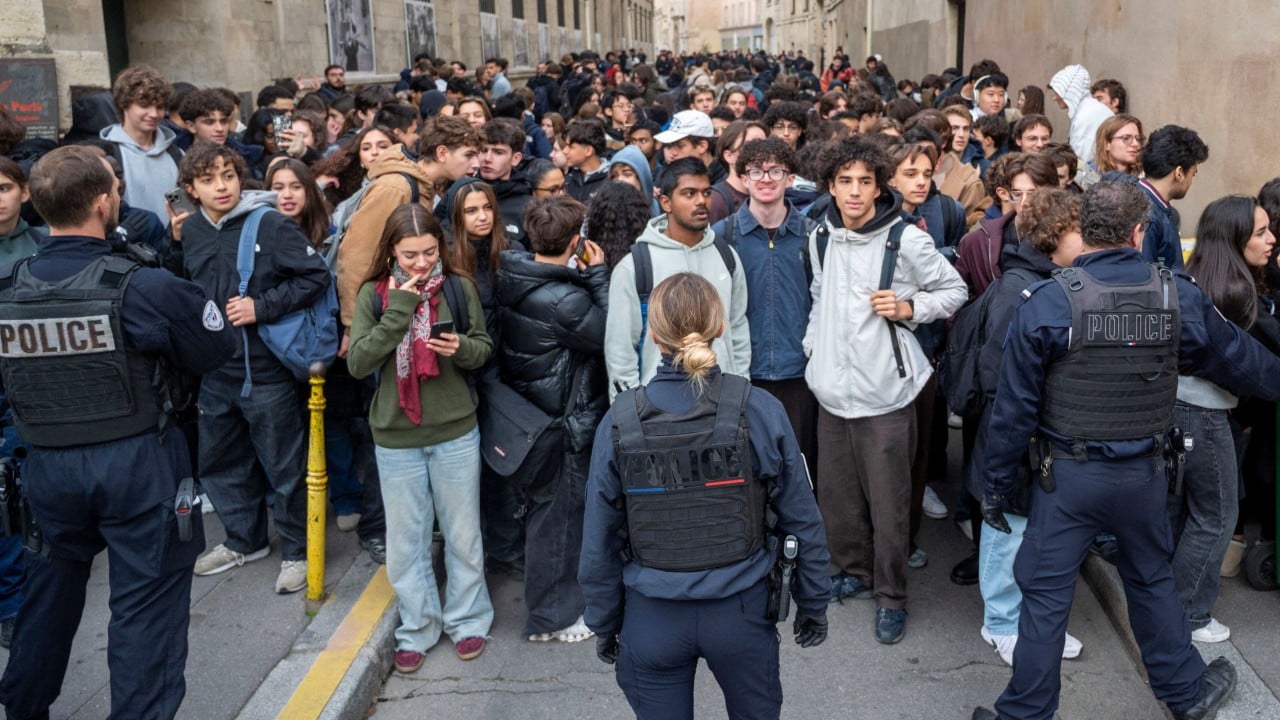
Walk past a protesting French high school at 7:30 AM and the atmosphere is totally different from a massive union march down Boulevard Voltaire in Paris. It's smaller, louder in pockets, and weirdly routine.
Usually, a core group of twenty to fifty students shows up early. They stack metal barriers, recycling bins, and whatever wooden crates they've scavenged from behind local supermarkets across the main doors. Hand-painted banners hang from the iron gates, usually targeting the current Education Minister by name or demanding more funding for public schools.
Most of the student body stands across the street on the sidewalk, scrolling on their phones, drinking cheap coffee from the corner café, and waiting to see if the administration cancels morning classes. Sometimes local riot police (CRS or municipal officers) arrive, clear the bins in ten minutes flat, and the students disperse to the nearest square to hold a general assembly (assemblée générale). Other times, the principal negotiates directly with student reps to keep at least one side entrance open so students taking mock exams can get inside.
Media outlets love counting heads at these morning assemblies and declaring that the movement is "running out of steam." Honestly, headcounts at 8:00 AM on a Tuesday miss the entire point of how French social movements build pressure.
What Most People Get Wrong About Lower Turnout Numbers
There's a predictable cycle in French political reporting. Week one of a dispute brings dramatic photos of packed boulevards and hyperbolic headlines about a country on the brink. Then a holiday hits. Week three brings quieter photos of fifty people standing in the drizzle outside a regional education office (rectorat), followed by punditry claiming the government has weathered the storm.
Here's why that reading fails repeatedly:
- Testing the waters isn't quitting. French unions rarely blow their entire organizational budget on the first week back from holiday. They use smaller, localized strikes to take the temperature of rank-and-file workers before committing to a coordinated nationwide strike date (journée interprofessionnelle).
- Youth movements move in waves. High school and university protests don't follow rigid union schedules. A single viral video of heavy-handed policing outside one high school can turn a quiet Tuesday into forty blockaded campuses by Thursday morning.
- Public sympathy doesn't vanish overnight. Polling in France consistently shows that while commuters get frustrated by transit strikes, parents are remarkably sympathetic toward teachers asking for smaller classes and better pay—because parents see the exact same overcrowding at parent-teacher conferences.
- Local wins keep activists fueled. Even when national policy doesn't budge, localized protests regularly force regional education authorities to release emergency substitute teachers or cancel planned class closures at specific schools. Those small victories keep the fire alive.
The Bigger Picture for Students, Parents, and Policymakers
If you're trying to gauge where this dispute goes over the next few weeks, stop staring at raw crowd estimates from the first forty-eight hours after the break. Watch three specific indicators instead.
First, look at inter-union unity. When rival education unions—from the more combative SUD Éducation to the larger, more moderate FSU and UNSA—sign joint strike notices, the government has a real problem on its hands. When they issue separate calls on different days, the pressure dissipates.
Second, pay attention to university campuses. High school protests rarely force major policy reversals on their own. When university students at campuses like Tolbiac in Paris, Rennes 2, or Lyon 2 start voting for campus blockades and merging their assemblies with high schoolers and teachers, the political temperature spikes overnight.
Third, watch exam season deadlines. The French school calendar revolves around Parcoursup (the national university admissions platform) and the Baccalauréat. As spring deadlines approach, anxiety among seniors and their parents shoots up. Unions know that disrupting exam logistics carries massive leverage—and massive political risk if parents turn against them.
If you're a parent, student, or expat navigating school closures in France right now, check your local académie portal and the school's ENT (digital workspace) before heading out the door each morning, since headteachers are legally required to communicate minimum reception services (service minimum d'accueil) for younger children when primary teachers strike. Keep an eye on national union calendars for the next unified strike date rather than assuming quiet mornings mean the dispute is over, because in French education politics, a slow restart after the holidays is almost always the warm-up act rather than the final curtain.