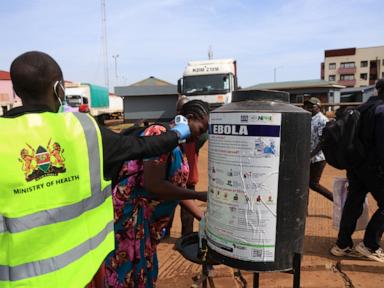
Three cases. Zero community spread. Headlines scream alarm anyway.
Read the standard breaking-news coverage of Kenya's third confirmed Ebola case—a 65-year-old woman linked to the first patient who died—and you get the same tired script. Officials announce a new infection in a quarantined relative. Reporters treat every single-digit tally bump like a fuse burning toward Nairobi. Politicians point to temperature guns at border posts and call it a shield. Meanwhile, you can find related events here: Deconstructing Gaza Malnutrition Metrics Through Systems Analysis.
That script is lazy. Worse, it trains the public to watch the wrong scoreboard.
When a quarantined household contact tests positive for Ebola virus disease (specifically the Bundibugyo strain imported from the Democratic Republic of the Congo), that is not a sign that containment just failed. It is often the system catching an infection that was already seeded inside a known chain of transmission. Meanwhile, the real danger sits outside the quarantine perimeter—in unmonitored informal crossings, delayed recognition of atypical early symptoms, and the massive, ongoing Bundibugyo outbreak raging across the DRC. To understand the bigger picture, we recommend the recent article by CDC.
What the Competitor Article Gets Wrong About Case Counts
Standard outbreak reporting confuses detection inside a known cluster with uncontrolled expansion.
In Kenya's October 2026 cluster, the index case was a 40-year-old man who arrived from the DRC via Uganda, tested positive, and died on October 5. The third confirmed case—a 65-year-old relative—had already been placed in quarantine on October 6 before developing symptoms and testing positive.
Alarmist coverage treats case #1, case #2, and case #3 as proof that the virus is slipping past defenses. Look closer at the epidemiology:
- Known contact vs. mystery case: A case emerging among traced, quarantined contacts shows contact tracing is operating. A single unlinked case with no known exposure chain is the real red flag.
- Incubation reality: Ebola's incubation period typically runs from 2 to 21 days. Secondary cases showing up days after an index death are predictable arithmetic, not a surprise twist.
- Denominator blindness: Tracking raw case numbers in a small imported cluster without tracking contact-tracing completion rates, time-to-isolation, and healthcare worker exposures tells you almost nothing about trajectory.
I have seen health agencies and media outlets blow millions on panic messaging and performative border theater while ignoring basic triage bottlenecks inside clinics. When a hospital misses the first febrile patient or fails to isolate a relative early enough, that is where chains of transmission break loose.
Bundibugyo Is Not Zaire, and Precision Matters
Public health shorthand lumps every filovirus scare into one Hollywood movie. Precision saves lives.
Ebola virus disease is caused by orthoebolaviruses, and the Bundibugyo virus has a distinct epidemiological profile compared to Zaire ebolavirus. Historically, Bundibugyo outbreaks have carried lower average case-fatality rates than Zaire outbreaks—though in the massive 2026 DRC surge, crude fatality figures have still hovered near half of confirmed cases amid strained health systems and community mistrust.
Lower average lethality does not make a virus harmless. It creates a different trap: mild or non-specific early symptoms—fever, headache, fatigue, muscle aches—look like malaria, typhoid, or routine viral illness. Patients walk into clinics or stay home with family. Caregivers get exposed before anyone even whispers "viral hemorrhagic fever."
The Real Bottlenecks Nobody Wants to Fix
If you want to judge whether Kenya—or any neighboring state—is actually safe from an imported Ebola cluster spiraling out of control, stop staring at the daily case count. Watch four operational choke points instead.
| Operational Metric | What Headlines Focus On | What Actually Determines Outbreak Control |
|---|---|---|
| Case Tally | Whether the number rises from 1 to 3 | Whether new cases appear outside known contact lists |
| Border Screening | Temperature checks at official checkpoints | Informal cross-border movement and clinic-level suspicion in border towns |
| Contact Tracing | Raw number of contacts identified | Percentage of contacts monitored daily for the full 21 days |
| Hospital Triage | Flashy isolation units and PPE photos | Speed of isolation and early supportive care at the first point of contact |
1. Porous Borders Make Thermal Scanners a Comfort Blanket
Look at a map of East and Central Africa. People do not move strictly through tidy customs lanes with clipboards. Traders, families, and travelers cross porous borders every day along informal paths.
Even at official crossings, thermal screening has a glaring biological blind spot: a person incubating Ebola can cross a border afebrile—with zero fever—and develop symptoms days later. When residents in border towns like Busia point out informal crossings, they are pointing to a structural reality, not a minor detail. Border checks can intercept some symptomatic travelers, but they cannot substitute for rapid fever surveillance and strict infection control inside local clinics.
2. Contact Tracing Is a Logistics Grind, Not a Press Release
Finding 135 contacts sounds impressive on paper. Keeping eyes on every single one of them for 21 days—especially mobile individuals or reluctant relatives—is grueling field work.
If health workers miss even a small fraction of high-risk contacts, or if quarantine feels punitive rather than supported with food, medical care, and clear communication, people hide symptoms. That is why heavyweights in outbreak response—from the World Health Organization to seasoned epidemiologists like Michael Osterholm—repeatedly stress early case recognition, supportive care, and community trust over blunt travel bans. Travel restrictions often push movement underground and punish neighbors without stopping transmission.
3. Safe and Dignified Burials Decide Trust
Ebola transmission spikes sharply when people handle bodies of patients who died with high viral loads during traditional funeral rites. Yet heavy-handed body removal without family involvement breeds deep resentment and secrecy.
"Safe and dignified burials" exist for a reason: they combine strict biosafety with cultural respect. When authorities treat funerals purely as a security operation instead of a negotiated care process with grieving families, families hide sick relatives to avoid losing control over burial customs.
A Thought Experiment: What If Case #3 Had Never Been Quarantined?
Imagine a scenario where the 65-year-old relative had not been identified and placed in quarantine early.
She develops a fever at home. A neighbor brings soup and helps her to a local clinic. Because early symptoms look ordinary, triage staff take a standard history without catching the family link to the DRC travel history. Another patient sits nearby in a crowded waiting room. Over three days before referral to an isolation unit, ten new people have brief or direct exposure.
Now compare that to a patient already under daily monitoring when symptoms start. The window of uncontained community exposure shrinks dramatically.
That contrast proves the point: containment succeeds or fails in the hours between symptom onset and isolation, not in the press conference announcing the test result.
Honest Downsides of Focusing on System Metrics Instead of Case Counts
Taking a cold, systems-first view of an Ebola cluster has real risks, and pretending otherwise would be dishonest.
First, downplaying case counts can breed complacency. A cluster of three cases can turn into thirty if a single high-risk contact slips through or a healthcare worker suffers a breach in personal protective equipment. Calm analysis must never become carelessness.
Second, focusing on technical metrics can sound detached from human fear. To a family burying a relative or a nurse putting on heavy protective gear in tropical heat, statistical nuance does not erase danger. Good public health communication respects fear without feeding hysteria.
Third, when a massive outbreak continues across the border in the DRC, re-importation remains an ongoing probability as long as regional transmission stays high. Zero local spread today does not guarantee zero new introductions next month.
What to Do Instead of Panicking Over the Tally
Stop asking, "How many cases does Kenya have now?" Start asking, "How fast are suspected cases being isolated, what share of contacts are completing 21-day follow-up, and are frontline clinics getting real-time diagnostic support?"
For health leaders and preparedness teams, the unconventional priority is boring execution over dramatic announcements:
- Audit clinic triage first: Train reception and triage staff in high-traffic urban and border clinics to pair fever checks with travel and contact questions automatically.
- Fund contact support, not just surveillance: Provide meals, stipends, and medical care for quarantined households so people stay put willingly.
- Pair rapid diagnostics with early supportive care: Quick lab confirmation and aggressive hydration, electrolyte management, and symptom control save lives and show communities that isolation facilities help patients survive.
- Keep borders open to cooperation, not closed in panic: Share cross-border epidemiological data transparently with neighboring health ministries rather than slapping on knee-jerk bans that disrupt trade and aid.
Watch the quarantine perimeter, not the headline counter.