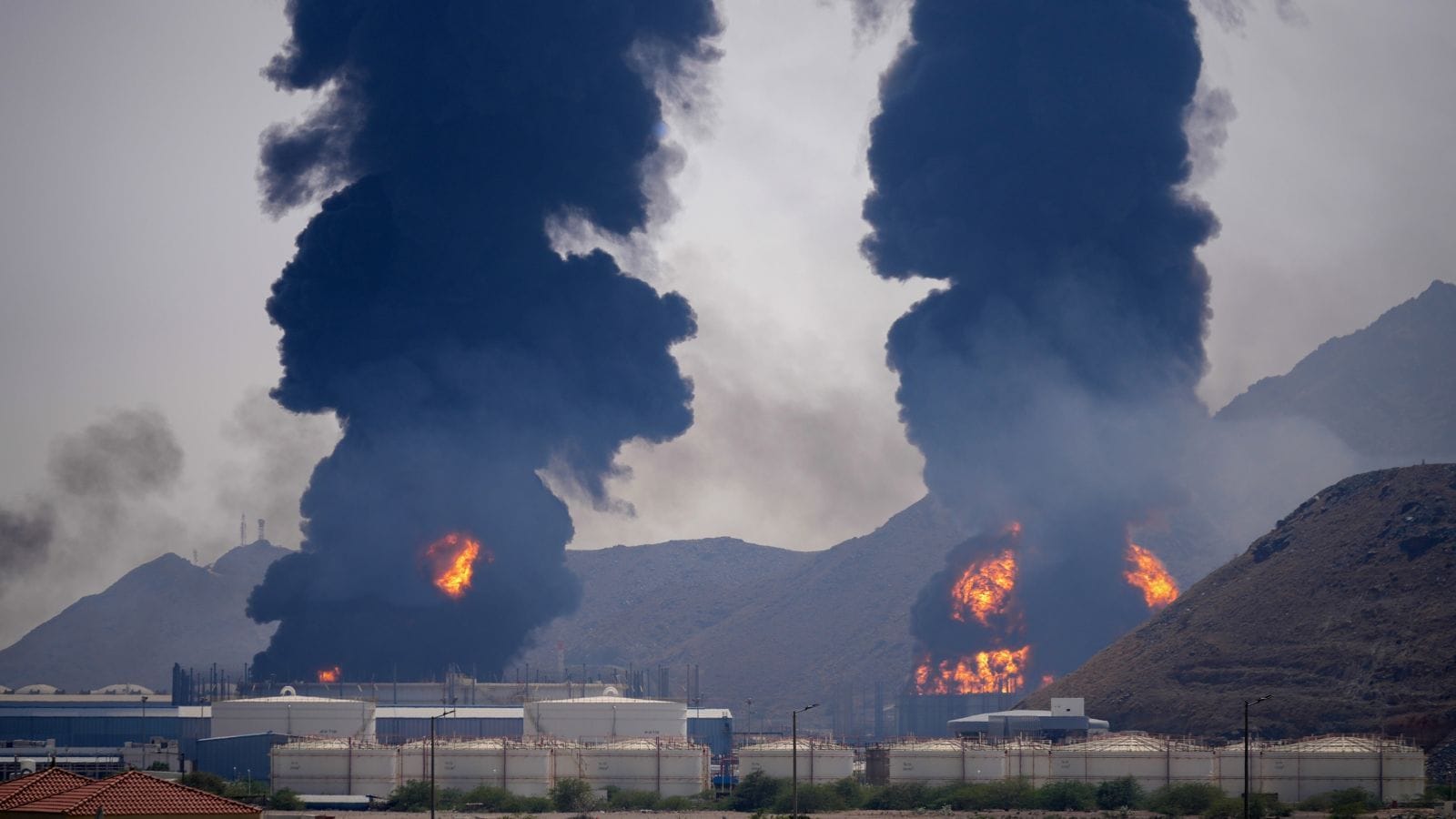
The alarm didn't wake him. It was the silence.
In the sprawling worker accommodations on the outskirts of Dubai, the pre-dawn air is usually a thick soup of hums—the collective groan of thousands of air conditioning units fighting a losing battle against the Arabian desert. But on the thirty-first day of a war that most of the world watched through flickering smartphone screens, the silence was different. It was heavy. It felt like held breath.
Halfway across the world, in a village in Kerala, a woman named Lakshmi would soon wake up to a phone call that would turn her life into a statistic. Her husband, a man whose name will be etched into a cold government ledger as an "Indian national," was not a soldier. He didn't carry a rifle. He carried a wrench. He worked at a desalination plant on the coast of Kuwait, a facility designed to do the most peaceful thing imaginable: turn salt into life.
Then the Iranian missiles fell.
The Invisible Infrastructure of Survival
We talk about war in terms of territory, ideologies, and "strategic assets." We use clinical language to mask the messy reality of metal tearing through concrete. But for those living in the Gulf, "strategic assets" aren't just points on a map. They are the difference between a functioning city and a dehydrated wasteland.
Kuwait, like its neighbors in the UAE and Saudi Arabia, is a miracle of engineering built on a foundation of scarcity. There is no river running through Kuwait City. There are no vast underground lakes waiting to be tapped. Every drop of water that sustains the millions of people living there—from the billionaire in the glass penthouse to the laborer in the orange jumpsuit—is manufactured.
When an Iranian strike hits a desalination plant, they aren't just attacking a building. They are attacking the very chemistry of survival.
Consider the mechanics. A desalination plant is a cathedral of high-pressure pumps and delicate membranes. It is a loud, hot, and unforgiving environment where men work in shifts to ensure the taps don't run dry. When the explosions occurred on that thirty-first day, the immediate "news update" focused on the geopolitical escalation. The markets shuddered. Oil prices twitched.
But inside the facility, the reality was much smaller and much more horrific. It was the sound of steam escaping. It was the smell of ozone and burning rubber. It was a man from a small town in India, thousands of miles from home, dying for a conflict he didn't start, in a country that wasn't his, while trying to provide water for people he would never meet.
The Human Debt of the Desert Miracle
The death of an Indian worker in a Kuwaiti plant isn't an isolated tragedy. It is the unveiling of a global dependency we prefer to ignore. The Gulf states are the world’s laboratory for a future that is rapidly approaching the rest of us—a future where water is not a right, but a commodity produced by industrial might.
This industrial might is fueled by a massive, invisible migrant workforce. They are the hands that keep the desert green. When the regional "Tension" (that sanitized word used by news anchors) boils over into kinetic warfare, these are the people on the front lines. They don't have bunkers. They don't have diplomatic immunity. They have work visas and a desperate need to send money back to families who measure the passage of time by the arrival of a bank transfer.
The "Day 31" milestone mentioned in news tickers isn't just a calendar count. It represents a month of mounting pressure. A month of supply chains breaking. A month of insurance premiums for cargo ships skyrocketing, making the very chemicals needed to treat that water more expensive.
The Iranian strike on the Kuwaiti plant serves as a grim proof of concept for modern warfare: you don't need to invade a city if you can simply turn off its thirst.
The Fragility of the Grid
We often assume that progress is a one-way street. We see the skylines of Dubai and Kuwait City and assume they are permanent fixtures of the earth. But they are more like space stations than traditional cities. They require a constant, agonizingly complex input of energy and labor to remain habitable.
If the desalination plants fail, the clock starts ticking.
A city has about three days of water in reserve. Maybe five if they ration. After that, the social fabric doesn't just fray; it dissolves. The "Live Updates" tell us about missile trajectories and diplomatic rebukes, but they don't tell us about the quiet panic in the supermarkets. They don't describe the look on a father's face when he realizes the bottled water is gone and the tap is hissing air.
The worker who died in the Iranian attack was a vital component of that life-support system. His death is a reminder that the "Global Economy" is actually just a series of fragile pipes, and those pipes are maintained by people who are often treated as interchangeable.
But they aren't.
Every time a technician is killed or a plant is damaged, the collective expertise of the region takes a hit. Panic spreads among the expatriate communities. The "What if?" starts to outweigh the paycheck. If the workers leave, the desert wins.
Beyond the News Ticker
The tragedy of Day 31 is that it will likely be forgotten by Day 32, replaced by a new casualty count or a fresh set of satellite images showing smoke over a different horizon. We have become experts at consuming the "what" of war while completely losing touch with the "who."
The "who" is a man who probably loved cricket, who sent 80% of his wages home, and who understood the internal rhythms of a desalination pump better than any politician understands the nuances of Middle Eastern policy.
The "who" is also us.
We are the ones who benefit from the stability of these regions. Our electronics, our energy, and our global financial systems are tied to the stability of the Gulf. When a missile hits a water plant in Kuwait, the ripples move through the global market, but the splash is felt most violently by the person standing next to the pump.
We are living in an era where the boundary between "civilian infrastructure" and "battlefield" has vanished. In this new reality, the most dangerous job in the world isn't always carrying a gun. Sometimes, it’s just making sure the water stays on.
The Weight of the Drop
As the sun rises over the Gulf today, the smoke from the strike may have cleared, but the atmosphere remains heavy. In Dubai, people check their phones for the latest updates, looking for signs of de-escalation. They look for reassurance that the life they’ve built in the sand won't be swept away by the next gust of regional animosity.
But for a family in India, there is no more waiting for updates. The war has already ended for them, leaving behind a silence that no amount of news coverage can fill. They aren't interested in the "Day 31" narrative or the strategic implications of Iranian foreign policy. They are left with the crushing reality that the cost of water in the desert is sometimes measured in more than just dirhams or dinars.
It is measured in the lives of those who go to work in the morning and never come home, victims of a war they never signed up for, working to provide a miracle they won't live to see.
The tap runs clear in the hotel lobby. The fountain dances in the mall. The water is cold, crisp, and seemingly endless. But if you listen closely to the hum of the pipes, you might hear the echo of a different story—a story of a man, a wrench, and the high price of surviving in a world that has forgotten how to be human.
The desert is patient. It is always waiting for the water to stop. It doesn't care about politics, or Day 31, or who fired the first shot. It only cares about the heat. And as long as we continue to treat the people who hold the desert at bay as mere footnotes in a news cycle, we are all just one broken pipe away from the sand.